
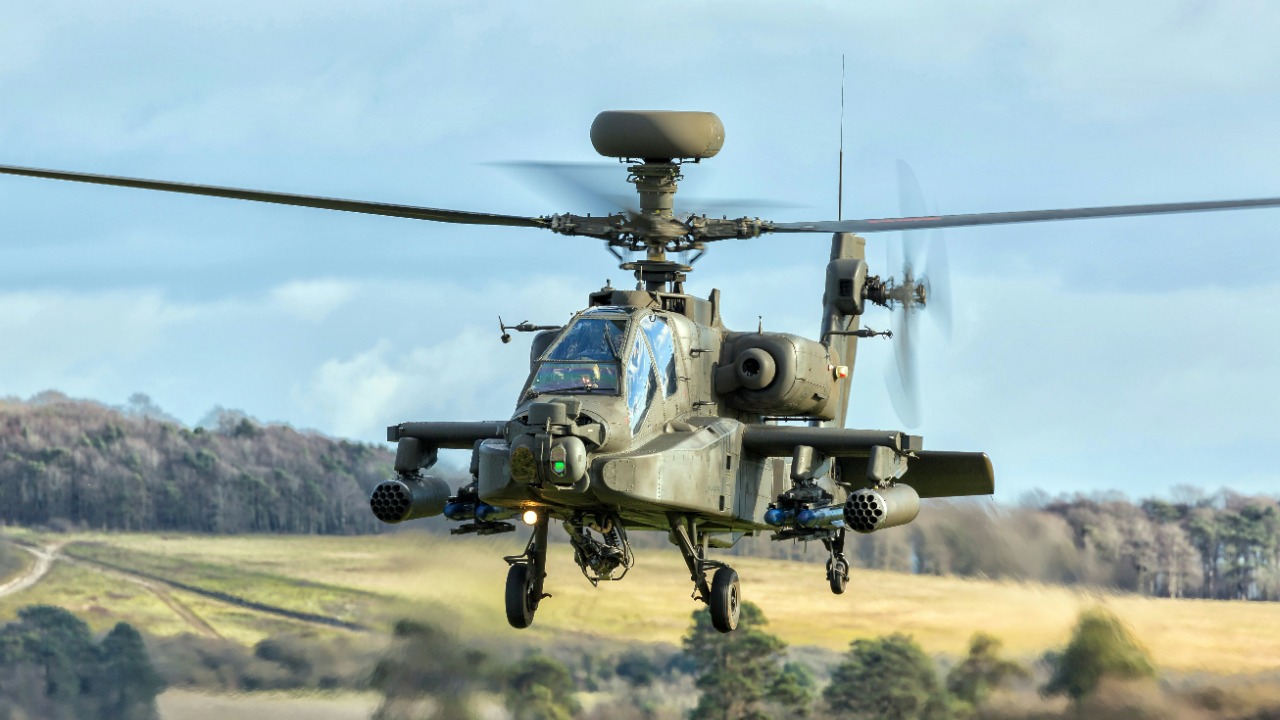
The AH-64 Apache has spent decades auditioning for the role of “most terrifying thing in the sky,” and it keeps getting the part. While sleeker, newer attack helicopters have tried to steal the spotlight, the Apache’s mix of brutal firepower, battlefield awareness, and sheer survivability keeps it at the top of the food chain.
From the first shots of Operation Desert Storm to today’s networked battlefields, it has evolved from a Cold War tank killer into a flying hunter that can stalk targets in the dark, shrug off punishment, and still punch far above its weight. The result is a helicopter that remains, by any practical measure, the deadliest gunship ever fielded.
Born to kill tanks, raised to dominate battlefields
The Apache did not stumble into greatness, it was purpose built to shred armored formations and survive while doing it. The Army formally accepted its first production AH-64A in the Twentieth century, and from the start the design revolved around a tandem cockpit, heavy armor, and a weapons suite that treated Soviet tank columns like a to-do list. The pilot sits higher in the rear, with the co-pilot and weapons officer closer to the nose, a layout that gives both crew members clear views and lets the helicopter pull off aggressive maneuvers that would make a civilian flight instructor reach for the sick bag, as detailed in analysis of The AH.
That design was not just for airshow theatrics. When Operation Desert Storm Started With An Apache Raid, the gunship opened the Gulf War by slipping in low and knocking out Iraqi radar sites, clearing the way for the air campaign. Reporting on Operation Desert Storm Started With An Apache Raid notes how the Army AH-64 Apache, operating from places like Bliss Texas, played a pivotal role in The Gulf War by doing exactly what it was built to do, smashing hardened targets at night and in bad weather while taking fire that would have shredded lighter aircraft. That early combat debut set the tone: the Apache was not just another helicopter, it was the opening punch.
Firepower that still scares modern armor
Plenty of helicopters carry guns and rockets, but the Apache treats firepower like a personality trait. Its 30 mm chain gun is slaved to the crew’s helmet sights, turning a glance into a firing solution, and its stub wings can haul a mix of anti-tank missiles and rockets that make armored vehicle crews reconsider their life choices. Technical breakdowns of the platform highlight that the Apache’s firepower remains one of its defining advantages, with its cannon able to spit out up to 600 to 650 rounds per minute and its missile loadout designed to kill tanks at standoff ranges.
That punch is not just theoretical. Analysts describing the Apache as The World’s Most Battle Proven Gunship point out that it has spent decades in real wars, not just training ranges, using laser guided Hellfire missiles, rockets, and its cannon to hit targets in daylight, at night, and through smoke or dust. Reporting on The Apache Helicopter notes that Apaches are equipped with laser targeting, night vision, and infrared systems that let them find and hit enemies who cannot even see them. When a helicopter can quietly orbit in the dark, mark a tank with a laser, and erase it from several kilometers away, “deadliest” stops sounding like hyperbole and starts sounding like a job description.
Sensors that turn the crew into predators

What really separates the Apache from the pack is not just what it can shoot, but how it finds things to shoot at. The helicopter’s Target Acquisition and Designation System, or TADS, gives the crew a kind of mechanical sixth sense, combining day cameras, thermal imaging, and laser rangefinding into a single swiveling turret under the nose. Reporting on the Boeing AH Apache’s targeting suite describes it as arguably the most devastating attack helicopter system in service, with the TADS feeding precise data to the weapons officer so missiles and cannon rounds land exactly where they are supposed to, even in poor visibility.
On top of that, Longbow equipped Apaches carry a distinctive mast mounted radar above the rotor that lets them peek over hills or buildings like a very dangerous periscope. Technical summaries of the type explain that these Longbow Apaches can locate and classify multiple targets, share that information with friendly forces, and coordinate attacks while staying mostly hidden behind cover. The result is a helicopter that does not just fly into a fight, it stalks it, using sensors and data links to turn the crew into hunters who already know where the prey is hiding before they ever pop up to fire.
Survivability that keeps pilots coming back
Deadliness is not just about how much damage a helicopter can dish out, it is also about how much it can take and still limp home. The Apache’s fuselage is 58 feet 3 inches long, with a height of 15 feet 3 inches to the top of the rotor hub, and 17.76 meters and 4.64 meters are often cited to describe its overall dimensions in metric. That relatively compact, dense frame is wrapped around armored crew seats, redundant systems, and a rotor and drivetrain designed to keep working even after taking hits that would send a lighter helicopter into the dirt.
Combat reporting and expert commentary repeatedly highlight that, Despite its age, the Apache remains by far the most capable Western attack helicopter in terms of combat capabilities and survivability. Analysis of the world’s most dangerous attack helicopters notes that the Apache’s structure and systems have proven robust and viable even after decades of upgrades and hard use, keeping it ahead of newer but less battle tested rivals. When crews know their machine can soak up punishment and still get them back to base, they are more willing to push it to the edge of its performance envelope, which only adds to its fearsome reputation.
A force multiplier that keeps evolving
Plenty of legendary weapons fade into museum pieces, but the Apache has stubbornly refused to age gracefully. Instead, it keeps getting smarter. Modern variants integrate advanced communications and data links that let them share targeting information with ground troops, drones, and other aircraft, turning a pair of crew members into the nerve center of a much larger fight. One senior officer, Murrell, described the Apache as a force multiplier that enables greater lethality, survivability, and situational awareness for the entire force, not just the helicopter itself.
That evolution is not happening in a vacuum. Recent breakdowns of why the Apache is still considered the world’s most advanced attack helicopter point to upgrades in sensors, weapons integration, and networking that keep it relevant on modern, multi domain battlefields. Coverage framed as “Built for Modern Mul” highlights how the platform has been adapted for roles beyond classic tank hunting, including close air support, armed reconnaissance, and even limited air to air engagements. In other words, the Apache has quietly reinvented itself as a flying Swiss Army knife, only with more Hellfires and fewer corkscrews.
Battle record that no rival can match
Hardware and software are impressive, but the Apache’s real trump card is its résumé. Analysts describing The World’s Most Battle Proven Gunship point out that the helicopter has flown in conflicts from the Gulf to Afghanistan and beyond, logging combat hours that would make newer designs blush. Reporting on Most Battle and Proven Gunship status emphasizes that, because there are only two seats in an Apache, there will always be a premium on highly trained crews who can exploit its full capabilities, and those crews have done so in real combat for decades. That depth of operational experience is something no rival platform can buy off the shelf.
The helicopter’s fearsome reputation has even seeped into popular coverage and enthusiast media. A widely viewed breakdown of the AH-64 as the world’s most feared US attack helicopter highlights how this “remarkable machine” has served nations around the world and become a staple of modern warfare. When both military analysts and YouTube audiences agree that a machine is terrifying, it is a safe bet that potential adversaries have noticed too. That combination of proven combat record, relentless upgrades, and a design that still scares modern armor explains why, even as new contenders arrive, the Apache continues to hold the unofficial title of deadliest helicopter in the sky.