
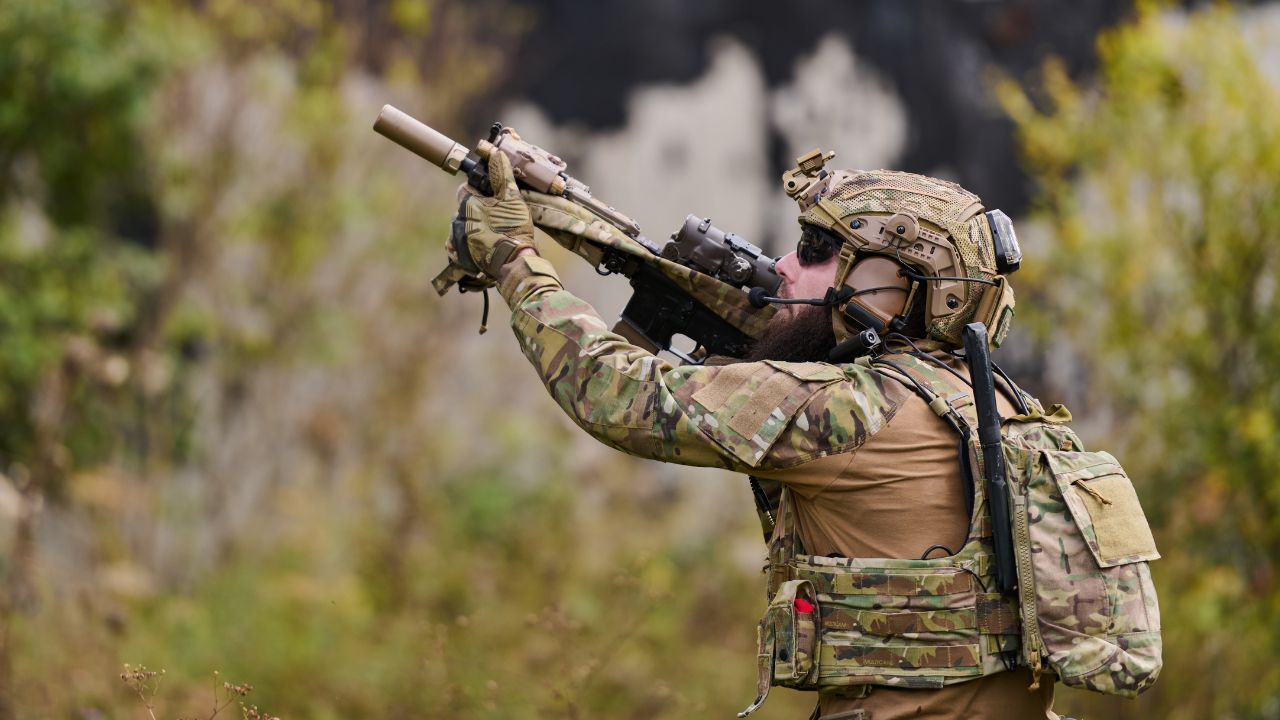
MultiCam became the world’s most widely adopted camouflage not because it is “perfect everywhere,” but because it is reliably acceptable across many environments, seasons, and mission sets. As operations increasingly played out in mixed terrain—urban areas next to farmland, scrub blending into rock, and green belts inside otherwise arid regions—many forces wanted a single pattern that wouldn’t look obviously wrong as soon as a unit crossed a road, canal, or ridgeline. MultiCam-style adaptive camouflage fit that requirement, and it arrived with something procurement offices value almost as much as field performance: a broad, ready supply ecosystem.
That combination—battlefield “good enough” plus procurement “easy enough”—helped MultiCam and its close relatives become a default across uniforms and the gear that goes with them, from plate carriers and packs to helmet covers and pouches. It also reinforced a follow-the-leader dynamic: special operations use, allied interoperability, and market availability all nudged conventional forces and partner nations toward similar-looking solutions. The result is that today’s most common camouflage is as much a logistics and market story as it is a design story.
How the “universal” trend set the stage
Over the past two decades, many militaries moved away from separate woodland and desert uniforms toward patterns intended to span multiple environments. MultiCam—associated publicly with Crye Precision—sits at the center of that shift and is often discussed alongside the broader “universal” camouflage push. In U.S. conversations, it is frequently contrasted with the Army’s Universal Camouflage Pattern (UCP), which is widely treated as a cautionary reference point in procurement debates.
In practical terms, “works” should be understood the way troops tend to mean it: a pattern that can reduce visual contrast against common backgrounds at typical viewing distances, especially when the rest of the kit doesn’t undermine it. No print is a substitute for fieldcraft, and any camouflage can fail when movement, silhouette, or mismatched equipment draws the eye. MultiCam’s appeal is that it often fails less dramatically than more specialized schemes when conditions change.
Why adoption mattered: survivability and credibility
Camouflage is survivability equipment. If a pattern helps delay detection, recognition, or tracking by a human observer, it can buy time—and small time advantages can shape who shoots first, who gets pinned, or who breaks contact. At the unit level, better concealment can also support tempo, making some movements less dependent on perfect light, heavy smoke, or other enabling measures.
Procurement considerations push in the same direction. Standardizing on one widely used pattern can simplify warehousing, reduce the number of uniform variants carried forward, and lower friction when units rotate between climates or train alongside partners. Conversely, a widely criticized pattern can become a long-running credibility problem because replacing uniforms and associated equipment is expensive and slow, even when the need for change is clear.
Why MultiCam tends to hold up: tones, transitions, and distance
MultiCam’s basic visual logic is mid-tones and gradual transitions rather than hard, single-environment matching. Real terrain is rarely one color: shadows, dead vegetation, soil, rock, and manmade surfaces can sit in the same field of view. Mid-tones help avoid the common failure modes of being too bright in green terrain or too dark in open, dry terrain when a unit moves through varied ground.
Distance effects matter as well. Many modern patterns are designed with smaller elements that break up outlines at close range and larger shapes that remain disruptive farther out. MultiCam-style patterns are often described as retaining enough variation to disrupt silhouette without collapsing into a flat-looking block at distance, though outcomes still depend on light, season, and background texture.
Special operations and the gear ecosystem: the accelerators
MultiCam’s spread is closely tied to special operations influence and the modern tactical equipment market. When elite units use a pattern, it tends to appear quickly on the equipment that needs to match it, because manufacturers follow demand. That matters because mismatched or solid-color gear can reintroduce contrast and undo some of the uniform’s benefit.
Once a pattern is widely available across clothing and equipment, adoption gets easier for everyone else. Conventional forces and partner units can buy into an existing product ecosystem rather than wait for a national pattern to be produced consistently across dozens of items. Over time, that availability becomes self-reinforcing: a common pattern is easier to source, and being easy to source makes it more common.
Interoperability and the rise of “similar-looking” national patterns
The global result is not only MultiCam itself, but a family of MultiCam derivatives and broadly similar patterns. The UK’s Multi-Terrain Pattern (MTP) is a prominent example often discussed in the same context. Other militaries and police forces have also moved toward mid-tone, multi-environment designs intended to cover mixed terrain rather than a single biome.
Some of that similarity comes from licensing and legitimate procurement; some reflects convergence on comparable design principles because many organizations are trying to solve the same operational problem. There is also institutional logic: when partners operate together, broadly compatible camouflage and equipment can reduce friction in sourcing and support, even if each nation maintains its own procurement rules and industrial priorities.
The UCP shadow and the appeal of the “safer” choice
Debates about multi-environment camouflage are often shaped by the U.S. Army’s experience with UCP, which remains a common reference point for what can go wrong when a force bets heavily on a pattern that doesn’t meet expectations outside certain assumptions. That legacy matters because camouflage is highly visible to troops and the public, and course corrections take time.
In that environment, MultiCam-style solutions were often viewed as a lower-risk path: not a claim of true universality, but a pattern with a reputation for reasonable performance across many settings and an established support base. Even when decisions leaned heavily on logistics and availability, “already in use and already supported” is a powerful argument inside risk-averse institutions.
Operational reality check: concealment is a system
MultiCam’s prominence can make camouflage seem like a uniform decision. In practice, concealment is a system that includes movement discipline, silhouette management, use of cover and shadow, noise and light discipline, and keeping gear colors and finishes consistent. A solid pattern can reduce contrast, but poor fieldcraft can still make a person stand out.
Season and local conditions also change the scorecard. A scheme that blends in spring growth can look out of place against winter dead grass; the same hillside can read differently at dawn than at midday. MultiCam’s advantage is typically that it stays within an acceptable band across many of these shifts, not that it is the best choice for every specific background.
Modern caveat: defeating eyes is not defeating sensors
Another reason serious discussions avoid crowning any pattern as “the best” is that detection has changed. A print that disrupts human vision can still be exposed by night vision, thermal imagers, or persistent aerial observation from drones. Signature management increasingly extends beyond the visible spectrum, and uniforms are only one layer of a broader approach.
That does not make MultiCam irrelevant. The human eye remains a common and decisive observation tool. But it does mean that future gains may come less from a new print and more from multispectral reduction, better concealment training, and tactics that address detection from above and at night.
What comes next: from a single pattern to managed signatures
MultiCam’s dominance has set a practical expectation: a multi-environment pattern supported across uniforms and equipment by a supply chain that can keep up. That has readiness implications, reducing the need for multiple clothing variants and limiting the problems caused by mismatched items, while making it easier for partners to align on compatible gear.
The more consequential shift ahead is how forces integrate camouflage into broader signature management. As surveillance becomes cheaper and more persistent—especially from drones—“blending in” becomes as much about behavior, concealment techniques, and multispectral considerations as it is about fabric. MultiCam became widely adopted because it balanced field usefulness with procurement reality; the next widely adopted solutions will likely be judged by the same standard, against a more demanding set of sensors and tactics.