
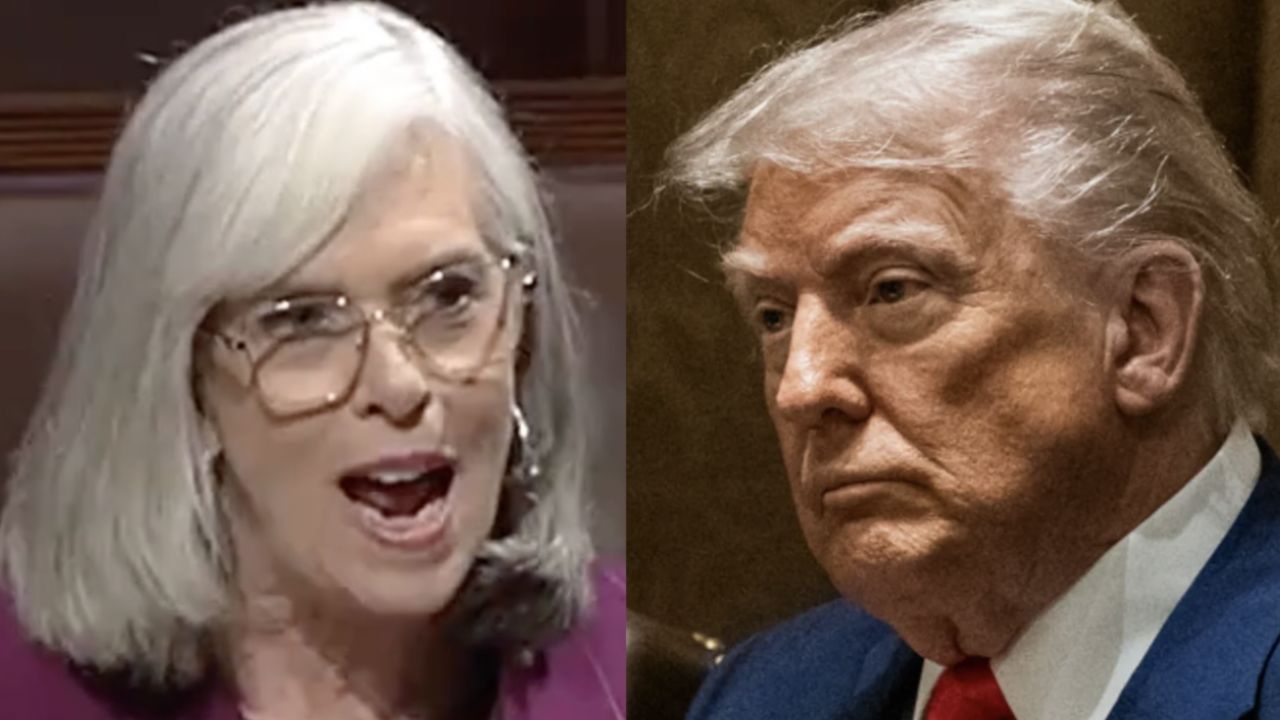
House Democratic Whip Katherine Clark accused President Donald Trump of neglecting major national security challenges while prioritizing relationships with authoritarian leaders, calling his conduct an embarrassment on the international stage. Her November 20 criticism followed Trump’s unprecedented three-way summit with Russian President Vladimir Putin and Chinese President Xi Jinping, where the leaders issued a declaration on international security but announced no concrete agreement to end the wars in Ukraine or Iran. Clark’s statement also raised concerns about the administration’s approach to artificial intelligence safety, an issue she has increasingly emphasized as a national security and public protection priority.
Clark published the following statement on X:
Trump is an embarrassment on the world stage.
Nothing to end his Iran war.
Nothing to help Ukraine.
Nothing about AI safety.Instead, he’s just obsessing over dictators.
The first part of Clark’s statement is a broader assessment of Trump’s international standing. By calling the president an embarrassment on the world stage, she is criticizing the diplomatic priorities and public image presented by the administration during a period of multiple international conflicts. Her reference to dictators directly points to Trump’s highly publicized meetings and statements about Putin and Xi, particularly his description of the Russian president as a personal friend.
The summit Clark was addressing took place in Shenzhen on November 19, 2026. Trump, Putin and Xi issued a joint document titled the “Declaration toward Peace,” outlining four areas of cooperation: United Nations reform, refined petroleum supplies, the treatment of state officials by international courts and dialogue to reduce nuclear risks. The document did not establish a timetable for arms-control negotiations or include a concrete agreement to end either the Iran war or Russia’s invasion of Ukraine.
Clark’s criticism that Trump was prioritizing relationships with dictators also followed the president’s public defense of his relationship with Putin. At a November 20 White House news conference, Trump said he had a very good personal relationship with the Russian leader but declined to say whether Putin was a friend to the United States. He also maintained that Putin wanted to end the war in Ukraine and suggested that both Putin and Ukrainian President Volodymyr Zelenskyy were responsible for the difficulty in reaching a settlement.
The president’s description of Putin as a friend has particular significance because Russia remains at war with Ukraine, a country that has relied heavily on American military, financial and intelligence assistance. Putin is also the subject of an International Criminal Court arrest warrant related to alleged war crimes involving the unlawful deportation and transfer of Ukrainian children. The summit’s declaration addressed the authority of international courts and the immunity of state officials, a provision that has drawn attention because of the legal proceedings involving the Russian president.
Clark’s first substantive criticism concerns the war with Iran. Her statement that Trump has done nothing to end the conflict reflects an ongoing position she has expressed since the military campaign began. On February 28, 2026, Clark issued a statement condemning the president’s decision to launch military operations without congressional authorization. She said Trump had campaigned on a promise of “no new wars” and argued that the administration had not provided a clear rationale or obtained the approval of Congress.
In that February statement, Clark also emphasized the risks to American servicemembers and the financial pressures facing households. She argued that families wanted an affordable cost of living rather than another military conflict. She called on House Speaker Mike Johnson to bring lawmakers back into session for a vote on a bipartisan War Powers Resolution, arguing that Congress had a constitutional responsibility to oversee the decision to take the country into war.
Her opposition continued through the following months. On May 13, Clark delivered a House floor speech arguing that the administration had failed to establish a clear objective, strategy or exit plan. She highlighted the continued deployment of approximately 50,000 American troops to the region, the disruption of shipping through the Strait of Hormuz and stalled negotiations. She also connected the military campaign to higher gasoline prices, utility bills and increased costs for imported goods.
On June 3, Clark joined Democratic Leader Hakeem Jeffries and Caucus Chairman Pete Aguilar in announcing that House Democrats had successfully passed a War Powers Resolution. Their statement criticized the administration for launching the conflict without congressional authorization, clear objectives or an exit strategy. The leadership also argued that the conflict had exposed servicemembers to danger while increasing costs for American households.
The second major issue in Clark’s post concerns Ukraine. Her statement that Trump has done nothing to help the country is consistent with her longstanding support for American assistance to Kyiv and opposition to Putin’s invasion. In September 2023, Clark said that House Democrats would continue providing Ukraine with the resources necessary to defend itself and defeat Russia. She also called for continued international cooperation to preserve Ukrainian sovereignty and hold Russia accountable for its aggression.
Clark’s position dates back to the beginning of Russia’s full-scale invasion in February 2022. In a statement issued on February 24 of that year, she described the invasion as an assault on international security and expressed support for Ukraine’s sovereignty and democratic government. She called for coordinated international action to impose costs on Russia and hold Putin accountable. Her subsequent statements supporting military assistance and international cooperation demonstrate continuity in her position on the conflict
The third issue in her post is artificial intelligence safety. Clark has argued that the United States must remain competitive in AI development while establishing safeguards against potential harms. In September 2026, she criticized Republican leadership for failing to address AI safety and said lawmakers needed to consider the effects of the technology on employment, children’s safety and privacy. She also raised concerns about the possibility of catastrophic risks from increasingly powerful AI systems.
Clark’s September remarks were particularly notable because she called AI safety a national and international issue rather than a partisan dispute. She argued that Congress should work with international partners to establish fundamental safety protections while allowing the technology to develop. She also criticized the administration for failing to provide leadership on the issue, raising concerns about the president’s personal financial interests and the potential influence of corporations involved in AI development.
Her criticism comes as Democrats prepare to pursue broader AI legislation after taking control of Congress. The policy debate includes independent testing of advanced AI systems, accountability for harmful AI products, data-center energy consumption and protections for consumers. Reuters reported in November that Democrats were preparing a broad legislative agenda involving AI safety and industry oversight for the next Congress. Clark’s own public comments place her among the Democratic leadership figures pressing for stronger federal action.
The summit itself provides the immediate context for Clark’s criticism. The White House’s published declaration addressed nuclear risks, international institutions, energy supplies and United Nations reform, but it did not specifically address either the Iran war or Russia’s invasion of Ukraine. It also contained no detailed AI safety commitments. Those omissions help explain why Clark grouped the three issues together in her post, contrasting the summit’s broad diplomatic statements with the unresolved security challenges facing the United States and its allies.
Clark’s statement therefore reflects three distinct areas of criticism: the absence of a clear path to end the Iran conflict, her concern about the weakening of American support for Ukraine and her demand for stronger AI safeguards. Her description of Trump’s relationships with Putin and Xi connects those issues to a broader argument about the administration’s diplomatic priorities. Her record on Iran and Ukraine includes direct congressional action and repeated public statements, while her recent AI comments indicate an effort to make technological security another priority for the incoming Democratic leadership.