

China has offered a rare public glimpse into how its pilots expect to fight Western airpower, staging a televised simulation that pits its J-16 multirole fighter against the French-built Rafale. The scenario, framed as a high-end dogfight against a “foreign” aircraft, is less about declaring a winner and more about revealing how the People’s Liberation Army (PLA) thinks about a future clash in contested skies.
The exercise highlights a deeper strategic question: how China measures its own 4.5-generation jets against Europe’s most advanced export fighter, and what that means for potential flashpoints where Rafales and J-16s could actually meet.
Inside China’s Rafale vs J-16 simulation
Chinese state television recently showed a command board for a large-scale air combat drill, with the “task” side listing “J16 x8” and the opposing “forces” including at least one Rafale-type aircraft. The scenario placed eight of the Chinese 4.5-ge fighters against a mixed adversary package, suggesting a complex engagement rather than a simple one-on-one duel, and underscoring that the PLA is training for dense, multi-axis air battles rather than stylized dogfights. Footage of the board and cockpit video indicated that the notional Rafale opponent was treated as a high-threat platform with advanced sensors and weapons, not a generic stand-in target, which aligns with the jet’s reputation in export markets.
Officials involved in the drill described a layered engagement in which pilots had to manage long-range missile shots, electronic warfare and close-in maneuvering, all within a single simulation. One officer pointed to additional threats on the planning board, noting that the simulation folded in multiple factors and opponents, from other aircraft types to ground-based systems, to stress-test decision making under pressure. That approach matches other PLA training that uses detailed simulation environments to approximate real-world complexity rather than isolated one-on-one engagements.
Why the Rafale is the benchmark “foreign” jet
The choice of Rafale as the named adversary is not accidental. The French fighter has become a marquee export to key Asian states, including India, which operates Dassault Rafale jets as a core part of its airpower modernization. In South Asia and the Indian Ocean region, Rafales are widely seen as a qualitative leap over older fleets, combining an advanced radar, high agility and a broad weapons inventory that includes long-range air-to-air missiles. For Chinese planners, modeling against a Rafale-type opponent means preparing for scenarios where regional rivals field top-tier European technology rather than legacy platforms.
Rafale’s design as a true multirole aircraft, capable of air superiority, deep strike and maritime missions in a single sortie, also makes it a useful yardstick. Its ability to switch from beyond-visual-range engagements to low-level penetration and precision strike complicates any defender’s planning, which helps explain why Chinese analysts treat it as “Europe’s most advanced jet” in their own framing. Earlier reporting on a separate 2020 simulation that pitted China’s J-20 against India’s Dassault Rafale, with claims of “17” Rafales downed, shows that Chinese military circles have been benchmarking against this aircraft for several years, even if such figures cannot be independently verified and remain contested by Indian experts.
What the drills reveal about the J-16’s role
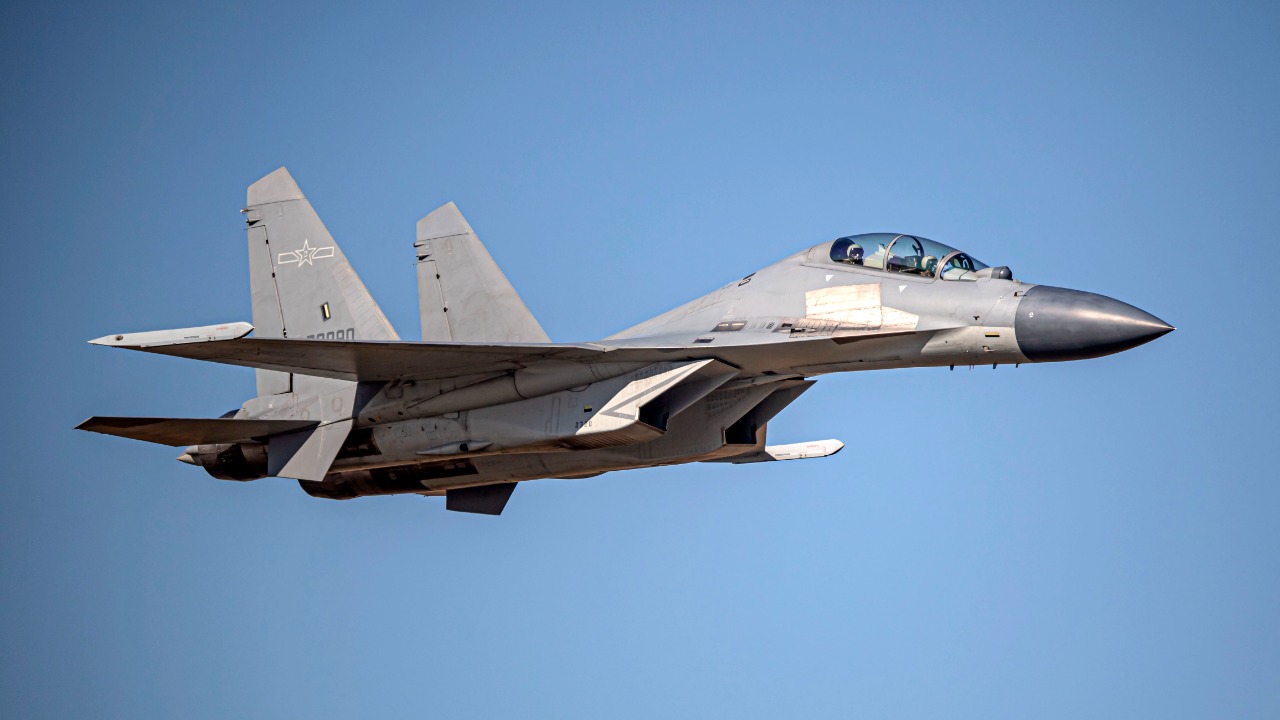
The J-16 sits at the heart of China’s non-stealth combat fleet, and the Rafale-focused drill underscores how central it is to Beijing’s airpower calculus. Described as a 4.5-ge fighter, the twin-seat J-16 is built to handle air superiority, strike, reconnaissance and maritime missions with minimal external support, giving it a flexibility similar in concept to the Rafale’s multirole profile. Analysts note that the aircraft’s large airframe and powerful engines allow it to carry a heavy weapons load and significant fuel, which in turn supports long-range patrols and stand-off strike missions.
Performance assessments from Chinese and regional observers highlight the J-16’s payload capacity and range as key advantages, particularly for operations over wide maritime spaces or against distant targets. In “Performance Highlights” sections of Chinese-language coverage, the jet is credited with excelling in long-range strike roles, while still retaining enough agility and sensor capability to hold its own in close-in air combat. The same reports emphasize that the J-16 regularly conducts patrols along China’s coastline and near sensitive areas linked to the Taiwan issue, suggesting that the aircraft is already embedded in frontline missions that could one day bring it into contact with Rafale-equipped forces.
Dogfights, data and the limits of “who wins”
The televised drill has naturally sparked debate over which jet would “win” in a real dogfight, but the structure of the exercise points to a more nuanced reality. Rather than staging a clean, symmetric duel, Chinese planners built a scenario in which J-16s had to contend with a Rafale-type aircraft amid other threats, including additional enemy platforms and environmental constraints. One description of the event highlighted the “distinctive characteristics” of the foreign aircraft in close air combat (dogfight) scenarios, suggesting that pilots were being trained to recognize and exploit specific strengths and weaknesses rather than rely on generic tactics.
That focus on characteristics rather than scorecards mirrors how modern air forces think about air combat. In a real conflict, outcomes would depend on who detects whom first, the quality of networking and electronic warfare, pilot training and rules of engagement, not just raw performance figures. Chinese state media coverage of the J-16 versus Rafale simulation was careful to avoid disclosing sensitive data that could expose vulnerabilities, underscoring that the public footage is only a partial window into the underlying assessments. Earlier Chinese reporting on a J-20 simulation against Rafales, which claimed lopsided kill ratios, drew skepticism from Indian Air Force voices, a reminder that such figures are as much about messaging as they are about technical truth.
Signals for Taiwan and future arms races
Beyond the technical comparisons, the J-16 versus Rafale scenario sends a clear strategic signal. The J-16 is a frequent participant in patrols and shows of force near Taiwan, and Chinese commentary has linked its training to potential contingencies in that theater. By publicly rehearsing combat against a Rafale-type opponent, China is implicitly acknowledging that any future crisis could involve not only U.S. and Japanese aircraft but also European-designed fighters in the hands of regional partners. The use of sophisticated simulation tools to model such scenarios suggests that Beijing is trying to anticipate a coalition air threat rather than a purely bilateral clash.
The visibility of the drill may also influence future arms sales and regional procurement decisions. States weighing Rafale purchases, or considering Chinese fighters of their own, will read the exercise as both a recognition of the Rafale’s capabilities and a statement of confidence in the J-16’s ability to counter it. Analysts have noted that China’s decision to broadcast the wargame, highlighted in coverage under the banner “China Broadcasts Wargame With” J-16 and Dassault Rafales, reflects a broader effort by China to showcase its training sophistication and reassure domestic audiences about its readiness. At the same time, the reliance on controlled simulation environments, rather than real-world encounters, means that the ultimate question of which jet “wins” remains unresolved in practice, and will likely stay that way as both sides continue to refine their aircraft and tactics.