

Vice President JD Vance said Wednesday that it was appropriate for National Counterterrorism Center Director Joe Kent to resign from his position after opposing the administration’s position on the ongoing war in Iran, emphasizing that officials who cannot support presidential decisions should step aside. Speaking during remarks in Michigan, Vance framed Kent’s departure as consistent with the expectations of serving in a presidential administration.
Vance underscored the importance of internal debate while making clear that final decisions rest with the president and must be carried out by those in his administration. “He recognizes that everybody has smarts and everybody has wisdom. That said, whatever your view is, when the president of the United States makes a decision, it’s your job to help make that decision as effective and successful as possible. And so, the president said this yesterday, if you are on the team and you can’t help implement the decisions of his administration, he has the right to make those decisions, then it’s a good thing for you to resign. And I think that’s exactly right. It’s fine to disagree, but once the president makes a decision, it’s up to everybody who serves in his administration to make it as successful as possible. That’s how I do my job, and I think that’s how everybody in the administration should do their job, too,” Vance said.
JD Vance on Joe Kent:
— Clash Report (@clashreport) March 18, 2026
Whatever your view is, when the POTUS makes a decision, it’s your job to help make that decision as effective and successful as possible.
If you are on the team and you can’t help implement the decisions of Trump’s administration, then it is a good thing… pic.twitter.com/mnxIuEr62F
Kent resigned on Tuesday, becoming the highest-ranking Trump administration official to step down in opposition to the war in Iran. In his resignation letter to President Donald Trump, Kent wrote, “I cannot in good conscience support the ongoing war in Iran. Iran posed no imminent threat to our nation, and it is clear that we started this war due to pressure from Israel and its powerful American lobby.” He described his decision as rooted in principle and a belief that the conflict did not serve U.S. interests.
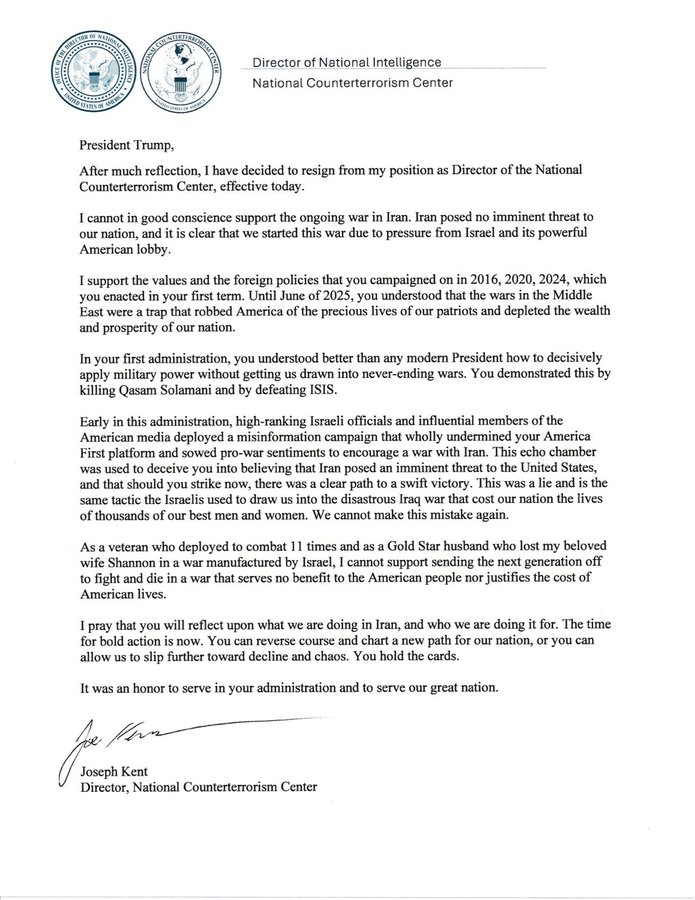
Date: 17 March 2026
Source: Twitter
Author: Joseph (Joe) Kent
In the letter, Kent pointed to his previous support for Trump’s foreign policy, arguing that earlier approaches had avoided prolonged conflicts while still achieving military objectives. He cited actions such as the killing of Qasem Soleimani and the defeat of ISIS as examples of decisive force without long-term entanglement, contrasting those efforts with what he described as a shift toward a more expansive conflict in Iran.
Kent also detailed his concerns about how the war began, alleging that high-ranking Israeli officials and elements of the American media contributed to a “misinformation campaign” that built support for military action. He compared the situation to the lead-up to the Iraq War in 2003, which he characterized as a costly and avoidable conflict driven by similar dynamics.
His resignation letter included deeply personal reflections, referencing his military service and the loss of his wife, Shannon Kent, a Navy cryptologist killed in Syria in 2019. “As a veteran who deployed to combat 11 times and as a Gold Star husband who lost my beloved wife Shannon in a war manufactured by Israel, I cannot support sending the next generation off to fight and die in a war that serves no benefit to the American people nor justifies the cost of American lives,” he wrote, urging the president to reconsider the current course of U.S. policy in Iran.
Vance’s remarks framed Kent’s departure not as a breakdown within the administration, but as an example of how disagreements should be handled when they cannot be reconciled internally. By pointing to the president’s authority to set policy and the expectation that staff members carry out those decisions, Vance suggested that resignations in such circumstances can reinforce, rather than undermine, the administration’s ability to function cohesively.
He concluded by signaling that alignment within the administration remains a priority as it navigates the ongoing conflict, indicating that those who remain are expected to fully support and implement the president’s agenda. In that context, Kent’s exit was characterized as a necessary step that allows both the administration and the former official to remain consistent with their respective positions.