
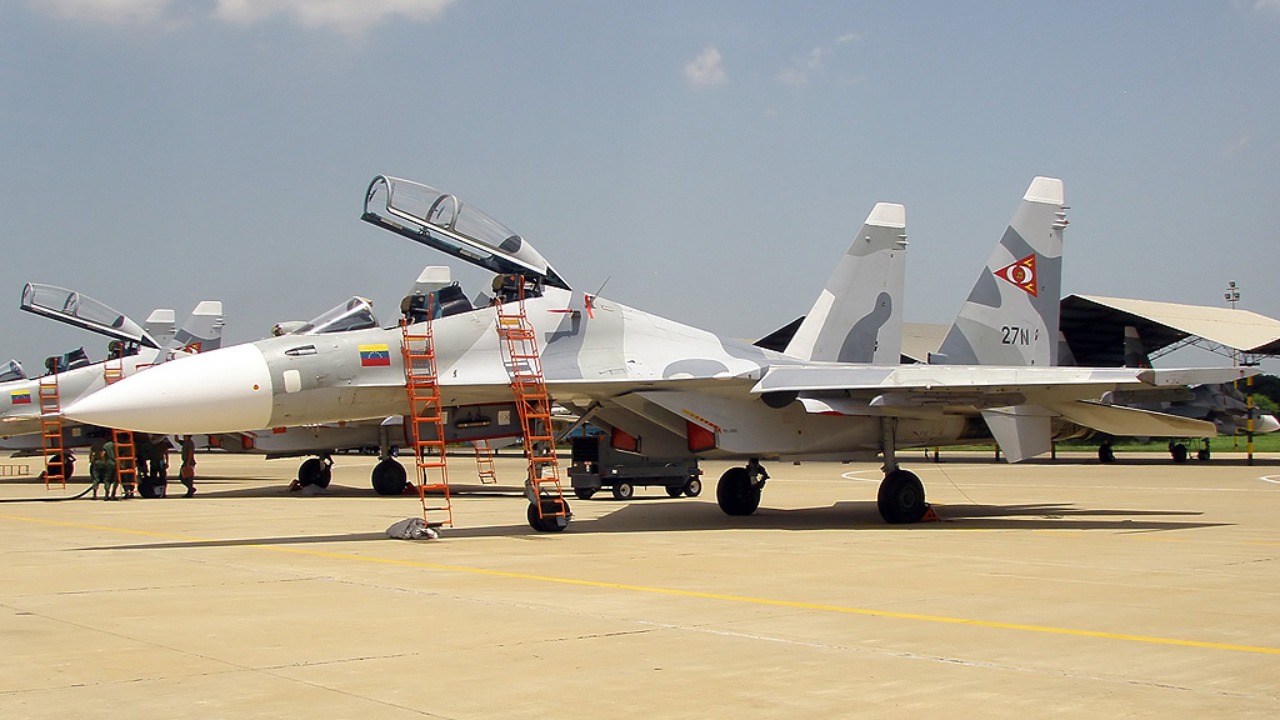
A Venezuelan Su-30 fighter closed in on an American reconnaissance aircraft over the Caribbean, turning a routine patrol into a tense, low-altitude duel of nerves. The encounter, captured on video, showed the Venezuelan jet holding an unusually tight formation with the larger U.S. plane as both aircraft traced arcs above international waters. The incident crystallized how fragile the line has become between deterrence and miscalculation in the skies off Latin America.
I see that brief, hair-raising sequence as more than a viral clip. It is a compressed snapshot of clashing narratives, contested airspace, and political theater, all playing out at jet speed. To understand why a single Su-30 sliding up on an American aircraft matters, I need to unpack the tactics, the legal claims, and the risks that ride on every pass within a few dozen yards of another nation’s military plane.
The close pass that jolted the Caribbean
The core of the confrontation was proximity. A Venezuelan fighter jet, identified as a Su-30, moved in so close to an American reconnaissance aircraft that the two large airframes appeared to share the same slice of sky. U.S. officials described the fighter as having “aggressively shadowed” the American plane over the Caribbean, language that signaled more than a routine intercept. In the video, the Su-30 holds a steady line off the U.S. aircraft’s wing, a position that leaves almost no margin for error if either pilot misjudges speed or turbulence.
From my perspective, what made the pass so alarming was not only the distance but the duration. Shadowing implies persistence, and the Venezuelan pilot did not simply swing by for a quick visual check. Instead, the fighter maintained its station, matching the American aircraft’s course and speed in a way that U.S. authorities later framed as reckless. That description of an aggressively shadowed American reconnaissance aircraft over the Caribbean captured the sense that this was not a standard, by-the-book intercept but a deliberate show of pressure.
Competing stories at 30,000 feet
Once the video surfaced, the clash in the sky quickly became a clash of narratives. U.S. authorities said that a Venezuelan fighter jet had “aggressively shadowed” an American intelligence plane flying in international airspace, stressing that the American crew was operating lawfully and that the intercept created unnecessary danger. In that telling, the Su-30’s behavior was not only provocative but also a violation of basic norms that govern how militaries interact when they meet above open water.
Caracas, by contrast, has long framed such encounters as defensive moves against foreign surveillance near its territory. While the sources at hand focus on the U.S. account, I read the broader pattern as one in which Venezuelan officials cast American flights as intrusive and justify close approaches as a way to signal resolve. The U.S. description of the Venezuelan jet as having aggressively shadowed an American intelligence plane in international airspace underscores how far apart the two governments stand on the basic question of who was in the right.
Why “aggressive shadowing” is so dangerous
As someone who has followed military aviation for years, I see the phrase “aggressively shadowed” as a red flag in its own right. Intercepts are common, but they are usually choreographed: one aircraft approaches, identifies, then peels away at a safe distance. Here, the Venezuelan Su-30 stayed close enough, long enough, that U.S. officials publicly labeled the maneuver reckless. That choice of words matters, because it implies that the American crew believed the fighter’s behavior increased the risk of collision or forced maneuvering.
In practical terms, a large reconnaissance aircraft has less agility than a nimble fighter. When a Su-30 tucks in tight, the heavier American plane has fewer options if something goes wrong. Wake turbulence, sudden weather, or a minor miscalculation can turn a show of presence into a midair emergency. The U.S. characterization of the Venezuelan jet’s conduct as an aggressively shadowed approach signals that, in their view, the Su-30 pilot pushed that envelope to an unsafe edge.
The legal and political airspace battle
Beneath the cockpit-level drama lies a quieter fight over maps and law. Washington insists that its American reconnaissance and intelligence aircraft were flying in international airspace over the Caribbean, outside any country’s sovereign control. That claim rests on long-standing rules that treat airspace above international waters as open to military flights, even when those flights collect signals or imagery that nearby governments would rather keep private.
Venezuela, for its part, has often blurred the line between international and national airspace in its rhetoric, treating U.S. surveillance flights near its borders as hostile acts. When a Venezuelan fighter jet moves in close to an American plane, it is not only a tactical decision but also a political message about who gets to operate in the skies off the Venezuelan coast. The U.S. assertion that the Venezuelan Su-30 aggressively shadowed an American intelligence plane in international airspace is therefore not just a safety complaint, it is a reaffirmation of how Washington reads the map.
What this showdown signals for future encounters
When I look at this incident, I see a template that could repeat. A Venezuelan Su-30, a U.S. reconnaissance aircraft, contested airspace over the Caribbean, and two governments eager to frame the story to their advantage. Each time such a close pass occurs, it normalizes a higher level of risk and raises the odds that a future intercept will end not with dueling statements but with wreckage in the sea. The language of “aggressively shadowed” suggests that, at least from the U.S. perspective, the threshold for acceptable behavior has already been crossed.
That is why the video of the Venezuelan fighter jet sliding up alongside the American plane matters beyond the day it was filmed. It captures a moment when tactical bravado, legal ambiguity, and political rivalry converged in a few square miles of Caribbean sky. Unless both sides find a way to reestablish clearer rules of the road, the next time a Venezuelan Su-30 closes in on an American aircraft, the world may not be watching a near miss but the opening seconds of a crisis that no one can easily climb down from.