
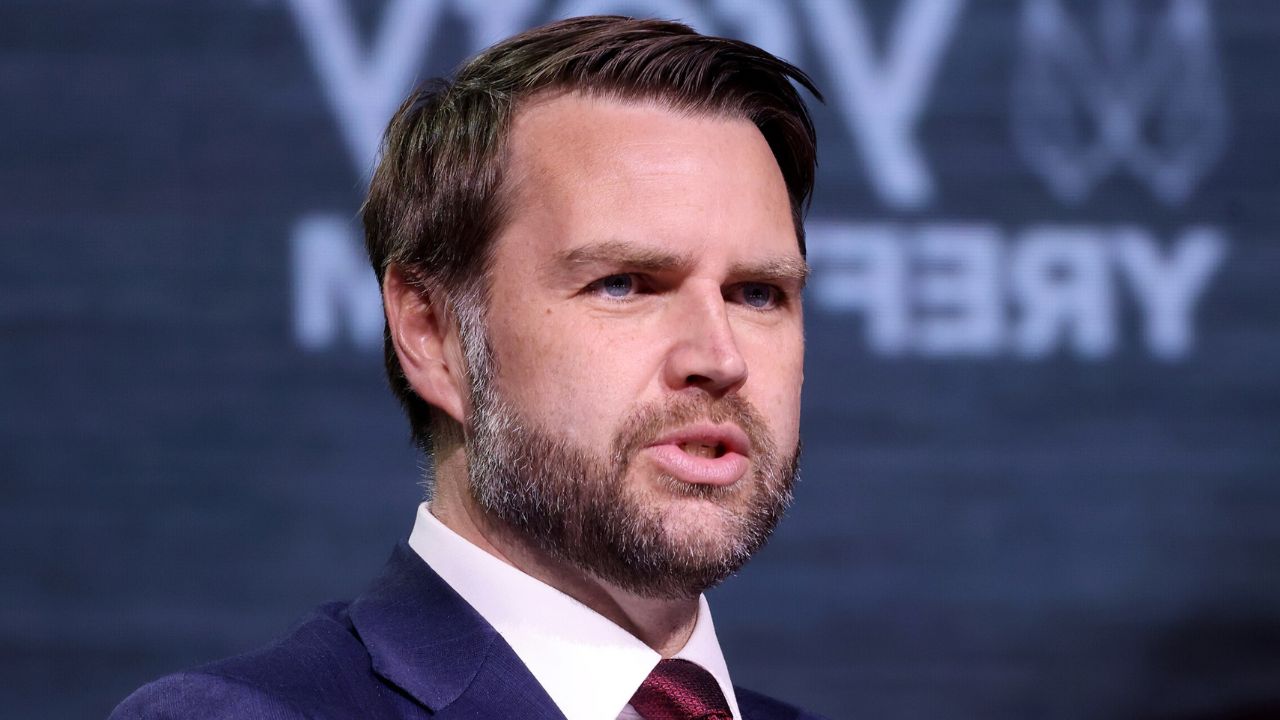
Vice President JD Vance told a crowd in Brewer, Maine, on Monday that Canada has chronically underspent on its own armed forces and depends on the United States for its basic security, framing the argument as the backdrop for an escalating tariff war between Washington and Ottawa that has already sent duties as high as 50% into effect on billions of dollars of Canadian goods. Speaking at Competitech, a defense manufacturer that produces ballistic equipment for the U.S. Army, Vance took questions from local reporters on the state of trade talks with Canada, using the moment to argue that Ottawa has for years relied on American military protection while simultaneously squeezing Maine farmers and manufacturers with steep tariffs and non-tariff barriers.
The Remarks
Asked by Rachel M. of the Portland Press Herald about the state of tariff negotiations with Canada, Vance responded directly, tying Canada’s trade posture to its defense record. “We have to remember Canada is a state — sorry, Freudian slip, that was actually an accident,” Vance said, correcting himself before continuing. “Canada is a country that has underinvested in its military, that quite literally would get invaded by a foreign country were it not for the umbrella of protection provided by the United States of America. And so how does Canada actually respond to that? By treating the people of Maine fairly? No, they apply ridiculous tariffs and other non-tariff duties on Maine products coming into Canada, and they don’t expect Maine or anybody else to fight back. We’re sick of that. We are actually going to fight back against unfair trade practices, whether it’s coming from China or Canada.” He went on to say that Canadian dairy, cheese, butter and milk enter Maine at 0% tariffs, while Maine dairy exports to Canada “could be paying as much as a 250% tariff,” calling the disparity unfair to Maine farmers. Vance also accused Canada of functioning as “a backdoor for Chinese goods,” saying Ottawa “treats Chinese goods more fairly than they do the goods that come from the people of Maine,” and said the two countries had appeared close to a deal before Canada arrived with “a bunch of unreasonable last-minute demands.” He closed by saying, “Stop taking advantage of the people of Maine. Stop taking advantage of America. It’s over. We expect fairness in our trade policy.”
How Accurate Is the Military Spending Claim
Vance’s characterization of Canada as a chronic laggard on defense spending has a documented basis, though the picture has shifted significantly in recent months. Canada’s defense spending fell to roughly 1% of GDP by 2014, half of what NATO members had pledged to the alliance, and for more than a decade Ottawa lagged behind the 2% of GDP benchmark set at NATO’s 2014 Wales Summit. That changed in March 2026, when Prime Minister Mark Carney announced Canada had officially reached the 2% target for the first time, spending more than $60 billion (Canadian) on defense in 2025 — the highest level relative to the size of the economy since the fall of the Berlin Wall. That milestone came years ahead of the timeline set by Carney’s predecessor.
Even with the increase, Canada remains near the bottom of the alliance by that measure. NATO’s own reporting placed Canada in the bottom third of member states even after crossing the 2% line, alongside Belgium, Spain, Albania and Portugal, while Poland, Lithuania, Latvia, Estonia and Denmark all spent well above 3% of GDP. By comparison, U.S. defense spending sits at roughly 3.4% of GDP, translating to more than $1 trillion in projected 2026 outlays once wartime supplemental funding tied to the ongoing Iran conflict is included. Canada has since pledged, along with the rest of NATO, to reach 5% of GDP by 2035 — a target that would cost Canadian taxpayers roughly $150 billion annually, and one independent analysts say Ottawa currently has no credible funding plan to meet.
Canada’s Proximity and the “Umbrella of Protection” Argument
Vance’s broader point — that Canada benefits from an implicit U.S. security guarantee given its geography and integration into North American defense infrastructure — reflects a long-standing dynamic between the two countries. Canada and the United States jointly operate the North American Aerospace Defense Command (NORAD), and the two nations share the world’s longest undefended border, stretching roughly 5,525 miles. That closeness has repeatedly been cited by American officials across administrations as justification for pressing Ottawa to raise its own defense spending rather than lean on Washington’s far larger military footprint. Pressure from the first Trump administration produced only modest results at the time: then-Defense Minister Harjit Sajjan announced in 2017 that Canada would raise spending toward 1.4% of GDP by 2026-27, still short of NATO’s 2% floor. It took nearly a decade longer, and a change in prime ministers, before Canada actually crossed that threshold.
The Dairy Tariff Dispute
Vance’s specific claim about a 250% tariff facing Maine dairy exporters points to Canada’s supply-managed dairy system, which imposes steep “over-quota” tariffs on imports exceeding set thresholds under the U.S.-Mexico-Canada Agreement (USMCA). American dairy groups have long argued Canada uses quota-allocation rules to keep U.S. products effectively locked out even where tariff-rate quotas exist on paper. Gregg Doud, president and CEO of the National Milk Producers Federation, said this week that the standoff reflects Canada’s continued disregard for its USMCA dairy commitments, and called on Ottawa to stop pursuing workarounds and instead negotiate the outstanding implementation issues in good faith. He warned that Canadian retaliation would likely push the United States to escalate further rather than de-escalate the dispute.
Trade Talks Collapse and Tariffs Take Effect
Vance’s remarks came just days after negotiations between Washington and Ottawa broke down entirely. Talks fell apart late on a Friday night, shortly before a midnight deadline for 50% tariffs to take effect on roughly $20 billion worth of Canadian products, including dairy items, alcoholic beverages, cement, furniture, clothing and hockey equipment. U.S. Trade Representative Jamieson Greer said Canada had declined to finalize a deal under terms both sides had agreed to earlier in the week, while Carney said in a statement that late changes on the American side had upended the negotiations. The administration had threatened to invoke Section 338 of the Tariff Act of 1930 — a provision no U.S. president had ever previously used to impose tariffs since the law’s enactment — before ultimately following through this week. Energy, potash and critical minerals were carved out of the new tariffs.
Canada’s Retaliation
Carney has vowed to respond in kind. The Canadian prime minister said his government would begin retaliatory tariffs against U.S. imports on Sept. 8 and, at a press conference, likened the American action to a military conflict, saying, “You’re at war when you get attacked. We got attacked.” The retaliatory measures are expected to target U.S. steel, dairy, appliances, agricultural equipment, pulp and paper, and electronics. Polling conducted shortly before talks collapsed suggested Canadians broadly favored taking a firm stance with Washington — a July survey from the Angus Reid Institute found 65% of Canadians believed their government should treat the U.S. cautiously, as a potential threat, or as an outright adversary.
Scale of the Trade Relationship
The dispute involves one of the largest bilateral trade relationships in the world. Trade between the U.S. and Canada totaled $376 billion in the first half of 2026 alone, more than double the volume the U.S. conducts with China and trailing only Mexico among American trading partners. Over the past year the two countries sold each other $880 billion worth of goods and services combined. The new U.S. tariffs are expected to affect roughly 5% of what Canada ships to the United States annually, touching products ranging from hockey sticks to medical supplies. Despite the scale of the relationship, the two nations have wrangled for decades over friction points such as Canadian softwood lumber exports and U.S. access to Canada’s protected dairy market, all while remaining close security partners — Canadian forces fought alongside American troops in Afghanistan following the September 11 attacks.
Context of the Brewer Visit
Vance’s tariff comments came during a broader economic address at Competitech, a manufacturer supplying ballistic equipment to the U.S. Army that Small Business Administration head Kelly Loeffler described as the fastest-growing manufacturer in Maine. The vice president used the appearance to campaign for Republican congressional candidate Paul LePage, the state’s former governor, while touting manufacturing job growth, tax policy and anti-fraud enforcement under the Trump administration. He also fielded questions on cooperation with Maine Governor Janet Mills’ administration on fraud prevention and on a fatal shooting involving an immigration enforcement agent in Bedford, Maine, before closing with remarks on economic revival in manufacturing towns like Brewer.
What Happens Next
With formal negotiations suspended and no further talks scheduled as of the weekend, Canada’s retaliatory tariffs are set to take effect Sept. 8. The Trump administration has not announced a timeline for resuming discussions, and Vance’s remarks in Brewer suggest the White House intends to keep public pressure on Ottawa rather than rush back to the negotiating table. For now, both governments have moved from negotiation to enforcement, with Maine’s cross-border agricultural and manufacturing sectors positioned among the industries most directly exposed to the fallout.