
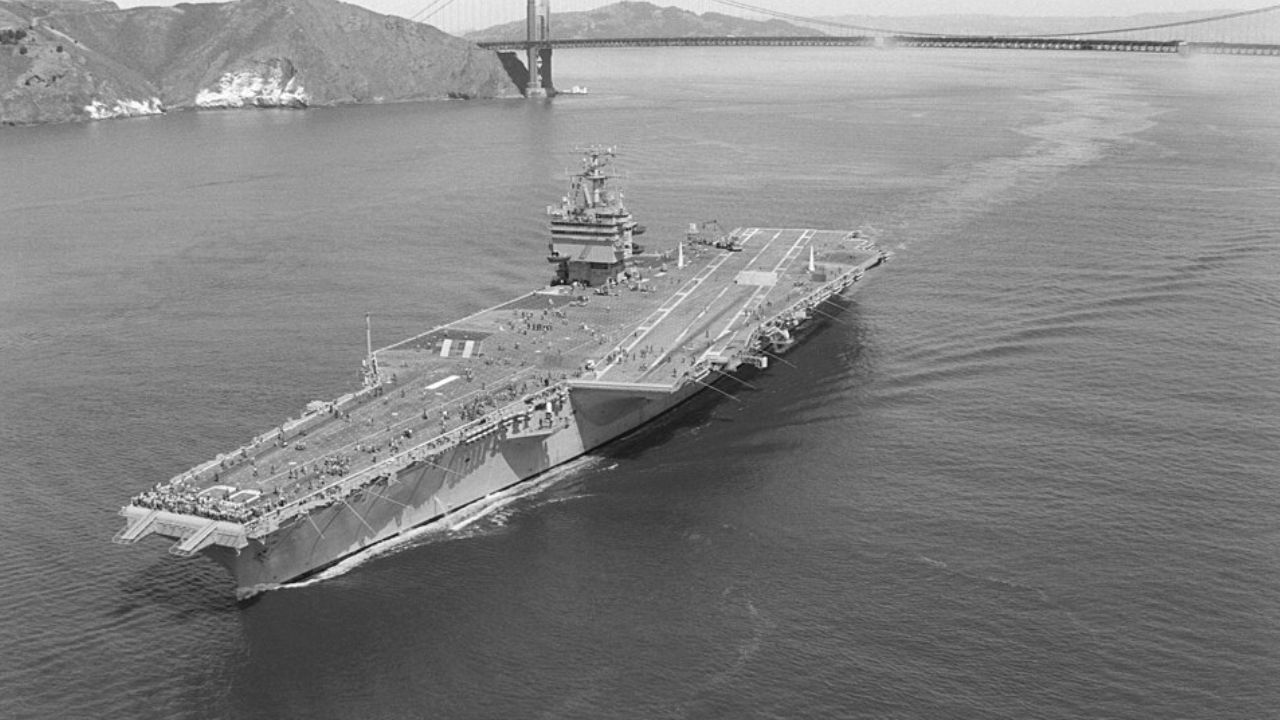
USS Enterprise (CVN-65) is what “the world’s first nuclear-powered aircraft carrier” actually refers to—and the dates matter. Naval History and Heritage Command (NHHC) ship history/DANFS records show she was built at Newport News, laid down Feb. 4, 1958, launched Sept. 24, 1960, and commissioned Nov. 25, 1961. That sequence makes Enterprise a true leap-ahead ship: a carrier-scale attempt to prove that nuclear propulsion could deliver operational advantage, not just technical novelty.
What followed was not a long experimental pause, but rapid use in the real world. In the early 1960s, the Navy was operating at Cold War tempo, and Enterprise quickly became part of the era’s presence and signaling—most visibly through Operation Sea Orbit. Her final years also underline a less dramatic but essential part of the nuclear story: the long, carefully defined end-of-service process and its costs.
USS Enterprise (CVN-65)
NHHC’s overview and DANFS history frame Enterprise as a one-off, first-of-kind design—the only ship of her class—and the first nuclear-powered aircraft carrier in the world, commissioned in late 1961. Built at Newport News and entering service in a period of sustained tension, she became a centerpiece of U.S. power projection because she demonstrated nuclear propulsion at the scale of the fleet’s most complex surface combatant.
Her “one-off” status is more than a curiosity. It shaped how people talk about the ship—and how readers should evaluate what they read. Many secondary summaries conflict on technical specifics, so for a publication-grade account, NHHC/DANFS remains the clean reference point for the core chronology and the basic framing of what made Enterprise different.
The nuclear propulsion plant on Enterprise
Enterprise is routinely described as uniquely complex compared with later U.S. carrier designs, and NHHC’s “world’s first nuclear-powered aircraft carrier” background emphasizes that she was a first-generation effort rather than a refined template. The most defensible takeaway here is not a single unverified performance number, but the broader point: the Navy was still learning what “carrier-scale nuclear” should look like in practice.
That context also helps answer a question the ship inevitably raises: why didn’t the Navy simply build more carriers exactly like Enterprise? A first-of-kind propulsion approach can deliver major endurance advantages, but it can also bring complexity that later programs work to reduce through standardization. Stated carefully, the story is the one NHHC supports: Enterprise proved the concept, and the Navy later refined it.
Operation Sea Orbit (1964)
Operation Sea Orbit is where nuclear endurance became a public strategic message. NHHC’s Sea Orbit photo-page describes Task Force One—an all-nuclear surface task force—circumnavigating the globe in 1964 with USS Enterprise (CVAN-65) at its center. The goal was not merely spectacle. It was to demonstrate global reach and sustained movement without relying on conventional refueling.
One editorial caution belongs in any serious retelling: later sources often disagree on “how far” and “how long,” sometimes because they mix statute and nautical miles and sometimes because they rely on uneven summaries. The safest approach is to describe the operation as NHHC presents it, and treat exact totals as disputed unless cross-checked and quoted in their original units. The point remains clear either way: Sea Orbit advertised a nuclear task force that could go far, fast, and with fewer logistics constraints.
USS Long Beach (CGN-9)
NHHC’s Sea Orbit material also makes the structure of the message clear: this was not framed as a single-ship achievement. USS Long Beach (CGN-9), a nuclear-powered guided-missile cruiser, sailed with Enterprise during Sea Orbit as part of Task Force One. Including Long Beach reinforced that nuclear endurance could apply across a surface force, not only to a carrier.
Operationally, that distinction matters. A carrier’s staying power is significant on its own; a carrier paired with escorts that do not need to detach frequently for fuel implies a different kind of sustained presence. For accuracy, there’s no need to drift into unsourced design details here—the key supported fact is Long Beach’s role as a named nuclear escort in the Sea Orbit trio per NHHC.
USS Bainbridge (DLGN-25)
USS Bainbridge (DLGN-25) was the other nuclear escort in the Operation Sea Orbit trio, and NHHC’s Sea Orbit page preserves that period designation. With Enterprise and Long Beach, Bainbridge helped the Navy present a coherent concept: a nuclear-powered task force capable of sustained high-speed movement with reduced dependence on refueling support. USNI Proceedings is also noted in the context as summarizing the trio and the “unprecedented around-the-world cruise” framing, underscoring how widely the operation’s message circulated.
Here again, restraint improves accuracy. Since voyage duration and distance are sometimes restated inconsistently in later accounts, it’s best to keep claims bounded to what the cited references clearly support. Bainbridge belongs in the Enterprise story for a simple reason: she shows Sea Orbit was designed to demonstrate a task force model, not a lone technological showcase.
Cold War crisis relevance (Cuban Missile Crisis era)
Enterprise’s importance was not limited to planned demonstrations. Common histories tie her early service to the high-tempo early 1960s, including the Cuban Missile Crisis period in October 1962 when U.S. quarantine operations took place. The context cites Wikipedia’s Enterprise timeline as a pointer to that broader setting, while also flagging a firm limitation: do not assert Enterprise’s precise tasking or location during the quarantine without an NHHC/DANFS entry that explicitly states it.
Within those boundaries, the relevance is still real. Enterprise entered service during a period when the Navy was actively applying pressure and projecting readiness, and nuclear propulsion offered a new form of mobility and endurance to that posture. Even without pinning down a specific stationing claim beyond what the context supports, the strategic implication is straightforward: fewer refueling constraints can change what commanders can credibly plan and execute on short notice.
End-of-service milestones — inactivation vs decommissioning vs being stricken
Enterprise’s final timeline is often mishandled, and the distinctions are part of the story. U.S. Pacific Fleet announced the ship would inactivate on Dec. 1, 2012, after 51 years of service. That is separate from decommissioning. Navy.mil later announced that Enterprise was decommissioned Feb. 3, 2017, and NHHC’s DANFS summary notes she was stricken the same day. These are three distinct milestones, not interchangeable labels.
The precision matters because it reflects real work and real time. Nuclear-powered ships have lifecycle steps that can extend well beyond their last operational period, and casual “retired in 2012” phrasing obscures what actually happened. For a publication-ready account, the correct terms and dates are essential.
Disposal and cost reality — the “nuclear carrier bill” long after the last deployment
The last chapter is not dramatic, but it is unavoidable: the cost and complexity of what comes after service. The context notes that USNI News reported on the “final bill” for inactivating/scrapping/recycling, a reminder that nuclear-powered capital ships do not exit the inventory on the same timeline or with the same simplicity as conventional ships. Even without introducing figures not provided in the context, the takeaway is clear—nuclear propulsion shifts major obligations into the future.
That reality does not diminish what Enterprise proved; it completes the picture. NHHC’s documentation of her first-of-kind status and her dated milestones, paired with USNI News’ attention to disposal costs, shows the full arc: breakthrough capability, strategic signaling, and the long administrative and financial tail. “Inside” USS Enterprise (CVN-65) is ultimately a story of a leap-ahead ship that reshaped expectations for carrier endurance—and of the long responsibilities that came with making nuclear power central to sea power.