
On Nov. 14, 1965, at Landing Zone X‑Ray in Vietnam’s Ia Drang Valley, the U.S. Army’s new airmobile concept collided with a worst-case reality: infantry under heavy fire, a landing zone too dangerous for normal traffic, and wounded soldiers piling up. In that moment, survival depended on whether aircraft could still get in and out. According to the U.S. Army’s Medal of Honor materials, Bruce P. Crandall did exactly that—flying an unarmed UH‑1 “Huey” into a landing zone that had become effectively closed by enemy fire and helping evacuate most of the wounded.
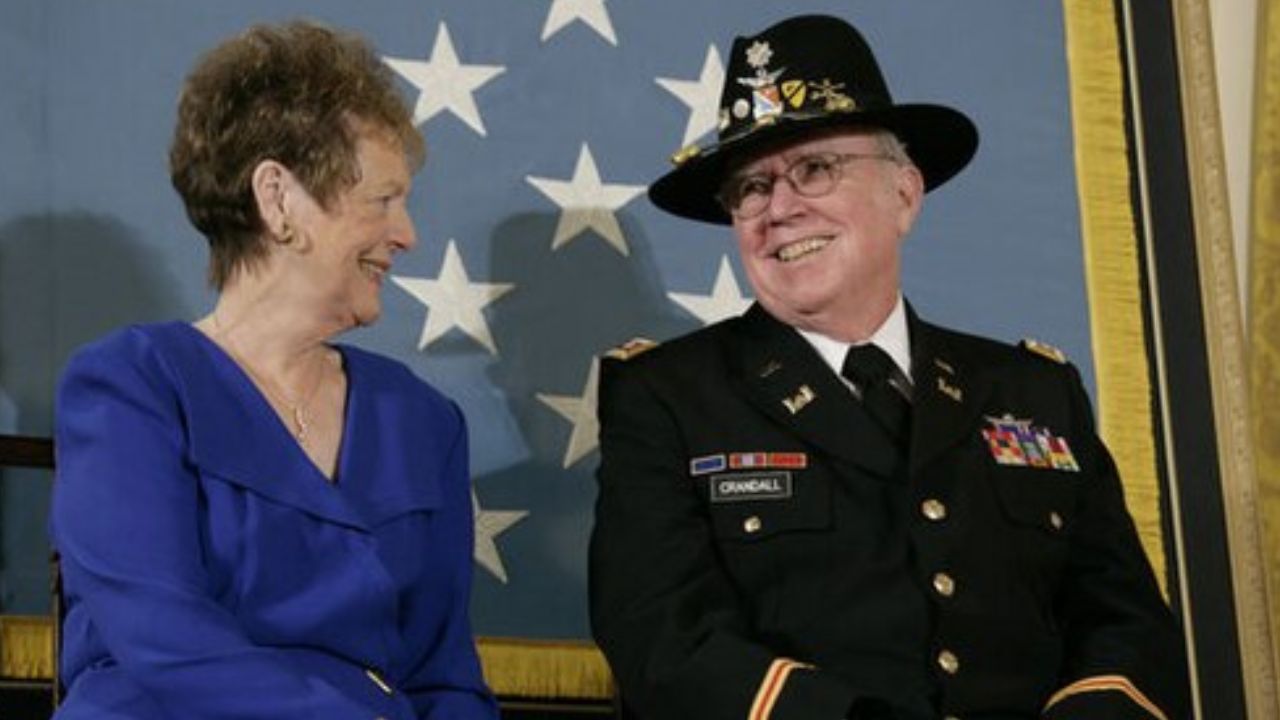
The central figures are not based on loose retellings. The U.S. Army Medal of Honor page for Crandall states that about 78 wounded were evacuated during the engagement and that Crandall’s flights accounted for 70 of them, after he flew 22 missions into the fire-swept zone. The Vietnam Veterans Memorial Fund’s Ia Drang overview provides the larger frame: repeated landings under intense fire were not a footnote to the battle, but a lifeline that kept the ground force supplied and able to hold on. Crandall and wife Arlene shown above.
Battle of Ia Drang (Landing Zone X‑Ray), Nov. 14, 1965
Ia Drang’s LZ X‑Ray became a defining early test of airmobile warfare because helicopters didn’t just insert troops—they had to sustain them in contact. The Vietnam Veterans Memorial Fund describes repeated landings under fire as a defining feature of the battle. That detail matters because in a fight like this, logistics and casualty evacuation aren’t separate “support” activities; they directly shape whether the perimeter can endure.
Many accounts use the term “closed” to describe what happened to the landing zone once fire intensified. In this context, it’s best understood as effectively closed due to enemy fire rather than a formal closure order. The operational point is simple: aircraft that would normally come in—particularly medical evacuation platforms—stopped landing, even as the ground force still needed ammunition, water, and a way to move badly wounded soldiers.
Bruce P. Crandall
Crandall’s actions at LZ X‑Ray are anchored by unusually specific official sourcing. The U.S. Army’s Medal of Honor recipient page for Crandall includes the core tally: 22 missions into the landing zone, and 70 wounded evacuated on his aircraft out of roughly 78 evacuated overall. A VA profile repeats the “22 trips” and “rescued 70” framing, reinforcing that this figure is consistent across government-backed summaries.
What makes the number meaningful is the repetition. This wasn’t one dramatic landing; it was a sustained series of flights into a “hot” LZ. Each cycle meant approaching under fire, landing long enough to offload supplies and load casualties, and then departing under the same threat. That rhythm—repeated exposure, repeated landings, repeated lifts out—captures what these missions demanded.
Some secondary accounts circulate different totals (for example, 75), including figures appearing via the Gathering of Eagles Foundation. For Combat Rated purposes, “70” is the safer number because it is tied to the Army’s Medal of Honor materials and echoed by the VA profile. The goal isn’t to stretch the story; it’s to keep the headline anchored to the strongest available sourcing.
Ed W. Freeman
Crandall wasn’t the only pilot who kept the lifeline open. Ed W. Freeman is widely credited with 14 flights into LZ X‑Ray under heavy fire during the same action window. The Department of Defense’s “Medal of Honor Monday” feature describes Freeman using unarmed helicopters to bring in supplies and evacuate wounded. Wikipedia summaries also emphasize the sustained nature of the risk—“14 times” through machine-gun fire—and the Ia Drang entry commonly contrasts Freeman’s 14 volunteer flights with Crandall’s 22.
Where the record is less consistent is the exact number of wounded attributed to Freeman’s flights. Some secondary sources, such as the Gathering of Eagles Foundation, claim he “rescued 30 injured,” but those counts vary by retelling. That’s why the “70 wounded” figure should remain tied to Crandall in the way the Army’s citation context presents it, rather than being blended into a combined total.
Freeman’s role also reinforces the operational lesson. Airmobile operations depend on continuity—keeping aircraft moving even when the LZ is “hot.” The DoD account frames that choice plainly: these were not armed gunships forcing their way in; they were unarmed helicopters doing the essential work of bringing in what the ground needed and taking out those who couldn’t walk out.
UH‑1 “Huey” troop carriers (“slicks”)
The aircraft at the center of the Ia Drang story is the UH‑1 “Huey,” specifically troop-carrying “slicks,” not dedicated medical evacuation aircraft. The DoD feature explicitly describes “unarmed helicopters” making supply-and-evacuation runs, and that detail is the hinge of the story: a transport aircraft, pressed into casualty evacuation because the purpose-built evacuation option wouldn’t land.
That distinction also keeps the narrative grounded in how fights actually unfold. Airmobile doctrine assumes aviation can sustain the ground force, but Ia Drang showed how quickly that sustainment pipeline can be disrupted—and how much it depends on crews continuing to fly. Using unarmed slicks as an improvised casualty-evac platform highlights the stakes without turning the moment into myth: if the wounded can’t be moved and supplies can’t get in, the ground position becomes harder to hold.
A note on nomenclature: some accounts describe the Ia Drang lift variant as a UH‑1D, but not every strong source cited here specifies the exact model letter. The safest phrasing is the one consistently supported in the DoD and VVMF framing provided here: UH‑1 “Huey” troop carriers (“slicks”) used for ad hoc resupply and evacuation under fire.
Company A, 229th Assault Helicopter Battalion; 1st Cavalry Division (Airmobile); 1/7 Cavalry at LZ X‑Ray
Unit context clarifies why these pilots were in a position to make those choices. The DoD feature identifies Freeman’s role tied to the 229th Assault Helicopter Battalion and the insertion mission supporting 1/7 Cavalry. The Army Medal of Honor page places the action within the 1st Cavalry Division’s airmobile operation into LZ X‑Ray. Together, that framing shows the chain of dependency: lift units inserted the infantry and then had to keep that infantry supplied and evacuated when the fight intensified.
It also corrects a common misconception. This wasn’t a separate “medevac unit” arriving from outside the battle’s immediate risk. When dedicated medical evacuation helicopters would not land under the conditions at X‑Ray, the lift force became the evacuation force. In an airmobile fight, the boundary between “combat” and “support” can disappear quickly.
The battlefield effect is straightforward. Supplies delivered into a hot perimeter help keep the defense functioning, and evacuations reduce the burden on the position while proving to the troops that they are not cut off. The VVMF’s overview and the Army’s citation-based numbers point to the same conclusion: these repeated landings were not symbolic gestures—they materially affected the ground force’s ability to endure the engagement.
Medal of Honor awards and the decades-later timeline (Freeman: July 16, 2001; Crandall: Feb. 26, 2007)
This story also remains prominent because the highest recognition arrived decades after the battle. Freeman received the Medal of Honor on July 16, 2001, and Crandall received his on Feb. 26, 2007—both for actions on Nov. 14, 1965 at Ia Drang. That delay doesn’t change what happened, but it does shape how these events are remembered and reintroduced to new audiences.
For Combat Rated, the core takeaway is the one supported by the strongest official language: per the U.S. Army’s Medal of Honor materials, Crandall flew 22 missions and his aircraft evacuated 70 of the roughly 78 wounded moved out during the engagement. In the first major test of airmobile warfare, those repeated runs—by volunteers in unarmed UH‑1 “Huey” slicks—show how an aviation lifeline can become the difference between collapse and survival.