
The Navy is getting ready to double up on fitness tests, and it is not just a paperwork tweak. It is part of a broader push to make enlisted leadership look less like a PowerPoint slide and more like a group of people who can actually lead from the front. The message from the top is simple enough: if you wear the uniform, you are going to prove twice a year that you can still do the job.
That shift lines up with a wider Pentagon drumbeat on physical standards, and it puts sailors squarely in the middle of a culture change that stretches from boot camp gyms to flag officer conference rooms. The Navy is not just adding another test to the calendar, it is trying to reset expectations about what everyday readiness looks like for the fleet.
Why the Navy is moving to twice-yearly PT
From what I see, the Navy’s decision to move to two physical readiness tests a year is less about tormenting sailors and more about closing the gap between “fitness on paper” and “fitness in real life.” When the top enlisted sailor tells the fleet that sailors can expect to take the Navy Physical Readiness Test twice a year, that is a signal that annual box-checking is no longer enough to count as combat ready, even in a service where most people spend more time on steel decks than in foxholes. The shift puts physical performance in the same category as watchstanding and qualifications, something that gets checked regularly instead of once in a blue moon, and it frames PT as a leadership responsibility, not a side hobby.
That message does not exist in a vacuum. Secretary of War Pete Hegseth has already told the joint force that, at his direction, every member of the force at every rank is required to take a PT test twice a year, every year of service, a standard that clearly sets the tone for what the services are expected to enforce. When the person in charge of war policy says “twice a year” out loud, the Navy’s move looks less like a quirky sea service experiment and more like the maritime branch falling in line with a department wide expectation that physical readiness is a recurring obligation, not a once a year surprise.
What the new testing rhythm means for sailors’ daily lives
For sailors, the practical effect of doubling the test schedule is that fitness can no longer be treated like taxes, something you panic about once a year and then forget. The Navy Physical Readiness Test already leans on familiar events like pushups, cardio, and core work, and guidance on meeting military fitness standards makes it clear that each service branch has its own mix of pushups and other events that show whether you can actually move your own body weight. With two test windows on the calendar, sailors will have to treat those pushups and runs as part of their normal routine, not a crash diet project that starts three weeks before weigh ins.
That shift will hit different communities in different ways. A sailor on a destroyer that spends months at sea will have to juggle watch rotations, maintenance, and cramped gyms while still staying ready for the next test, while someone at a shore command might have easier access to facilities but fewer built in excuses. Either way, the expectation is the same, sailors are supposed to be ready to pass the test on any given day, not just during a carefully choreographed fitness season. The new rhythm nudges commands to build PT into the workday and pushes individual sailors to think of their next set of pushups as part of their job description, not an optional lifestyle choice.
How Hegseth’s standards are reshaping the whole force

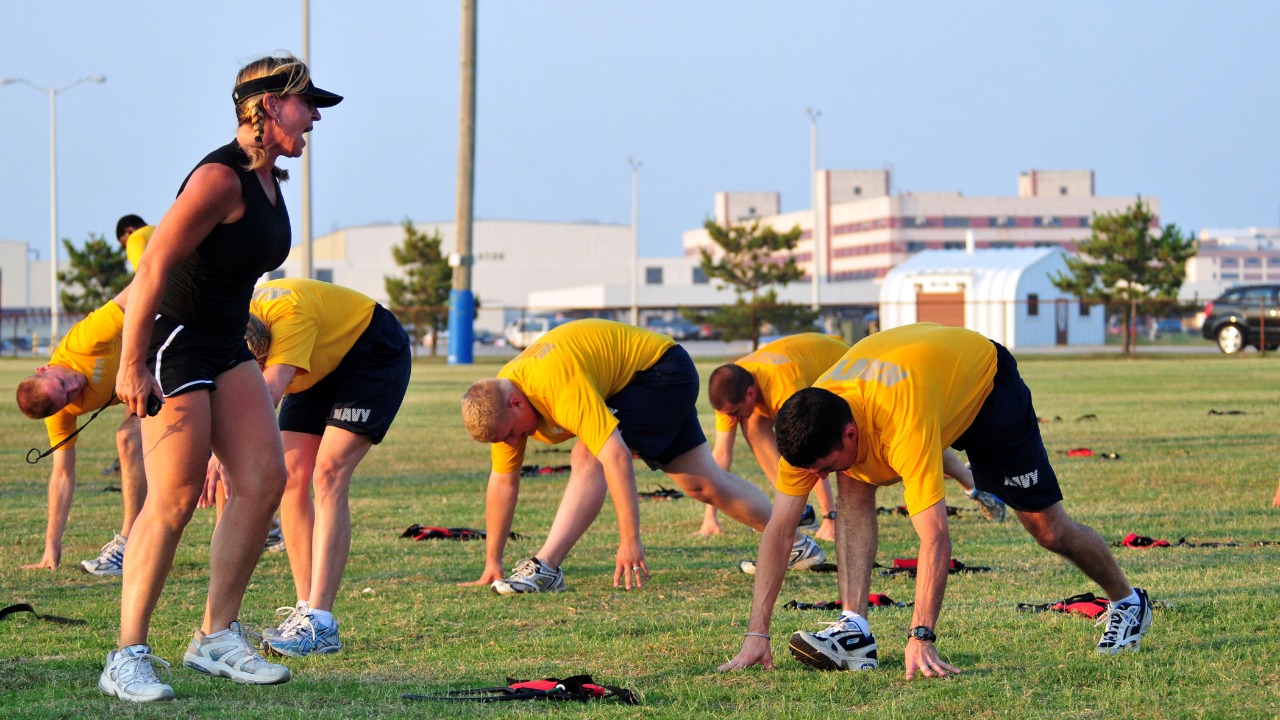
MCC Holly Boynton/U.S. Navy – Public domain/Wiki Commons
Zooming out, the Navy’s move fits neatly into a bigger pattern that Secretary of War Pete Hegseth has been sketching for the entire military. When he talks about newly proposed military fitness standards, he is not just tinkering with scoring tables, he is telling troops that they will now be required to take fitness tests twice a year and that the bar for what counts as “in shape” is being recalibrated. The focus is on making sure that Troops are measured against standards that match the realities of modern operations, instead of clinging to legacy rules that were designed for a different era and then endlessly grandfathered.
That broader push matters for sailors because it means the Navy is not operating on an island, even if it spends most of its time surrounded by water. When Hegseth lays out how his standards compare to existing tests, he is effectively setting a benchmark that the services are expected to meet or exceed, and the Navy’s decision to align its PT tempo with that twice yearly requirement shows that it is buying into the idea that physical readiness is a shared currency across the joint force. For enlisted leaders, that creates both pressure and opportunity, pressure to keep their people within those standards, and opportunity to use the new rules as leverage to demand better training time, better equipment, and a culture that treats PT as mission critical instead of a nice to have.
Enlisted leadership, Sailor 360, and the culture shift behind the tests
If the new testing schedule is the visible tip of the iceberg, programs like Sailor 360 are the part under the waterline that explain why the Navy thinks this will work. At places like Mayport, Sailor 360 has been pitched as a way of Bringing the Fleet to the Home Front in About 60 seconds, a quick hit approach to leadership development that tries to make professional growth feel less like a mandatory lecture and more like a conversation. A video from Mayport that pulled in 6.9K views and 43 reactions shows how commands are using that Sailor 360 framework to talk about Navy PRT updates for 2025, which tells me the service is deliberately tying physical readiness to leadership identity instead of treating it as a separate track.
That matters because enlisted leaders are the ones who will live or die by the success of twice yearly testing. Chiefs and leading petty officers are the people who will have to schedule group PT, chase down stragglers, and explain to a division why the command climate suddenly includes more planks and fewer donuts. By folding PT updates into Sailor 360 sessions, the Navy is effectively telling its future deckplate leaders that part of their job is to model the standards, not just enforce them. It is a subtle but important shift, the message is that a strong leader is not only the person who knows the instruction, but also the one who can knock out the required pushups without looking like they are reenacting a medical drama.
Preparing for twice-yearly tests without losing your mind
From a sailor’s perspective, the trick now is figuring out how to live with this new tempo without turning every week into a pre test panic. The good news is that the basic building blocks of the Navy Physical Readiness Test are not a mystery, guidance on meeting military fitness standards spells out that each branch leans on core events like Pushups and other simple movements that do not require a fancy gym. That means sailors can build a sustainable routine around bodyweight exercises, short runs, and core work that fits into a 20 or 30 minute window, instead of waiting for a perfect two hour block that never appears on the watchbill.
Commands can help by treating PT like any other recurring requirement, something that gets scheduled, tracked, and resourced. That might mean using tools as simple as a shared calendar or as elaborate as a unit fitness app, but the principle is the same, if you can track maintenance on a 2019 Ford F-150 in the motor pool, you can track who showed up for morning PT. For individual sailors, the twice yearly test can actually be a blessing in disguise, it removes the illusion that you can cram for fitness and replaces it with a steady drumbeat that rewards consistency. In a world where the Secretary of War is telling Troops across the services to meet higher standards, sailors who build those habits now will be the ones who treat the next policy change as just another lap, not a sprint from zero.