
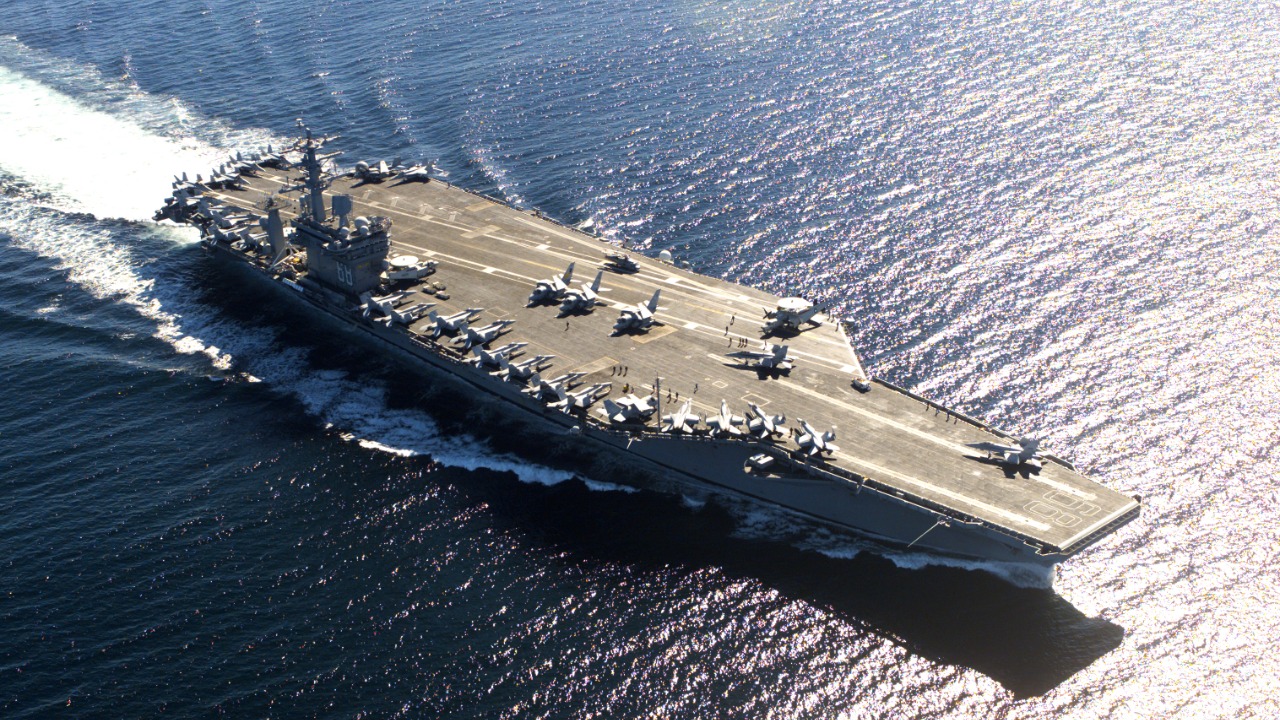
The United States has moved a Nimitz-class aircraft carrier into contested waters near China, signaling that Washington intends to keep a heavy naval footprint in the Indo-Pacific even as it retires some of its oldest flattops. The deployment underscores how carrier strike groups remain the centerpiece of American power projection at sea, at a moment when Beijing is testing red lines from the South China Sea to the Taiwan Strait.
I see this move not as an isolated show of force, but as part of a broader effort to manage risk on two fronts: deterring China in Asia while also preserving flexibility for crises from the Mediterranean to the Middle East. The pattern of recent carrier movements, live-fire drills, and decommissioning decisions reveals a Navy trying to stretch finite hulls across a widening map of obligations.
Carrier power in China’s backyard
Positioning a nuclear powered Nimitz-class carrier close to China is a deliberate choice to put steel and aviation capacity within rapid striking distance of disputed sea lanes. The unnamed authors who described a recent deployment of a nuclear carrier and its carrier strike group, or CSG, into what they called China’s backyard captured the essence of this strategy. I read that description as a reminder that geography still matters, and that sailing a supercarrier into contested waters is a political message as much as a military one.
The recent tempo of operations by USS Abraham Lincoln, a Nimitz-class ship, illustrates how this presence looks in practice. The Abraham Lincoln Carrier has been reported operating in the Philippine Sea while associated forces maneuver in the East China Sea, a pattern that effectively brackets key Chinese approaches. When I look at that footprint, I see a layered posture designed to reassure partners and complicate any rapid move by Beijing in the first island chain.
Abraham Lincoln as the Indo-Pacific workhorse
Among the Nimitz-class hulls, USS Abraham Lincoln has emerged as the workhorse for this phase of Indo-Pacific signaling. Reporting that the USS Abraham Lincoln (CVN 72) quietly shifted into disputed waters underlines how the Navy prefers to move these assets without fanfare, then let their presence speak for itself. The reference to CVN 72 and to the ship as the fifth of the nuclear powered Nim class underscores that this is not an experimental platform, but a mature, heavily armed carrier built for sustained operations.
Once on station, the ship has not stayed idle. The carrier has engaged in live-fire drills in the South China Sea, with Joe Sommerlad noting that the exercises took place at 1:52 AM PST, a detail that hints at the round-the-clock nature of carrier flight and gunnery operations. I read those drills as a rehearsal for the very scenarios that keep planners awake at night, from anti-ship missile salvos to swarming small boats, and as a signal to Beijing that the United States is willing to train with live ordnance in contested waters.
From live-fire drills to daily deterrence
Live-fire events are the visible tip of a much larger routine that turns a carrier into a daily instrument of deterrence. One report described how Aircraft carrier USS Abraham Lincoln conducted such drills in the South China Sea as part of what the Navy framed as routine operations. When I see the word routine attached to live weapons in that environment, I interpret it as a deliberate normalization of high end training inside a region that China claims as its own sphere.
Behind the headline events, the ship’s air wing and escorts are constantly practicing the basics. Imagery from the SOUTH CHINA SEA showed An MH 60R Sea Hawk helicopter from Helicopter Maritime Strike Squadron 71 preparing for flight operations, a reminder that anti submarine and surface surveillance missions are central to keeping the carrier safe. The explicit reference to the number 71 in that squadron designation, and to the Sea Hawk platform, underlines how much specialized hardware and training is tied to each deployment.
The drills are also sharpening the carrier’s ability to handle new threats. Analysis of how the Nimitz-class ship is armed to counter drones and small craft noted that a recent exercise confirmed the carrier’s ability to defeat close range aerial and surface threats amid heightened regional military activity, a point anchored in reporting on Jan drills. I read that as evidence that the Navy is not only parking a symbol near China, but also adapting its defenses to the cheap, proliferated systems that regional actors are fielding.
Balancing Indo-Pacific focus with global demands
Keeping a Nimitz-class carrier near China is only possible if the Navy can free hulls from other theaters, and recent movements show how tight that calculus has become. The USS Gerald R. Ford left its home port of Norfolk to sail to the Mediterranean in support of Israel, a deployment that pulled the newest carrier away from the Atlantic and into a crisis zone. When I factor that into the Indo-Pacific picture, I see a fleet that must cover the Middle East, Europe, and Asia with a finite number of decks, each one carrying its own political weight.
At the same time, the Navy is rotating other carriers out of forward roles. The Reagan, formally known as The Reagan, had been homeported at Yokosuka, Japan, from 2015 to 2024 to bolster forces in the eastern Pacific, but has gone into dry dock in Washington state. That shift removed a permanently forward based carrier from Japan, which in turn increases the pressure on ships like Abraham Lincoln to shuttle in and out of the region to maintain presence.
Port calls and regional engagements are part of how the Navy tries to make each deployment count. Reporting on Power Projection and in the Indo Pacific highlighted how Rear admirals use these visits to knit together coalitions and showcase supercarriers and their strike groups. I view those stops not as ceremonial extras, but as a way to turn a single hull into a regional diplomatic platform while it is already on station for deterrence.
The Nimitz legacy and the risk of a carrier gap
All of this Indo-Pacific maneuvering is unfolding as the Navy prepares to retire its oldest active carrier. The 50-year-old USS Nimitz has returned to Bremerton after what was described as its final global deployment, with plans for a 17 month docking period before eventual inactivation at Naval Base Kitsap in 2029. I see that timeline as a reminder that even iconic ships age out, and that maintenance and nuclear refueling cycles impose hard limits on how many carriers can be at sea at any given moment.
There is also an emotional and symbolic dimension to that retirement. Coverage framed as Bidding farewell to the USS Nimitz emphasized that it is the Navy’s oldest active aircraft carrier and America’s oldest operational carrier, a status that carries weight in congressional debates and within the fleet. When I weigh that against the demands in the South China Sea and beyond, I understand why some analysts worry about a gap.
One of the sharpest critiques has come from Jan Gordon Chang, who argued that decommissioning the ship amounts to a gift to China because it could leave the United States short of carriers for an extended period, a point he made in an opinion piece linked through Gordon Chang’s analysis. I do not have to agree with every line of that argument to see the core concern: as the Navy retires legacy hulls faster than it brings new ones online, each Nimitz-class ship that can still sail near China becomes more strategically valuable, and its presence in the Indo-Pacific carries stakes far beyond a single deployment.