
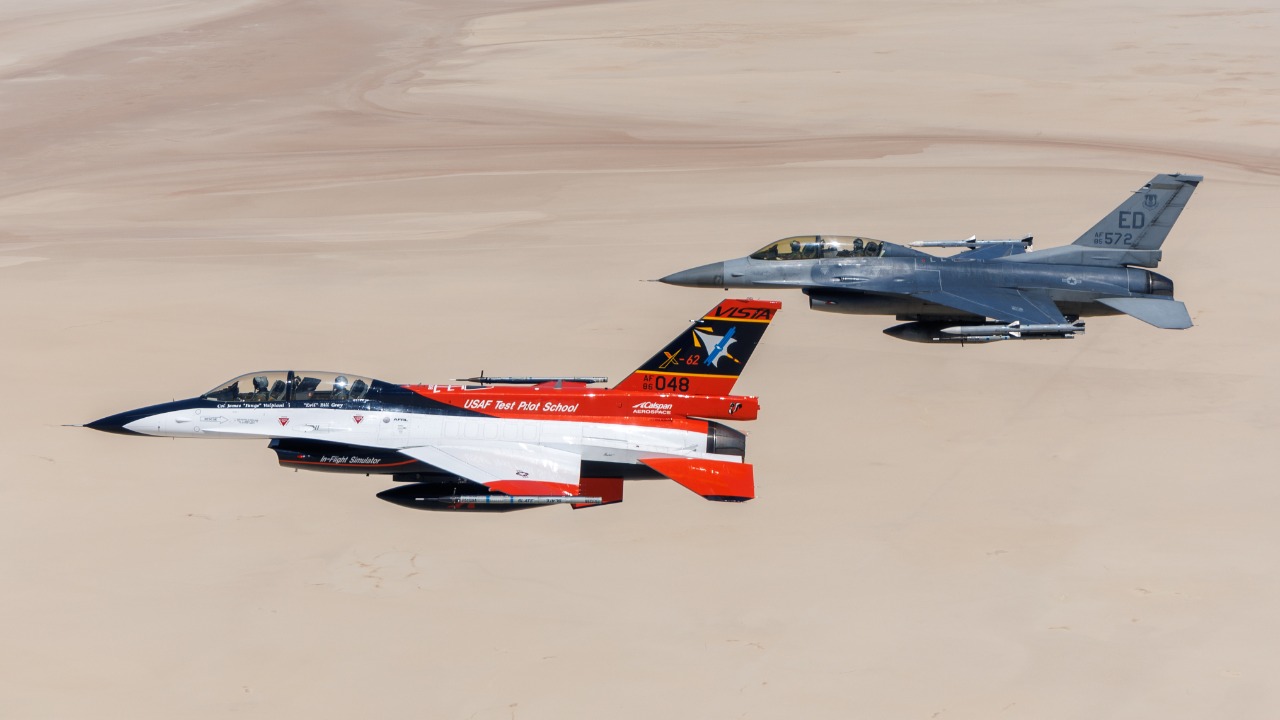
The U.S. Air Force has quietly crossed a milestone that once belonged to science fiction: in complex battle simulations, artificial intelligence generated war plans faster and, in key respects, better than human experts. The result is not a handover of the battlefield to machines, but a rapid shift toward human commanders working alongside algorithms that can process sprawling data in seconds.
Early experiments show that AI can compress hours of staff work into under a minute while preserving, and sometimes improving, the quality of operational decisions. Yet the same trials also exposed brittle edges, from flawed assumptions baked into test design to the risk of machine “hallucinations,” underscoring why senior officers insist humans will remain firmly in charge.
Inside the experiment where AI pulled ahead
In a recent multi-service, multi-domain scenario, the Air Force set out to test whether algorithms could keep pace with the messy reality of modern operations. The scenario involved coordinating air, maritime, and other forces in a situation that officials described as more complex than typical training problems, with planners asked to protect a damaged fleet ship while juggling risk, fuel, timing, and force packaging constraints. Several advanced tools were pitted against experienced human planners, and the best of the AI systems consistently produced workable courses of action that matched or exceeded human performance in speed and quality, according to Air Force reporting.
Officials involved in the trials emphasized that the machines were not simply spitting out generic options. The AI systems demonstrated the ability to generate multi-domain courses of action that explicitly accounted for risk, fuel, time constraints, and the composition of force packages, according to an official summary. That level of detail matters, because it shows the algorithms are not just optimizing on a single metric like speed, but are starting to reason across the same operational tradeoffs that human staffs wrestle with in real-world contingencies.
Speed, accuracy and the 97% advantage

The headline numbers from these experiments are striking. In one series of trials, machine-generated recommendations were up to 90% faster than traditional planning methods, yet still judged comparable in quality by evaluators. Another assessment of a USAF algorithm found that it delivered 90% acceptable solutions in 97% less time than human planners working the same problem. In practical terms, that means a planning cycle that might have taken an hour for a human team could be compressed to a couple of minutes or less by the algorithm, a shift that directly affects how quickly commanders can respond to fast-moving threats.
Other experiments echo those gains. At the Shadow Operations Center at Nellis, known as the ShOC-N, initial results showed that machines could boost both the speed and accuracy of battle management decisions when tested under conditions designed to resemble real-world operations, according to Air Force experiment data. In a related cross-border effort, AI-generated recommendations reportedly arrived in under one minute and significantly increased the share of courses of action considered viable and tactically valid, as described in a summary of the DASH 3 event. Taken together, the numbers suggest that, at least in structured scenarios, AI can compress decision timelines by an order of magnitude without collapsing the quality of the plan.
Why humans still matter in machine-led planning
Despite the eye-catching metrics, Air Force leaders are explicit that algorithms are not ready to replace human judgment. The same USAF algorithm that delivered 90% acceptable solutions in 97% less time did so in a test environment that, by design, favored machine strengths, with clearly defined objectives and constraints that could be encoded in software, as noted in the analysis of the experiment. Real operations rarely stay that tidy. They involve ambiguous intelligence, shifting political guidance, and adversaries who adapt in ways that can break the assumptions embedded in an algorithm’s training data.
There are also technical limits. When the Air Force evaluated several advanced tools, some produced output that was not just suboptimal but grossly inaccurate, including what officials described as hallucinations, according to test reporting. That kind of failure is unacceptable in combat, where a fabricated sensor track or an invented constraint could send aircraft into danger or leave a ship exposed. The Air Force’s own messaging around human-machine teaming stresses that operators remain in the loop, with AI framed as a decision aid rather than an autonomous commander, a stance echoed in earlier commentary that Air Force AI writes battle plans faster than humans but that some of them are wrong, as highlighted in technical coverage.
Building trust in human‑machine teams
For the Air Force, the next challenge is not just improving algorithms, but convincing operators to trust them without becoming dependent. Official messaging around human-machine teaming explicitly frames the effort as Looking Ahead, Building Trust in AI for Future Operations As the Air Force moves into its next series of Decision Advantage Series events. Those experiments, including DASH 2 and DASH 3, are designed to expose crews from the United States and partner nations to AI tools in realistic, high-pressure environments, so they can learn when to lean on machine recommendations and when to override them. A social media summary of DASH 2 described the effort as Accelerating Decision Advantage with Human‑Machine Teaming The Air Force, underscoring the focus on joint and coalition operations.
Trust is not just a military problem. Across government and industry, leaders are grappling with how to integrate AI as a co-pilot rather than a replacement. One federal technology executive, Ariga, has argued that In the end, Ariga said AI’s promise isn’t to replace people but to ease the process, a sentiment that mirrors the Air Force’s public stance. In the private sector, one workforce technology firm has pushed a similar message, stating that the Myth that AI will replace HR and the Reality that Agentic AI is your team’s co‑pilot applies in high-volume hiring. The parallel is clear: whether screening job applicants or orchestrating air campaigns, organizations are trying to harness AI to reduce workload and improve outcomes while keeping humans accountable for final decisions.
Limits of current AI and what comes next
The Air Force’s experience also aligns with broader research that highlights where current AI falls short. A recent study from MIT found that, across 43 different environments, humans consistently outperformed tested models on tasks that required understanding how the world works, predicting the effects of actions, and detecting when the rules of the environment changed. According to the researchers, these gaps suggest that even state-of-the-art systems can struggle when confronted with novel situations or subtle shifts in context, exactly the kind of challenges that define real-world conflict.
Within the Air Force, leaders like Air Force Col John Ohlund, who directs the Advanced Battle Management System Cross Functional Team, are trying to bridge that gap by pairing algorithms with experienced operators. Ohlund has been a prominent voice in experiments at the ShOC-N and in cross-border trials, where human-machine teams are evaluated not just on raw speed but on how well they maintain situational awareness and adapt to changing conditions, as reflected in Air Force Col John Ohlund, Advanced Battle Management System Cross Functional Team ABMS CFT briefings. Earlier work on the Advanced Battle Management System, involving figures like Robert Claude from the joint Air Force and Space Force team, has already shown that AI can draft battle plans faster than humans can, but that it still takes a human to correct flawed options, as noted in earlier ABMS experimentation. The emerging model is clear: algorithms will increasingly handle the grind of data fusion and option generation, while commanders focus on judgment, creativity, and accountability in decisions that no machine can own.