
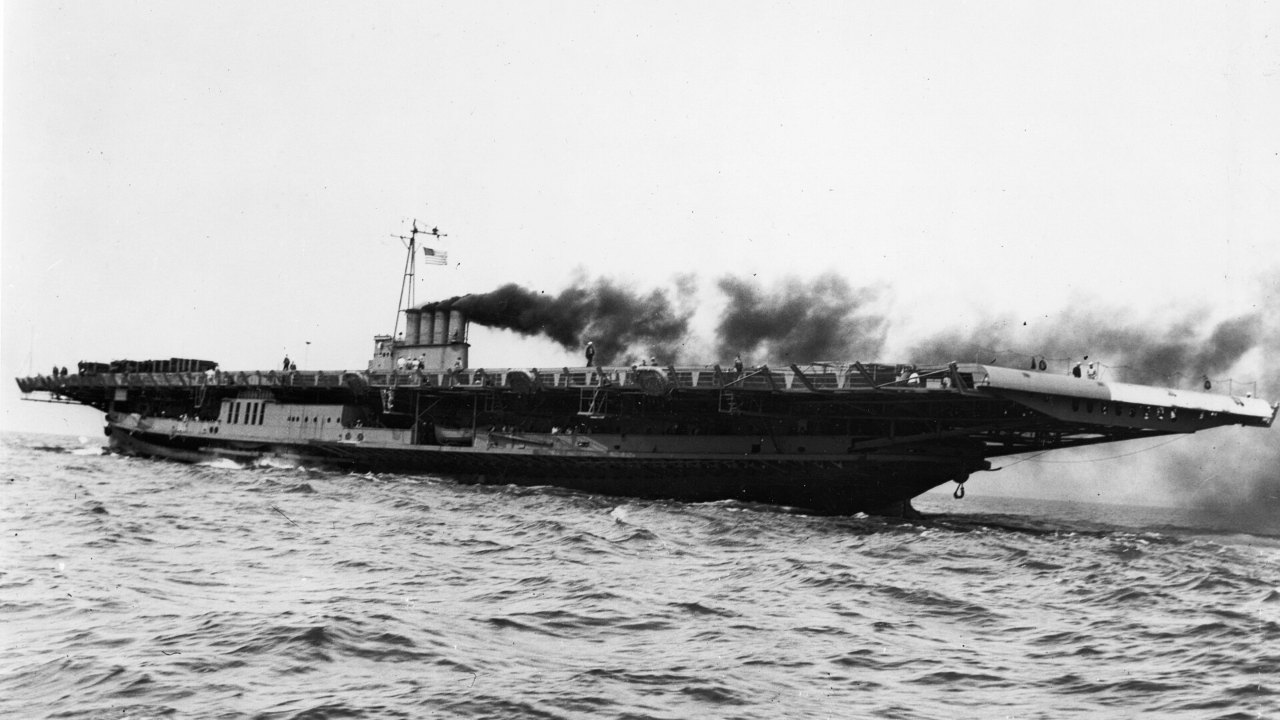
Paddle wheels driven by coal-fired engines moved two of the most unusual flattops the U.S. Navy ever commissioned. USS Wolverine (IX-64) and USS Sable (IX-81) began life as Great Lakes passenger steamers, and during World War II they gave Navy pilots a real carrier deck on the sheltered water of Lake Michigan.
Their job was to turn trained aviators into carrier-qualified ones, and by the end of the war the count of those who qualified ran into five figures.
Writing for the Naval History and Heritage Command’s blog on Sept. 27, 2019, Hill Goodspeed, historian at the National Naval Aviation Museum, explained the choice of water: “the Navy looked to Lake Michigan as a protected location for this aspect of training.” His history of Lake Michigan’s naval aviation also explains what made the pair stand apart: “The vessels retained their coal-driven, side-wheel propulsion systems, making them unique ships in the U.S. Navy.”
Seeandbee becomes Wolverine
The first conversion was an old lake boat. The Navy’s Dictionary of American Naval Fighting Ships entry for Wolverine says she was built in 1913 as Seeandbee by the American Shipbuilding Co. of Wyandotte, Mich., for the Cleveland and Buffalo Transit Co., the line her name played on. The Navy acquired her on March 12, 1942, and conversion to a training aircraft carrier began May 6.
Wolverine was commissioned Aug. 12, 1942, at Buffalo, N.Y., with Cmdr. George R. Fairlamb in command, according to DANFS. Goodspeed writes that she launched her first aircraft on Aug. 25, 1942, less than two weeks later.
Greater Buffalo becomes Sable
The second ship was newer. The DANFS entry for Sable says she was built in 1924 by the American Shipbuilding Co. at Lorain, Ohio, as Greater Buffalo for the Detroit and Cleveland Navigation Co. The War Shipping Administration acquired her for the Navy on Aug. 7, 1942, and she was renamed Sable and classed IX-81 on Sept. 19 of that year.
She was converted at American Shipbuilding’s Erie plant in Buffalo and commissioned May 8, 1943, with Capt. Warren K. Berner in command. DANFS lists her home port as Chicago and says she was “Fitted with a lengthier deck than Wolverine (IX-64).” Goodspeed records that Sable qualified her first two pilots on May 29, 1943.
The two sources measure the decks differently. Goodspeed describes both ships’ “550-feet-long flight decks” as “smaller than those on board the Navy’s fleet carriers,” while DANFS says Sable’s was the longer of the two. Either way, the point was the challenge. Goodspeed’s article puts it this way: “If a pilot could make it on this deck, he could make it on any other deck in the Navy’s fleet.”
120,000 landings and 128 aircraft lost
The volume was enormous for two converted excursion steamers. Goodspeed writes that “some 120,000 successful landings took place on board the two training carriers,” “and an estimated 15,000 pilots successfully qualified.”
The training came at a price. Goodspeed counts “more than 200 accidents and 128 airplanes lost during the period 1942-1945,” and says eight pilots were killed.
The lake has since given some of them back. “The first occurred in 1990 and, since that time, 39 aircraft have emerged from Lake Michigan waters,” Goodspeed writes of recoveries, adding that “most have been in good condition when recovered.” Among them, he lists an SBD-2 Dauntless that had fought at Midway.
Decommissioned together
The two side-wheelers ended their Navy careers on the same day. DANFS says both were decommissioned Nov. 7, 1945, and struck from the Navy list on Nov. 28, 1945. Wolverine was transferred to the War Shipping Administration on Nov. 26, 1947, and sold for scrapping. Sable was sold by the Maritime Commission to H. H. Buncher Co. of Pittsburgh on July 7, 1948, as a scrap hull.
The ships are gone. Their work shows up in the qualification count, which Goodspeed gives as an estimated 15,000 pilots, and in the aircraft still being lifted from the lake that trained them.