
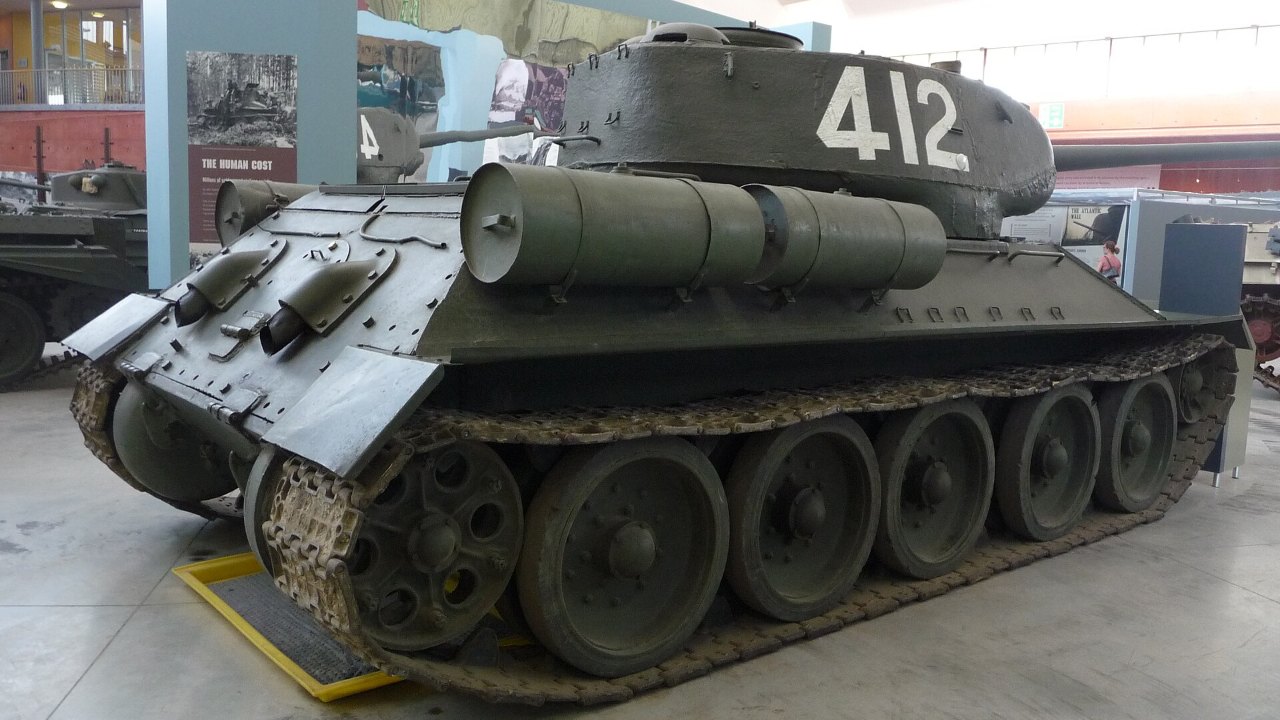
Krasnoye Sormovo Factory No. 112, in the Soviet city of Gorki, turned out a T-34/85 in late 1944 that would outlast the war it was built for. By 1950 it was in Korea, in North Korean hands, and by November 1950 it had been destroyed or captured along with almost every other North Korean T-34.
In 1952 the tank arrived at The Tank Museum in Britain, which still holds it. It is one of several T-34/85s in the museum’s collection, and the one the museum ties to the Korean War.
The museum lays out that history on its T-34/85 collection page: “This T-34/85 was built at the Krasnoye Sormovo Zavod (factory) No. 112 in Gorki in late 1944. It was supplied to North Korea and used by them in the Korean War (1950-53).” It adds that “by November 1950 almost all North Korea’s T-34s had been destroyed or captured, including this one,” and that the tank “came to The Tank Museum in 1952.”
The 85mm upgrade
The T-34/85 was the answer to a problem the original T-34 could not solve on its own. According to the museum, the Soviets had resisted changes that would interrupt production, but by 1943 that “was no longer an option and the Soviets developed the T34/85 as an upgrade” to deal with newer German tanks.
The fix was a bigger turret. “The new, larger turret on the T-34/85 had a far more powerful gun,” the museum says, and room for three men, which made for more efficient operation. The museum lists the main gun as an 85mm ZiS-53, backed by two 7.62mm DT machine guns, with a crew of five.
Its other figures, per the same page: 90mm of armor, a weight of 32 tonnes and a top speed of 55 km/h, or 34 mph. The museum puts total production at about 50,000, built in the Soviet Union, Poland and Czechoslovakia.
North Korea’s tanks in 1950
North Korea’s tank force was built on that design. In a 2010 Army News Service article for the 60th anniversary of the invasion, the U.S. Army Center of Military History said North Korea had “150 Soviet T34 tanks” when it launched its coordinated attack across the 38th Parallel on June 25, 1950.
American troops met those tanks early and in force. According to the Center of Military History, Task Force Smith, a delaying force sent from Japan under Lt. Col. Charles B. Smith, faced “thirty-three T34 tanks” near Osan and was overrun, “without armor, effective antitank weapons, or air support.” The same article says the 24th Division then received the 3.5-inch rocket launcher, which proved effective against the T-34.
The Tank Museum’s page does not say where its tank was knocked out or captured, or by whom. What it records is the end result: by November 1950, the vehicle was out of North Korean service.
One of several in the collection
The museum is careful to separate this tank from its other T-34/85s. One, received in 2022 from the Defence Academy at Shrivenham, combines a Soviet hull with a Czech turret and Czechoslovak RM31 radio equipment. Another, acquired in 1987 from a private collector, was “almost certainly one of around 1,380 tanks built in Poland between 1951 and 1955,” the museum says. A third “joined our collection in 2025 from the Duxford Aviation Society, and is part of our running fleet.”
Those tanks show how long the design stayed in production after 1945. The Korean War vehicle ties the type to 1950, when North Korea attacked with 150 of them: a late-1944 Gorki tank, out of the fight by November 1950 and in a British museum by 1952.