
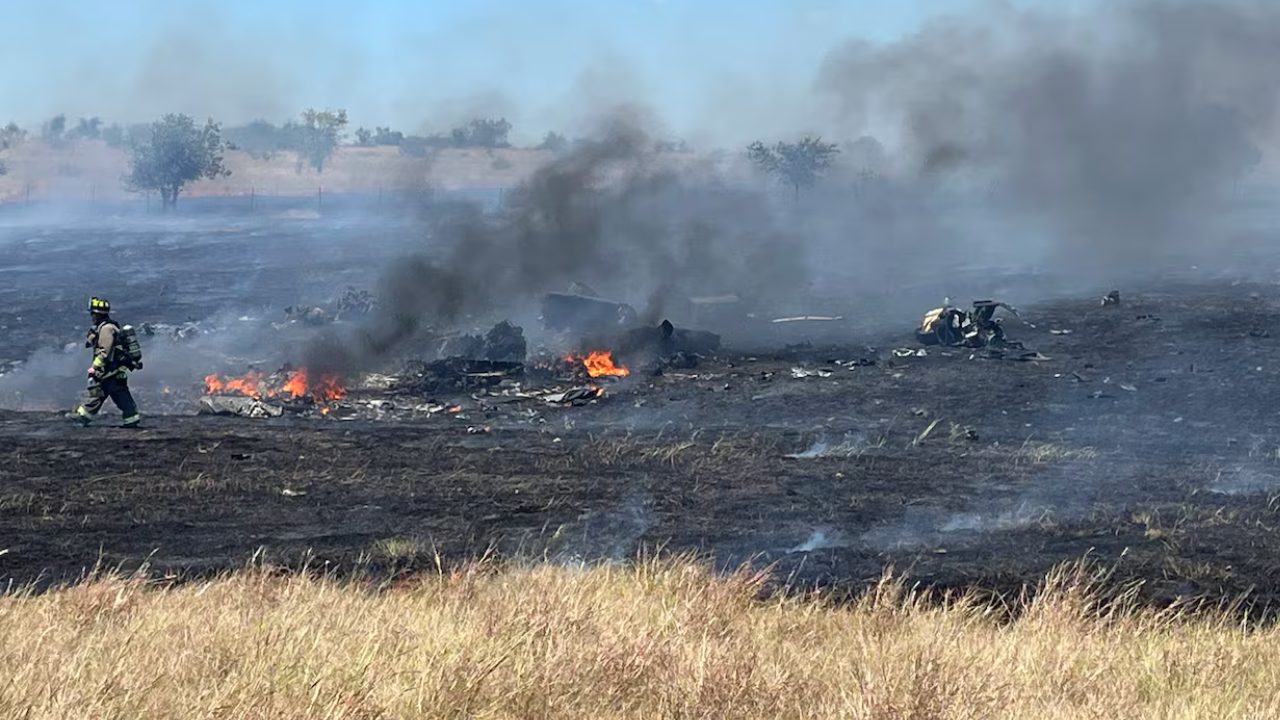
Two pilots were killed Wednesday afternoon when an AH-64 Apache attack helicopter from Fort Hood crashed into a field south of Salado, Texas, igniting an uncontrolled wildfire that forced evacuations and shut down a major roadway as emergency crews raced to contain the blaze.
The crash was reported at approximately 1:34 p.m. local time, according to Cliff Coleman, a spokesman for the Bell County Sheriff’s Office. Both pilots aboard the aircraft were confirmed dead at the scene.
“It crashed into a field, and you could tell it was a violent crash,” Coleman said, describing the condition of the wreckage to reporters in the hours after the incident.
Coleman confirmed the helicopter did not strike any structures or people on the ground, a detail authorities emphasized even as the resulting fire threatened nearby homes.
The aircraft went down in a rural area off Dove Hollow Lane, roughly 30 minutes from the Fort Hood installation, according to local station KWTX. Farm to Market Road 2843 was shut down near the crash site as emergency vehicles moved into the area.
Salado Fire and Bell County ESD #1 said crews were battling a “major grass fire” along FM 2843 in the wake of the crash and warned the public that the roadway was impassable in the affected area. “Please avoid the roadway and choose an alternate route,” the department said in a public safety alert, adding that doing so would “help keep traffic clear for responding fire and emergency personnel.”
As of 4 p.m. ET, the fire remained uncontrolled, Coleman said, and residents in the surrounding area had been evacuated because of the advancing flames.
Local station KWTX, citing the sheriff’s office, reported that the blaze was “a large fire that is out of control” in the immediate aftermath of the crash, prompting the evacuation of several homes in the vicinity of Dove Hollow Road.
Fort Hood confirmed in a statement that the aircraft was an AH-64 Apache attack helicopter based at the installation, and local station KXXV reported the helicopter was assigned to the 1st Cavalry Division, one of the Army’s storied armored divisions headquartered at the post.
Brig. Gen. Ethan Diven, Fort Hood’s acting commanding general, issued a statement following the crash addressing the military’s response and the families of the crew. “Our immediate priority is securing the site and supporting the initial response efforts,” Diven said. “Our thoughts are with the crew and their families as we await further information.”
Fort Hood described the incident as an “ongoing and developing situation” and said local emergency services, military responders and law enforcement were actively working the scene together. The installation said additional information would be released as it became available.
It remained unclear Wednesday afternoon where the helicopter had originated or where it had been headed at the time of the crash. The Fort Hood Criminal Investigation Division is leading the investigation, according to Coleman, with the cause not yet released.
The identities of the two pilots killed had not been released as of Wednesday evening, pending notification of their next of kin, a standard practice the Army follows in the aftermath of fatal service member incidents.
Abhiram Garapati, a Republican congressional candidate in Texas, offered condolences following the crash. “My prayers are with those aboard, the first responders responding to the scene, and any individuals affected by the fire that began as a result of the crash,” Garapati wrote in a public statement.
The AH-64 Apache’s Role in the U.S. Military
The AH-64 Apache is a two-seat attack helicopter, with the pilot stationed in the rear of the aircraft and a co-pilot and gunner seated forward, according to the U.S. Army. The four-bladed aircraft is capable of carrying 16 Hellfire missiles, 76 aerial rockets and 1,200 rounds of ammunition for its 30 mm cannon.
First introduced in 1984, the Apache has undergone repeated modernization and upgrade programs and is slated to remain in service with the Army through 2050. The Army describes the aircraft as “highly mobile, lethal” and capable of destroying armored, personnel and materiel targets in obscured battlefield conditions at ranges out to eight kilometers, or roughly five miles. The service credits the latest AH-64E variant’s improved situational awareness, flight performance and joint interoperability with making it “the most advanced aerial fighting vehicle in the world.”
A Pattern of Recent Army Aviation Incidents
Wednesday’s crash adds to a string of Apache-related incidents in recent Army history. In one recent case, three soldiers were killed and a fourth injured after two Army Apache helicopters collided midair while returning from a training flight in Alaska, an accident that drew renewed attention to the demands and risks of Apache flight operations.
Fort Hood itself, one of the largest military installations in the country and home to the 1st Cavalry Division and III Armored Corps, has been the site of past fatal aviation accidents involving both Apache and Black Hawk helicopters during routine training operations, underscoring the inherent risks associated with rotary-wing training at the sprawling Central Texas post.
Wednesday’s crash was under active investigation by Fort Hood’s Criminal Investigation Division as of Wednesday evening, with military and civilian authorities continuing to coordinate on both the crash site and the ongoing wildfire response. Fort Hood said further details, including the identities of the two pilots and the circumstances that led to the crash, would be released as the investigation progresses.