
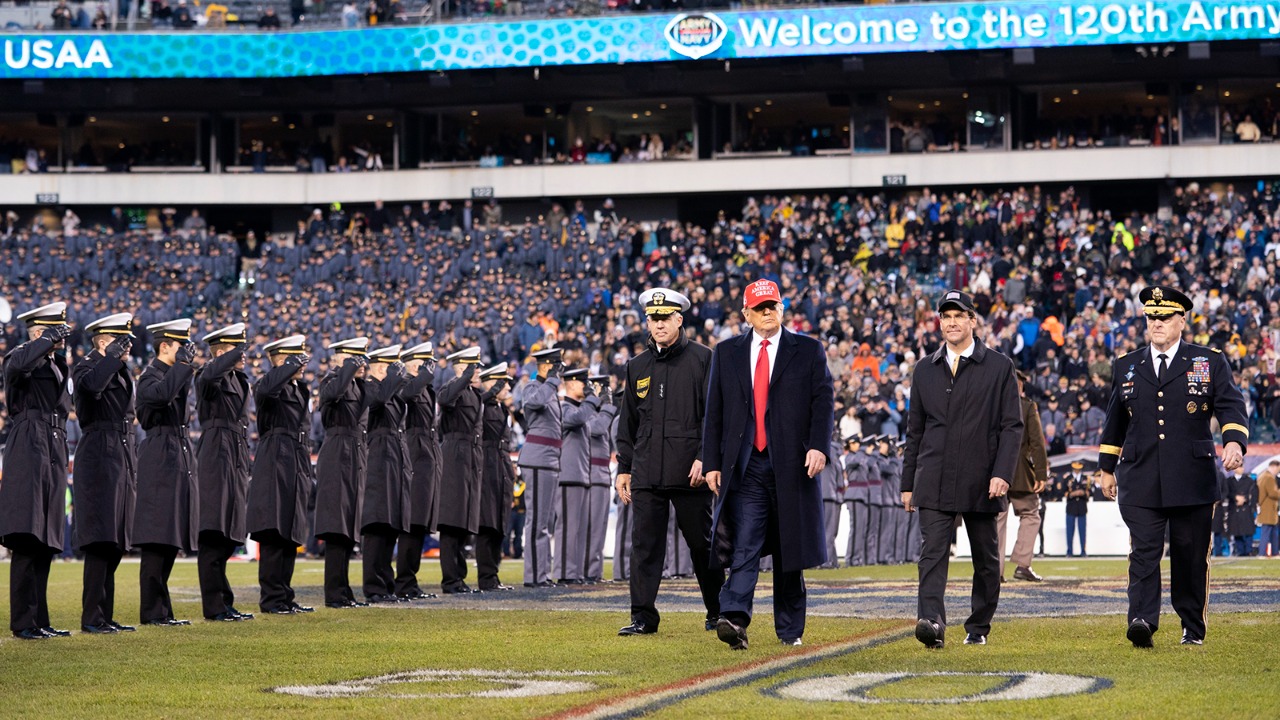
President Donald Trump is trying to turn a single college football game into appointment viewing by government decree. His plan to give the Army-Navy Game an exclusive television window would force rival broadcasters to go dark on competing football, a dramatic collision of sports pageantry, presidential power, and big media money.
The proposal, framed as a defense of military tradition, would in practice amount to a blackout of other games during that slot, reshaping how the NCAA postseason and major networks schedule some of their most valuable programming.
The executive order that would clear the airwaves
The core of the proposal is simple and sweeping. Trump has said he intends to sign an executive order that would make the Army-Navy football matchup the only game on television during its broadcast window, effectively barring other college or professional contests from airing at the same time. He has described the move as a way to shield the rivalry from what he calls the distorting influence of “big TV money,” and to guarantee that the service academies do not have to compete for viewers with playoff games or marquee conference matchups that now crowd the December calendar.
In public comments and on Truth Social, Trump has cast the order as a directive to protect the Army-Navy from “big TV money interference” and to lock in a dedicated broadcast slot. He has also framed it as a message to the NCAA, signaling that the federal government is prepared to intervene in the expanding College Football Playoff schedule if it encroaches on the traditional showcase for the Army and the Navy service academies.
A direct shot at the College Football Playoff and media giants
Trump’s plan not only touches the academies and their fans. It would also collide with the NCAA’s effort to expand the College Football Playoff and with the business models of the networks that pay billions for those rights. Reporting on the draft order indicates that it is designed to prevent any postseason football, including playoff contests, from being scheduled in the same time slot as the Army-Navy Game, a move that would constrain how the expanded bracket can be staged and televised. The language, as described, would apply broadly to football broadcasts, not just to one league or level.
That puts the White House on a collision course with the companies that control the playoff. One account notes that President Donald Trump is preparing to block College Football Playoff games from overlapping with the Army-Navy window, while another highlights that Disney, ESPN, and Warner would see a direct hit to their scheduling flexibility if the order takes effect. Those outlets have paid for the right to stack high-profile games across December, and a federally mandated blackout during one of the most valuable weekends would cut into the inventory they can sell to advertisers.
Tradition, politics, and a Truth Social megaphone
Trump has wrapped the proposal in the language of reverence for the military and for long-standing rituals. He has described the Army-Navy Game as a “great” national event and has argued that the players on the field, cadets from the Army and midshipmen from the Navy, deserve a stage that is not cluttered by competing spectacles. In one message, he declared that “We must protect the Tradition, and the Players, who protect us,” and presented the planned order as a formal warning to broadcasters and leagues that the federal government intends to carve out a protected window for the academies.
That framing surfaced in a post in which he wrote, “Please let this serve as Notice to ALL Television Networks, Stations, and Cable Channels” that they should not schedule football against the game. He has used Truth Social to amplify that message, and coverage of his appearance at the 2025 Army-Navy Game in Jan has stressed how he has tied the order to his broader political identity as a defender of the military and of patriotic ceremony.
Legal questions, media fallout, and a broader culture clash
The proposal raises immediate questions about how far a president can go in dictating programming decisions to private media companies. Trump has said he will direct television networks to “protect” the rivalry, a phrase that, if translated into binding regulation, would test the limits of executive authority over content scheduling. Legal analysts are already debating whether such an order would survive court scrutiny, particularly if it is seen as favoring one event over others without a clear national security or emergency rationale.
At the same time, the move fits a familiar pattern in which Trump uses high-profile cultural flashpoints to draw sharp lines with perceived elites. One report notes that he has pledged on social media to make the Army-Navy rivalry the only football game on television during its slot, a promise that would require networks to pull or reschedule other contests if the order is enforced, and that has been described as a plan to shield the rivalry. Another account details how he intends to instruct TV networks to protect the Army, while coverage of his Truth Social posts by reporter Alejandra Jaramillo has highlighted how he has vowed to stop other football from airing opposite the Army and Navy game. Industry focused coverage has also stressed that the order, if implemented, would grant the academies an exclusive TV window, while political reporting has noted that Trump’s comments came as he was also dealing with ICE activity in Minneapolis and tariffs on European countries, a reminder, as one account put it, that Trump, ICE, Minneapolis trade disputes are all part of the same crowded governing agenda.