
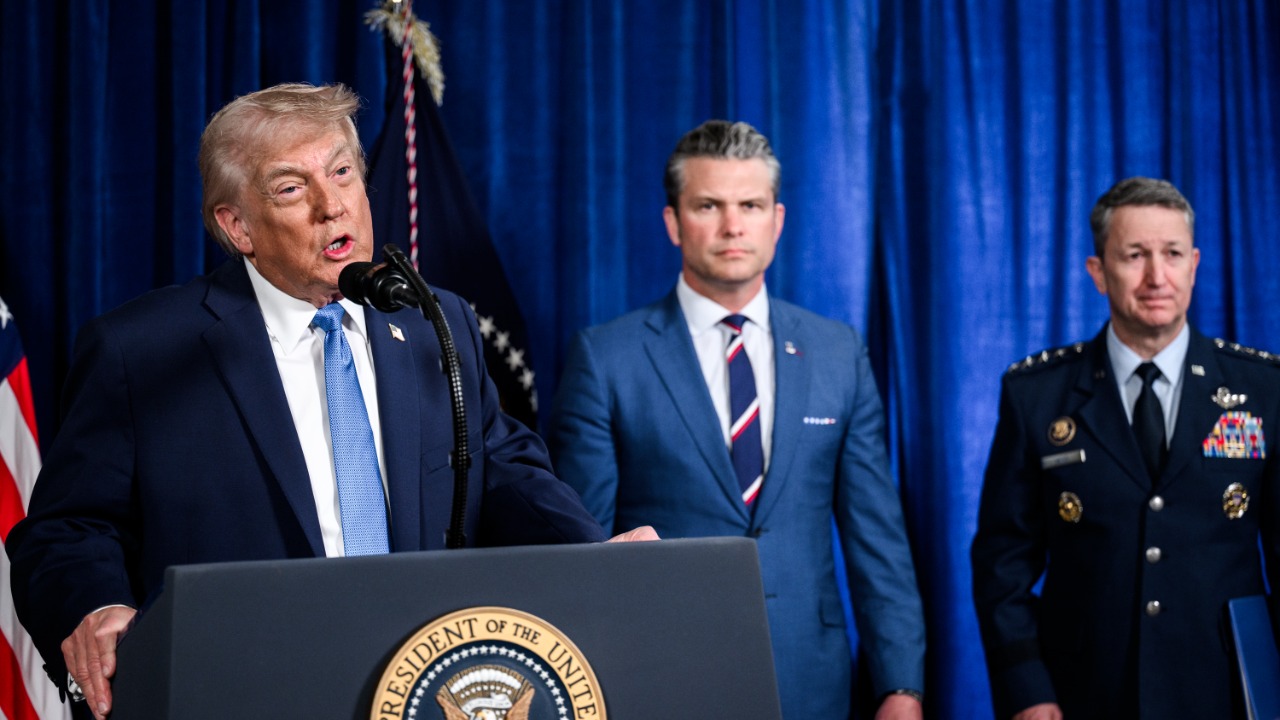
President Trump has edged back from the brink of a rapid military assault on Iran after a flurry of warnings from regional partners that retaliation by Tehran could spiral into a regional war. The hesitation reflects not only allied fears of revenge strikes but also the White House’s own struggle to reconcile pressure for a show of force with the risks of igniting a conflict that would engulf the wider Middle East.
I see a presidency caught between its instinct for dramatic action and the hard arithmetic of escalation, with allies urging delay, domestic politics pulling in different directions, and Iran signaling both defiance and tactical restraint. The result is a volatile pause rather than a stable de‑escalation.
The aborted blitz and fears of Ayatollah’s revenge
By all accounts, the United States came close to ordering a rapid series of strikes on Iran earlier this week, only for President Trump to be pressed to wait. I read the accounts of aides and foreign partners describing how they urged him to hold back, warning that the Ayatollah’s response could be swift and asymmetric, from missile launches to proxy attacks on American forces and shipping. One report describes Trump being persuaded to “delay Iran blitz by allies & aides” out of concern over how the Ayatollah would respond, a rare moment in which the president’s inner circle and outside partners aligned to slow his hand and avoid what they feared could become all‑out war.
Those same accounts point to a tense internal debate in which Trump’s desire to project strength collided with the reality that the United States has no clean way to neutralize Iran’s capabilities without inviting retaliation. I see the reference to “DONA” in that reporting as a reminder of how personalized and improvisational this process can be, with a small group around Trump shaping decisions that carry enormous regional stakes. The fact that allies and aides could still talk him out of an immediate strike suggests that, for now, the fear of a wider conflagration still outweighs the political appeal of a decisive blow.
Gulf and regional allies lobby against escalation
What stands out to me is how forcefully regional governments moved to head off American action. Officials from key Gulf partners and Turkey warned that strikes on Iran could trigger a major conflict that none of them felt ready to absorb. According to detailed accounts, leaders from the Gulf, including Saudi Arabia, as well as Qatar, Oman and others, privately urged Trump not to launch strikes, stressing that their cities, oil infrastructure and shipping lanes would be on the front line of any Iranian retaliation. One account describes coordinated messages from Gulf states and Turkey that framed a U.S. attack as the trigger for a “major conflict,” not a limited punitive action.
Diplomats describe a “blitz of diplomacy” in which Middle Eastern allies worked the phones and back channels to convince Trump that restraint now would preserve their leverage later. I read that these appeals came not only from Arab capitals but also from Israel and Egypt, both of which have their own channels to Washington and their own reasons to fear uncontrolled escalation with Tehran. One detailed account of this diplomatic push notes that Gulf states and Turkey warned Trump that strikes on Iran could lead to major conflict, and that officials from Qatar, Oman and Turkey delivered that message directly. In my view, this is a rare moment when regional actors, often divided among themselves, converged on a single priority: stopping Washington from lighting a fuse they would have to live with.
Trump’s mixed signals and the search for leverage
Even as he stepped back from immediate strikes, President Trump has sent a series of mixed messages that leave both allies and adversaries guessing. Analysts on one prominent political program described how, in the space of a day, he shifted from promising that “help is on its way” to Iranian citizens to hinting at military action, then pausing under pressure. I see that pattern reflected in broader commentary on his unpredictability on Iran, which notes that it seemed inevitable he would order strikes before he suddenly changed course. One detailed discussion of his approach highlights “mixed messages and unpredictability on Iran,” capturing a style that treats ambiguity as leverage but also risks miscalculation.
At the same time, Trump has tried to claim moral high ground by publicly praising Iran for reported concessions. In one appearance he commended Tehran for reportedly canceling hundreds of executions, a moment captured in a video clip that opens with the on‑screen prompts “Turn on desktop notifications? Yes Not now. Tap to unmute. Try watching this video,” before he lauds the decision. Another report notes that Donald Trump has thanked Iran for cancelling 800 executions of protesters, saying he “greatly respect[s]” the move. I read these gestures as part of a broader attempt to pressure Tehran over its crackdown while also holding out the prospect of de‑escalation if the regime shows what he can present as “good behavior.”
Domestic politics, protests and the limits of an ‘easy win’
Inside the United States, Trump’s Iran calculus is shaped by a political environment that rewards toughness but punishes costly wars. Reporting on Republican reactions notes that, at the same time as these Iran deliberations, At the national level Republicans remain overwhelmingly supportive of the president’s leadership on other issues, particularly immigration, even if some dislike his style. That backing gives him room to maneuver, but it does not erase the shadow of past Middle East wars that turned from quick victories into grinding occupations. I sense that Trump understands there is no appetite in his base for another open‑ended conflict, which makes the promise of a short, sharp strike on Iran politically tempting yet strategically fraught.
Analysts who track U.S.–Iran tensions argue that Trump has “no path to an easy ‘win’” despite Tehran’s internal woes, including economic pressure and unrest. One detailed assessment notes that new U.S. sanctions have targeted Khamenei’s aide and other Iranian officials over the protest crackdown, even as Trump welcomes purported concessions from Tehran. That same analysis stresses that, despite these vulnerabilities, Iran retains enough military and political resilience to absorb strikes and retaliate, denying Trump the clean victory he often seeks. I read this as a warning that the president’s instinct for bold gestures collides with a strategic landscape in which every move invites a costly counter‑move, especially when Iranian protesters and the regime’s brutal response are already under intense scrutiny.
A fragile pause in a region on edge
For now, the most striking feature of this crisis is how much of it is playing out through hurried diplomacy rather than open fire. One detailed account of a “blitz of diplomacy” describes how Middle East allies urged Trump to hold off on Iran strikes, with envoys shuttling messages that framed restraint as the only way to avoid a regional inferno. Another report on the latest developments quotes a diplomat saying that allies are pressing Washington to keep pressure on Tehran for its brutal crackdown while avoiding steps that would make de‑escalation impossible. I see in these efforts a recognition that, once the first missile is launched, the ability of any capital to control events shrinks dramatically.