
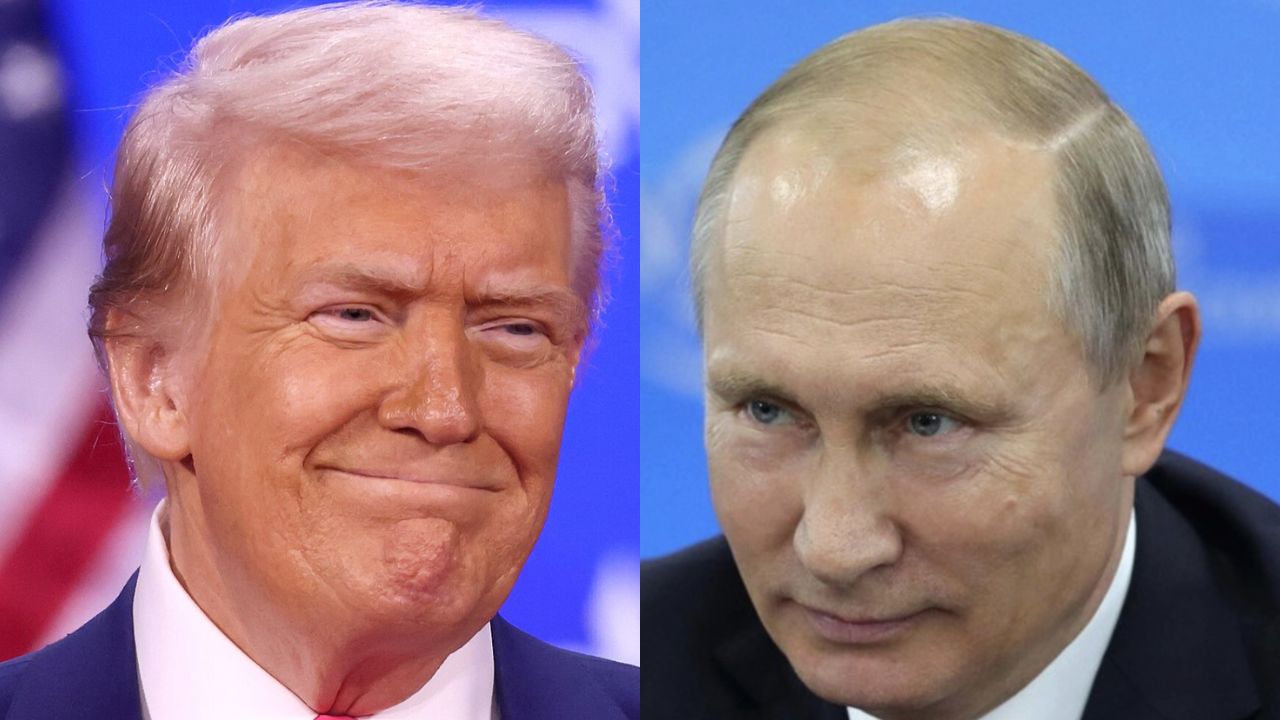
President Donald Trump announced Friday that Russia had agreed to supply millions of tons of diesel fuel to American and global markets, and the U.S. Treasury Department moved the same day to temporarily lift sanctions that had barred Russian fuel from the U.S. market. The announcement came as diesel prices sit near record highs, just weeks before the November 3 congressional elections that will decide control of Congress. It also landed while a Ukrainian delegation was in Washington discussing a path to ending Russia’s war.
Trump’s Announcement
In a Truth Social post Friday, Trump said he had “just concluded a highly successful discussion with President Vladimir Putin, of Russia,” in which it was agreed that Russia “will immediately supply over 300,000 Tons of Diesel Fuel to the American and Global Marketplace.”
Trump said another 500,000 tons would follow during November, and 1,000,000 tons “immediately thereafter.” He added that, “based on the condition of their Diesel Refineries,” Russia would then deliver 3,000,000 tons “within a short period of time.”
Trump tied the announcement to U.S. military operations in the Middle East. “Between our TOTAL CONTROL of the Strait of Hormuz, and this great announcement on Russian Energy, Diesel Prices for Americans and, indeed, the World, will be COMING DOWN, IN RECORD NUMBERS, AND FAST!” he wrote.
“Lower prices for Americans, especially our Great Farmers, Ranchers, and Truckers, is my Greatest Priority,” Trump said, calling it “a very big and important announcement.” He closed with a reference to the Iran war: “Additionally, it must be understood, that Iran will not have a Nuclear Weapon! Thank you for your attention to this matter.”
What the Numbers Mean
The first tranche of more than 300,000 metric tons equals about 2.25 million barrels of fuel. The United States exports roughly 1.5 million barrels of diesel per day, so the initial delivery is equivalent to about a day and a half of American export volume.
If every volume Trump listed were delivered, the total would reach 4.8 million tons, or roughly 36 million barrels at the same conversion rate. Trump gave no firm dates for the largest tranche, saying only that it would come “within a short period of time” and depend on the state of Russian refineries.
Markets responded immediately. U.S. diesel futures fell almost 5% after news of the deal and traded at $4.64 a gallon. Retail prices remain far higher: the average U.S. diesel price reached $6.28 a gallon on Thursday, according to the AAA motorist group, and diesel is up 70% since the United States and Israel launched the war with Iran on February 28.
Analysts said the agreement is unlikely to deliver sustained relief. “I cannot overstate how much of a nothing burger this is,” Rory Johnston, an oil market researcher and founder of CommodityContext.com, said on X, adding that Russia typically exports far more diesel than the volumes in the deal when its refineries are not under attack. Jim Mitchell, an analyst at consultancy Wood Mackenzie, called it “clearly not a fix, but another stream to aid a very tight diesel market.”
Treasury Issues a License for Russian Diesel
The Treasury Department’s Office of Foreign Assets Control (OFAC) issued General License No. 135 on Friday, authorizing transactions related to the sale, delivery, offloading and importation, including importation into the United States, of diesel fuel of Russian origin. The license covers transactions otherwise prohibited under the Russian Harmful Foreign Activities Sanctions Regulations and the Ukraine-/Russia-Related Sanctions Regulations. It runs through 12:01 a.m. eastern daylight time on April 7, 2027.
The license carries a limit. It does not authorize any debit to an account on the books of a U.S. financial institution of the Central Bank of the Russian Federation, the National Wealth Fund of the Russian Federation, or the Ministry of Finance. OFAC Director Bradley T. Smith signed the document, which is dated October 9, 2026.
A Reversal of Last Year’s Sanctions
The license eases measures imposed a year ago. On October 22, 2025, Treasury sanctioned Russia’s two largest oil companies, Rosneft and Lukoil, along with dozens of their subsidiaries, over Moscow’s refusal to pursue peace in Ukraine. “Given President Putin’s refusal to end this senseless war, Treasury is sanctioning Russia’s two largest oil companies that fund the Kremlin’s war machine,” Treasury Secretary Scott Bessent said at the time.
Those sanctions were designed to deprive Moscow of revenue for its war, which began in 2022. The diesel exports now authorized could provide Russia with billions of dollars in revenue that could help Putin continue the fighting.
The Kremlin welcomed the shift. After the call, Putin’s envoy Kirill Dmitriev praised cooperation between Russia and the United States in a post on X. Sources familiar with the situation said Dmitriev had asked U.S. officials during a visit to Washington last month to grant licenses to all major Russian oil firms to export diesel to the American market.
Zelenskiy and Congress Push Back
Ukrainian President Volodymyr Zelenskiy criticized the arrangement, which was announced while a Ukrainian delegation was in the United States to discuss how to seek a resolution of the war. He called it a “weak decision on the part of strong partners.”
“Gifts to Putin will not bring peace or any benefit to the civilized world,” Zelenskiy said on X. “Russia will ‘repay’ the diesel with further terror and perfidy.”
Criticism also came from Trump’s own party. Representative Don Bacon, a Republican, said Congress recently passed sanctions that should be applied, not lifted. “Now is the time to use those sanctions to squeeze Putin’s war machine, not reward a dictator by putting more money in his hands while he continues targeting and killing Ukrainian civilians,” Bacon said on X.
Hormuz, Refineries and a Global Fuel Squeeze
The deal arrives amid what has become a severe global fuel supply crunch. The Iran war began February 28, and Tehran responded to the opening U.S. and Israeli strikes by closing the Strait of Hormuz, the waterway that carries roughly a fifth of the world’s petroleum. Trump has repeatedly said the United States controls the strait. Iran has disputed that and says the waterway remains under its control.
The war in Ukraine has compounded the problem. Russian diesel refineries have been damaged by Ukrainian attacks, which is why Trump tied the largest promised volumes to the condition of those facilities. Russia is normally among the world’s most important diesel suppliers, and its reduced output has tightened supply further.
Prices have stayed high despite two recent moves by Trump to boost supplies. He pressured allies to release emergency reserves and expanded access to tax-exempt red-dyed diesel, which is normally used for farm equipment.
Midterm Stakes
Diesel powers agriculture, trucking and home heating, and its price is often a major driver of inflation. Prices near a record pose a political risk to Republicans, who hold thin control of Congress heading into the November 3 elections. Public opinion polls have shown the Iran war to be unpopular with voters, and the cost of living has emerged as a top electoral issue.
A Defense Production Act Directive Expected
Three industry sources said earlier Friday that Trump will issue a directive in the coming days instructing some department heads to find ways to control diesel prices. The directive could take the form of a presidential memo and would push officials to bypass local and state regulations that block energy production and use, and to invoke the Cold War-era Defense Production Act to increase output of oil and fuel.
Under the law, the president can authorize U.S.-backed loans or loan guarantees to expand domestic manufacturing of critical materials and can require companies to prioritize government contracts for essential goods. The White House has been weighing how to use it to expand refining capacity as the Iran war exposes U.S. vulnerability to supply disruptions and price spikes. Refining executives told administration officials last month that federal money would be better spent making existing refineries more efficient or expanding them than financing a new refinery, which would cost more and take years to complete.
What Comes Next
The Treasury license leaves the arrangement open through April 7, 2027, well past the midterm elections. How much Russian diesel actually reaches American and global markets, and how quickly, will determine whether the announcement moves prices beyond Friday’s futures dip. The Defense Production Act directive, the next round of Ukraine-related talks and conditions in the Strait of Hormuz are the next developments that will bear on fuel costs.