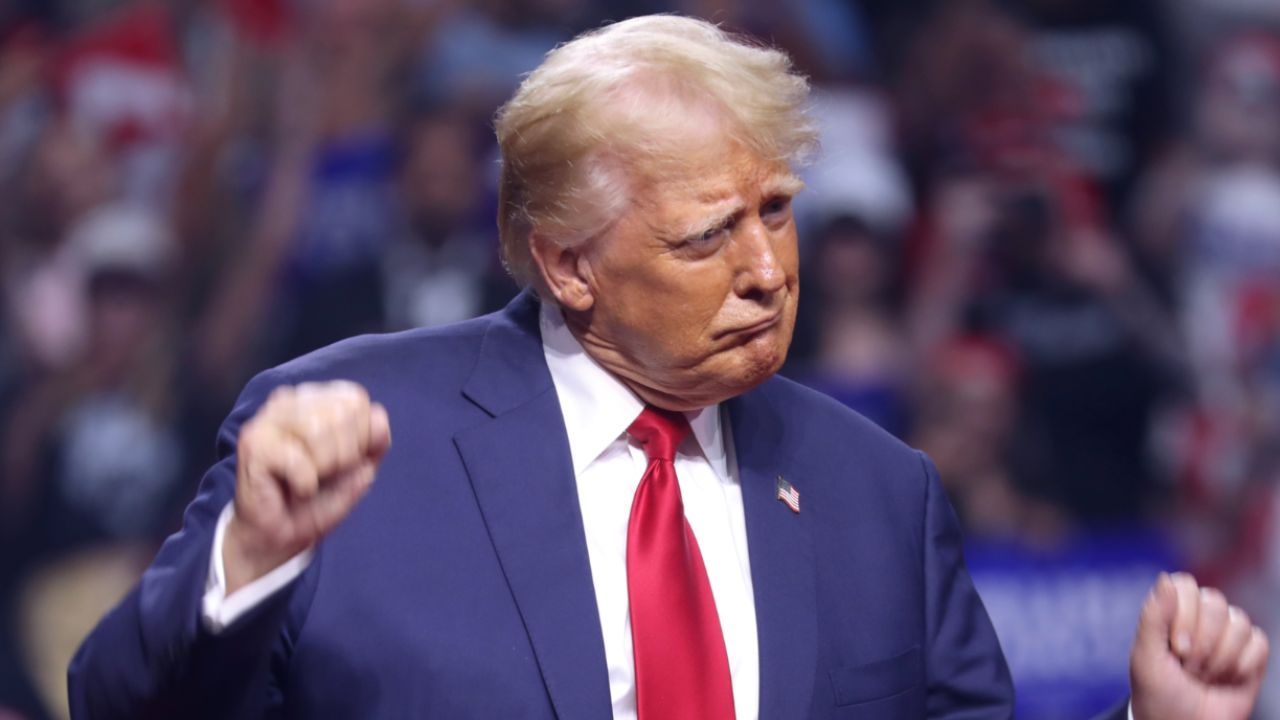
Trump Says Iran Wants A Deal “As Soon As Possible” As Oil Prices Plunge Nearly $10 A Barrel One Day Before Midterms — “There Will Not Be A War With Iran”

Trump Says Iran Wants A Deal “As Soon As Possible” As Oil Prices Plunge Nearly $10 A Barrel One Day Before Midterms — “There Will Not Be A War With Iran”

President Donald Trump on Monday claimed Iran is seeking an agreement to end the months-long conflict with the United States, pointing to a sharp decline in oil prices as evidence that markets are anticipating a diplomatic breakthrough. In a Truth Social post published November 2, Trump said oil had fallen nearly $10 a barrel and suggested an agreement with Tehran could be reached soon, even as reports of potential renewed military action after Tuesday’s midterm elections continue to raise questions about the future of the conflict.

Trump’s post read in full:

Oil Prices are DROPPING LIKE A ROCK, down almost $10 a Barrel, A RECORD, because people feel that there will not be a War with Iran. Iran wants a settlement, as soon as possible. It could happen! President DONALD J. TRUMP

November 2, 2026, at 2:46 p.m. ET

The president’s remarks came as international benchmark Brent crude experienced a significant decline during Monday’s trading session. Brent fell more than 8% to approximately $104 a barrel, its lowest level in four weeks, as optimism surrounding renewed negotiations reduced concerns about additional disruptions to Middle Eastern oil supplies. Earlier in the session, Brent had been trading closer to $112, while U.S. benchmark West Texas Intermediate crude fell to approximately $96 after approaching $103.

The decline followed indications that Iran’s leadership had authorized renewed diplomatic efforts. Iranian President Masoud Pezeshkian said Supreme Leader Mojtaba Khamenei had granted the government authority to pursue negotiations with Washington. The development followed two days of Qatar-mediated discussions involving representatives from both countries, with Iranian officials indicating that an agreement remained possible if commitments were implemented in practice. 

Trump also addressed the possibility of an agreement during remarks at the Lincoln Memorial Reflecting Pool in Washington on Monday, using his closing midterm-election message to highlight the decline in energy prices.

“Oil today is down $10,” Trump said.

“It’s going to go down a lot further because we’re winning with Iran, easily winning,” he added, claiming that the decline represented “the biggest drop in oil in history.” 

Trump’s Position on the Iran Conflict

Monday’s comments reflect Trump’s renewed emphasis on negotiations, although his public position throughout the conflict has included repeated declarations of military success, demands for Iranian concessions and threats of additional military action.

The conflict began on February 28, when the United States and Israel launched military strikes against Iran under the operation name Operation Epic Fury. In his initial announcement, Trump called for the Iranian people to take control of their government, describing the military campaign as an opportunity to change the country’s political future. He initially estimated that the operation could last approximately four to five weeks, although he subsequently acknowledged that military action could continue longer.

Throughout March, Trump repeatedly claimed that Iran’s military capabilities had been severely weakened while alternating between expressing confidence in negotiations and threatening further attacks. On March 23, he announced that he had instructed the Pentagon to postpone planned strikes against Iranian power plants and energy infrastructure for five days while diplomatic discussions continued. He described the conversations as productive and said the countries could ultimately reach a settlement, while warning that bombing would continue if negotiations failed. 

Trump’s willingness to pursue negotiations was accompanied by increasingly severe warnings directed at Tehran. In March and early April, he threatened Iranian power plants, oil infrastructure and the strategically important Kharg Island if Iran failed to meet U.S. demands and reopen the Strait of Hormuz. On April 4, he warned that Iran had 48 hours to reach an agreement or face further military action. The following day, he threatened attacks against Iranian power plants and bridges.

On April 7, Trump announced a two-week ceasefire, saying he had agreed to suspend U.S. bombing and attacks after discussions with Pakistani Prime Minister Shehbaz Sharif and military leader Asim Munir. Trump said the United States had already met and exceeded its military objectives and was close to reaching a long-term peace agreement with Iran. He also described an Iranian 10-point proposal as a workable basis for negotiations. 

The ceasefire subsequently became the basis for additional diplomatic efforts. In June, Washington and Tehran reached a 14-point memorandum of understanding that formalized the ceasefire, ended the U.S. naval blockade and reopened the Strait of Hormuz while establishing a 60-day negotiating period for a broader agreement. However, the framework ultimately collapsed, with the agreement expiring in August without a permanent settlement.

By July, Trump had again declared the ceasefire over and reinstated the blockade against Iran. His subsequent statements included additional threats against Iranian infrastructure and announcements of renewed economic pressure. On August 19, he described the administration’s sanctions campaign as the “MOST CRUSHING ECONOMIC OPERATION EVER TAKEN AGAINST ANY COUNTRY.” 

The administration also continued to leave the possibility of additional military action open. In a September 3 letter to congressional leaders, Trump disclosed that U.S. forces had conducted defensive strikes against Iranian targets on September 1 following attacks against American forces in late August. He said the strikes targeted Iranian military capabilities, including air defenses, naval assets and command-and-control infrastructure, and warned that American forces remained prepared to take further action if necessary. 

Renewed Diplomacy and Possible Post-Election Escalation

Despite Monday’s optimistic comments, the possibility of renewed military action remains unresolved. Reports surrounding Trump’s recent discussions with Israeli Prime Minister Benjamin Netanyahu indicate that Netanyahu has been pressing for a new U.S. air campaign against Iran following the November 3 midterm elections. Trump has not publicly committed to such an operation and has indicated a preference for allowing diplomatic efforts more time, while retaining the option of military action.

The potential timing of another escalation is particularly significant because the conflict has become a major factor in international energy markets. The Strait of Hormuz, through which a substantial share of global oil supplies normally passes, has experienced repeated disruptions during the conflict. Damage to regional energy infrastructure, restrictions on shipping and increased transportation costs have contributed to higher oil prices. Any renewed fighting could therefore reverse some of Monday’s market gains. 

Trump’s latest comments also came one day before Americans head to the polls in the November 3 midterm elections, with economic conditions and energy costs among the central issues facing voters. The average U.S. gasoline price stood at approximately $4.17 per gallon on Monday, around $1.13 higher than at the same time last year, adding to pressure on households already dealing with elevated transportation and living expenses. 

Political prediction markets were also heavily favoring Democrats to take control of the House of Representatives. On November 2, Polymarket placed the probability of Democratic control at approximately 95%, reflecting traders’ expectations rather than a confirmed election result. The forecast underscores the difficult political environment facing Republicans as the administration attempts to highlight falling oil prices and progress toward ending the conflict. 

For now, Trump is presenting the latest decline in oil prices as evidence that a diplomatic resolution with Iran may be approaching. However, with no permanent agreement announced, the previous ceasefire framework having collapsed and military options still under consideration, whether the latest negotiations produce a lasting end to the conflict remains uncertain.

Hillary Clinton Calls on Americans to Prepare for Potential Voting Problems as Trump Faces Democratic Challenge — Urges Americans to Save Election Protection Hotline, “It Is Everyone’s Right to See Their Vote Counted”

Former Secretary of State Hillary Clinton urged Americans on Monday to prepare for potential voting problems ahead of Tuesday’s midterm elections, emphasizing that every eligible voter has the right to have their ballot counted. Clinton encouraged Americans to save and share the number for the nonpartisan Election Protection hotline, which provides assistance to voters experiencing problems with registration, ballots or polling procedures. Her message comes one day before an election that could transfer control of Congress to Democrats, giving them greater authority to investigate President Donald Trump’s administration, scrutinize his Iran war and challenge aspects of his second-term agenda.  Clinton published the following message on X at 11:52 a.m. Monday: Millions of Americans will vote tomorrow, and it is everyone’s right to see their vote counted. Save and share the number for the free Election Protection hotline now in case you or your community end up needing it. The statement focuses on two distinct issues: the right of Americans to have their votes counted and the availability of assistance if voters encounter problems during the election process. Clinton’s instruction to save and distribute the hotline number suggests that she wants voters to prepare before problems occur rather than wait until Election Day to look for assistance. Unlike a direct candidate endorsement, the message centers on election administration, voter access and the protection of the ballot-counting process.  The hotline Clinton referenced is operated by Election Protection, a national nonpartisan coalition that provides information and assistance to voters. Its English-language number is 866-OUR-VOTE, or 866-687-8683, and voters can call or text the number with questions or concerns. The organization provides guidance on registration, absentee and mail voting, polling locations and other election-related issues. Its services are intended to help eligible voters understand the process and address difficulties that could interfere with their ability to cast a ballot.  Clinton’s emphasis on ensuring that votes are counted is consistent with her longstanding public position on voting rights. Her 2016 presidential campaign included a detailed voting-rights platform that called for restoring provisions of the Voting Rights Act, expanding early voting and making voter registration more accessible. The platform also proposed automatic voter registration for eligible Americans and supported restoring voting rights to people who had completed their criminal sentences. Those proposals established a documented record of advocating for expanded voting access and protections against restrictions on participation. Her concerns about democracy and voting rights have also become increasingly intertwined with her criticism of Trump. In a March 2025 appearance in Berlin, Clinton warned about what she described as a rise in autocracy, saying the United States had a government that had “thrown in its lot with the autocrats.” She also argued that the erosion of shared facts and public trust posed a threat to democracy. The remarks demonstrated that her concerns extended beyond individual voting procedures to broader questions about democratic institutions, political accountability and the credibility of public information.  Clinton continued that criticism in a June 18, 2026, interview with The New Yorker. Asked whether Trump and Trumpism represented a sustained threat of authoritarianism, she answered that she believed they did. She cited what she described as deliberate cruelty and an increasingly impulsive approach to governing, arguing that the president’s behavior was concerning. Her comments provide additional context for Monday’s election message, although her X post itself did not accuse the administration of manipulating ballots or claim that votes would not be counted.  Clinton has also raised concerns specifically about election oversight in the lead-up to the midterms. On October 7, she criticized the administration’s decision not to invite international election observers to monitor the 2026 midterm elections, describing the development as worrying and encouraging followers to participate in election-protection efforts. She wrote that “anxiety is not a strategy” and urged people to join an election-protection initiative. That message, like Monday’s hotline appeal, focused on preparing for potential election-related disputes rather than simply expressing concern about the political outcome.  Her public criticism of Trump’s second term has also included concerns about the administration’s relationship with the press and constitutional restrictions on executive power. In September, Clinton described Trump’s reported efforts to restrict certain news organizations’ access to the White House as “deeply disturbing.” She argued that excluding news organizations from covering the administration sent a troubling signal about press freedom. Her criticism reflected a broader concern about the independence of institutions that provide public oversight of government activity. 

Read More »

Michelle Obama Calls on Americans to “Change the Direction of This Country” — Urges Families, Friends and Neighbors to Get to the Polls, Says “Nothing’s Going to Change if You Don’t Vote”

Former first lady Michelle Obama issued an election-eve appeal to Americans on Monday, urging voters to mobilize their families, friends and neighbors ahead of Tuesday’s midterm elections, which could determine whether Republicans retain control of Congress during President Donald Trump’s second term. Obama emphasized that political change depends on participation at the ballot box, telling Americans that their communities and the country need every eligible voter to cast a ballot. Her message comes as Democrats enter Election Day with strong prospects of reclaiming the House of Representatives and a competitive opportunity to take control of the Senate, potentially giving them significant leverage over Trump’s remaining two years in office.  Obama published the following message on X at 8:39 a.m. Monday: This Election Day, you have the power to change the direction of this country. But nothing’s going to change if you don’t vote. So I want you to reach out to everyone you know. Help your family members make a plan to vote. Drive your neighbors to the polls. Text your friends until they show you their “I Voted” sticker. And if anybody gives you any attitude, tell them Michelle told you to vote!  Your community, your state, and our entire country needs every single one of you to cast a ballot on November 3. We’re counting on you! The message contains several distinct appeals, beginning with Obama’s assertion that voters have the ability to influence the country’s political direction. Rather than focusing on a particular candidate or explicitly criticizing Trump, she framed the election as an opportunity for Americans to exercise political influence through participation. Her warning that nothing will change without voting places responsibility on individual citizens to participate rather than assume political outcomes will change without their involvement.  Obama also called for voters to take an active role in mobilizing other people, specifically mentioning helping family members make voting plans, driving neighbors to polling places and encouraging friends to share evidence that they voted. The appeal goes beyond simply encouraging people to cast their own ballots, emphasizing community participation and efforts to increase turnout. Her closing statement, “We’re counting on you,” reinforces the collective nature of the appeal and places particular emphasis on participation in the November 3 election. The message is consistent with Obama’s longstanding involvement in national voter-registration and participation efforts. In 2018, she founded When We All Vote to encourage greater participation in elections, particularly among younger voters and communities historically less likely to participate. The organization describes its mission as increasing participation in every election, closing voting gaps and changing the culture surrounding voting. Obama remains one of its founding co-chairs.  Her involvement continued during the 2024 election cycle. On October 29, 2024, Obama headlined a When We All Vote rally in Atlanta, Georgia, where she addressed first-time voters and emphasized the consequences of sitting out an election. The organization’s announcement described the event as an effort to mobilize voters and encourage participation, with Obama’s remarks focused on the power of individual ballots and the responsibility people have to help their communities vote. That earlier campaign provides a direct precedent for Monday’s message, particularly her emphasis on mobilizing people beyond one’s immediate circle.  Her husband, former President Barack Obama, has also made voting and democratic participation central themes of his public statements ahead of the 2026 midterms. On April 29, he criticized a Supreme Court decision affecting the Voting Rights Act, arguing that it could allow state legislatures to weaken minority voting power through redistricting. He urged Americans to respond by mobilizing and voting in record numbers, emphasizing participation not only in the upcoming midterms but in elections at every level. His statement offers a parallel to Michelle Obama’s election-eve appeal, although the two have issued separate messages and spoken in their respective public capacities. 

Read More »

Trump Says Iran Wants A Deal “As Soon As Possible” As Oil Prices Plunge Nearly $10 A Barrel One Day Before Midterms — “There Will Not Be A War With Iran”

President Donald Trump on Monday claimed Iran is seeking an agreement to end the months-long conflict with the United States, pointing to a sharp decline in oil prices as evidence that markets are anticipating a diplomatic breakthrough. In a Truth Social post published November 2, Trump said oil had fallen nearly $10 a barrel and suggested an agreement with Tehran could be reached soon, even as reports of potential renewed military action after Tuesday’s midterm elections continue to raise questions about the future of the conflict. Trump’s post read in full: Oil Prices are DROPPING LIKE A ROCK, down almost $10 a Barrel, A RECORD, because people feel that there will not be a War with Iran. Iran wants a settlement, as soon as possible. It could happen! President DONALD J. TRUMP November 2, 2026, at 2:46 p.m. ET The president’s remarks came as international benchmark Brent crude experienced a significant decline during Monday’s trading session. Brent fell more than 8% to approximately $104 a barrel, its lowest level in four weeks, as optimism surrounding renewed negotiations reduced concerns about additional disruptions to Middle Eastern oil supplies. Earlier in the session, Brent had been trading closer to $112, while U.S. benchmark West Texas Intermediate crude fell to approximately $96 after approaching $103. The decline followed indications that Iran’s leadership had authorized renewed diplomatic efforts. Iranian President Masoud Pezeshkian said Supreme Leader Mojtaba Khamenei had granted the government authority to pursue negotiations with Washington. The development followed two days of Qatar-mediated discussions involving representatives from both countries, with Iranian officials indicating that an agreement remained possible if commitments were implemented in practice.  Trump also addressed the possibility of an agreement during remarks at the Lincoln Memorial Reflecting Pool in Washington on Monday, using his closing midterm-election message to highlight the decline in energy prices. “Oil today is down $10,” Trump said. “It’s going to go down a lot further because we’re winning with Iran, easily winning,” he added, claiming that the decline represented “the biggest drop in oil in history.”  Trump’s Position on the Iran Conflict

Read More »