
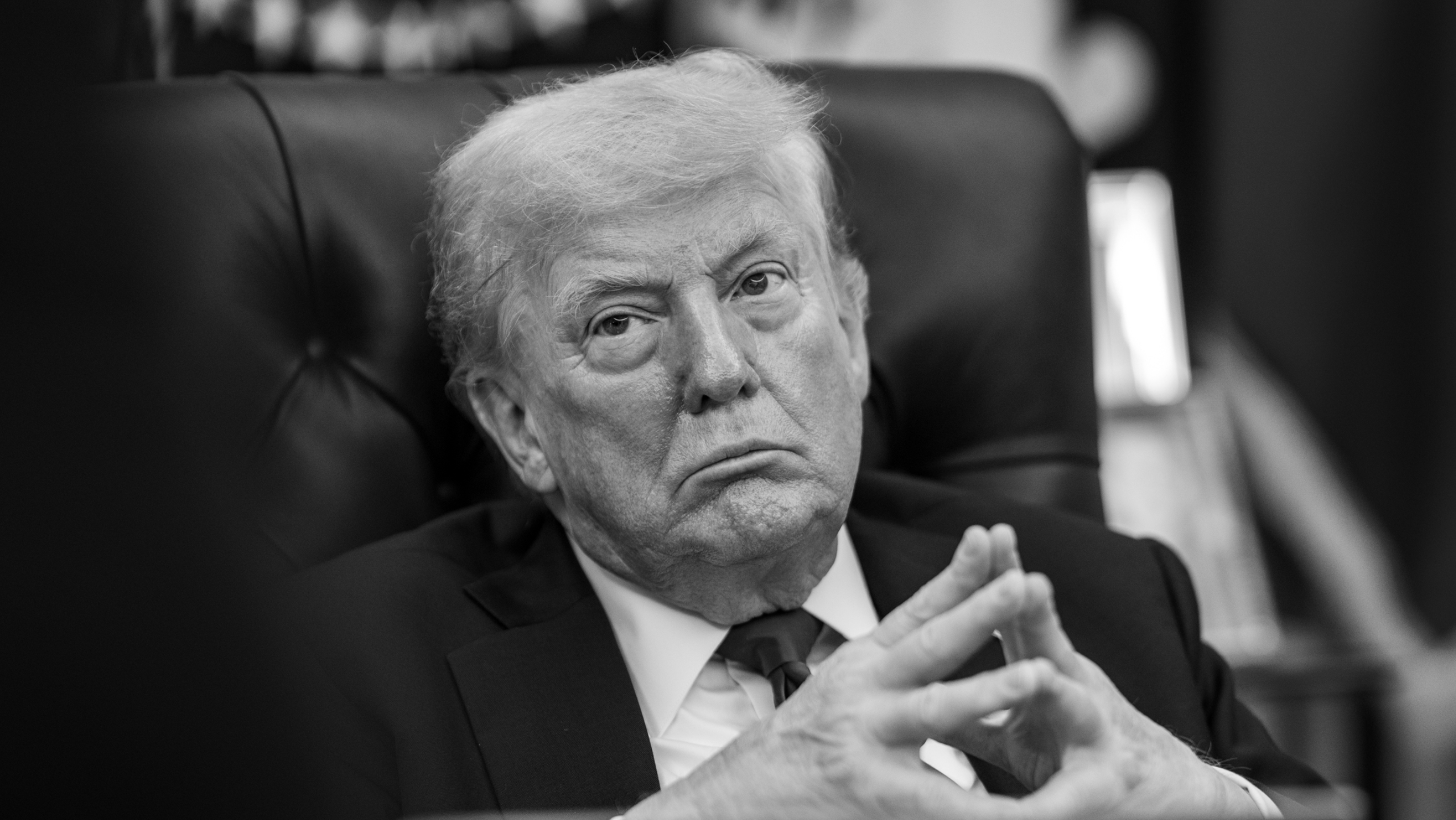
President Donald Trump pushed back forcefully on Monday against what he characterized as doubts about his strategy toward Iran, telling reporters at a White House maternal healthcare event that he possesses the best plan ever devised for dealing with the country — and that the plan itself is straightforward enough to be stated in a single sentence. The remarks came after a reporter asked about his rejection of Iran’s weekend response to a U.S. peace proposal, and Trump used the question as an opportunity to address what he described as widespread skepticism about whether he had any coherent direction at all.
“A lot of people said, well, does he have a plan?” Trump told reporters. “Of course I do, I have the best plan ever.” He did not treat the question as an insult so much as an opening, launching into an extended explanation of what he said the plan actually is and why, in his view, it is both obvious and non-negotiable. The core of it, he said, comes down to one principle: Iran cannot have a nuclear weapon.
Trump framed the simplicity of the plan not as a limitation but as a virtue. “Very simple plan,” he said. “I don’t know why you don’t say it like it is, Iran cannot have a nuclear weapon.” He went on to describe Iran as extremely dangerous and said the consequences of that country obtaining a nuclear weapon would be catastrophic, not just for the immediate region but potentially for Europe as well. “If they did have it, the Middle East would be gone, Israel would be gone and they would hit Europe probably next,” he said.
Central to his argument was a stark accounting of what he described as Iranian violence against its own people in recent months. Trump said Iran had killed 42,000 people over roughly the past month and a half, describing the victims as unarmed and nonviolent protesters who were shot in the streets. “They killed 42,000 people a month ago, month and a half ago,” he said. “They were unarmed protestors, not at all violent protestors and they started taking them out, shooting them. So we’re not going to let them.” The death toll figures, he added, represent only what is known, suggesting the actual number could be higher.
Trump also defended the naval blockade as a deliberate and strategically sound component of the broader effort, comparing it favorably to what he described as the military genius behind the U.S. operation in Venezuela. “The blockades first of all was a part of military genius just like Venezuela was military genius,” he said. That reference pointed directly to Operation Absolute Resolve, the January 3, 2026 mission in which U.S. special operations forces captured Venezuelan President Nicolás Maduro and his wife, Cilia Flores, in Caracas. Executed in under three hours with no U.S. casualties and involving more than 150 aircraft, the operation was held up by the Trump administration as a demonstration of what precise, decisive American military action looks like when properly executed.
His invocation of Venezuela was not incidental. It was part of a broader pattern Trump outlined of confronting adversarial governments that he views as threats to American interests or regional stability. He described Iran’s military as effectively destroyed, saying the country’s fleet of 159 ships had been reduced to zero, that it no longer has an Air Force, no functioning anti-aircraft systems, and no radar to speak of. “Their leaders have been killed at the first level, second level and half of the third level,” he said. Despite that, he expressed frustration that Iran’s remaining leadership was still attempting to negotiate from a position he viewed as entirely untenable given the military situation.
The reference Trump made to 47 years carried specific historical weight. The Islamic Republic of Iran was established following the 1979 revolution, meaning the regime has been in place for 47 years — a period during which it has repeatedly and publicly proclaimed hostility toward the United States and Israel, with chants of death to America becoming a defining feature of official state rhetoric throughout that span. Trump made clear that, in his view, the length of that history only reinforced the urgency of the current moment. “This has gone on for 47 years,” he said. “Other countries have the power but they didn’t do it.”
That last remark was pointed. Trump was suggesting that previous administrations and allied governments had possessed the means to prevent Iran from advancing toward nuclear capability but had chosen not to act, leaving the problem to compound over decades. He returned to the Obama-era nuclear deal, which he terminated during his first term, as the clearest example of what he described as a catastrophic failure of judgment by a predecessor. “When I terminated the worst deal ever made in the history of our country,” he said, referring to the agreement negotiated by the Obama administration, he had stopped Iran from reaching a threshold it would otherwise have crossed years ago.
Trump’s description of the military campaign itself was detailed and confident. He spoke about precision strikes carried out at one in the morning with no moonlight, describing pilots hitting every target inside granite mountains at depths that left the destroyed sites effectively unrecoverable. He recounted Iranian officials telling U.S. counterparts that the nuclear sites had been so thoroughly obliterated that only the United States and China possessed the equipment necessary to extract whatever remained. The account was offered as evidence that the military dimension of the plan had already been executed successfully, leaving the remaining question as purely diplomatic — whether Iran would agree to a verifiable, permanent renunciation of nuclear weapons.
Flexibility, Trump added, was also part of the plan, even if the core objective was fixed. “The more you have to change, be flexible,” he said. “You have to do different plans in different things but the plan is they cannot have a nuclear weapon and they didn’t say that in their letter.” Iran’s failure to include that guarantee in its weekend response was, in Trump’s telling, the reason the proposal was unacceptable and why the diplomatic process remained at an impasse. As far as he was concerned, everything else was negotiable. That one condition was not.