
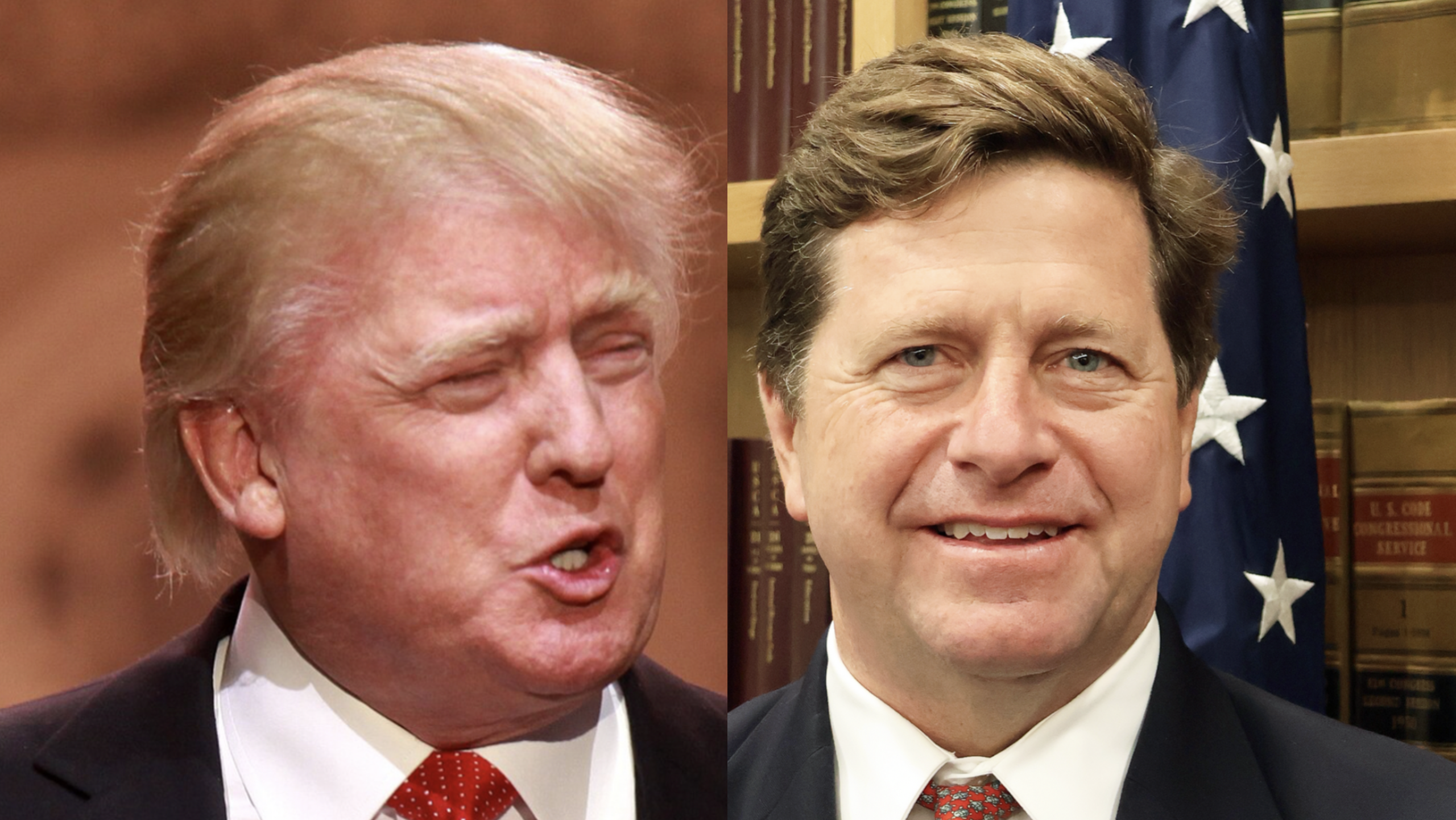
President Donald Trump on Thursday nominated Jay Clayton — the top federal prosecutor in Manhattan and former chairman of the Securities and Exchange Commission — to serve as the next Director of National Intelligence, a nomination that immediately drew bipartisan praise but arrived too late to prevent a major national security surveillance program from lapsing at midnight Friday.
Trump announced the move in a midday Truth Social post, calling Clayton one of the most respected figures in the American legal community and urging the Senate to act without delay. “I am pleased to announce the Nomination of very Highly Respected Jay Clayton, former Chairman of the Securities and Exchange Commission, the former Head of Sullivan & Cromwell, one of the most prominent and successful Law Firms anywhere in the World, and the current United States Attorney for the Southern District of New York, to be the next Director of National Intelligence,” Trump wrote. “Few people anywhere in the Legal Community are respected at the level of Jay. I encourage the United States Senate to confirm Jay as soon as possible.”
A High-Profile Pick to Lead 18 Intelligence Agencies
The DNI nomination places Clayton at the top of the United States intelligence community, a sprawling apparatus that oversees all 18 federal intelligence agencies — including the CIA, NSA, DIA, and the broader network of agencies responsible for the nation’s foreign and domestic threat assessments. The position was created by law in the aftermath of the September 11, 2001 attacks specifically to unify intelligence oversight and require a nominee with demonstrated national security credentials.
Clayton, 59, has spent his career in finance and law rather than intelligence. He began his legal career as a law clerk at the U.S. District Court for the Eastern District of Pennsylvania in 1993 before joining the global law firm Sullivan & Cromwell in 1995, where he rose from associate to partner. During Trump’s first term, he served as SEC chairman from 2017 to 2020, where he developed a reputation as a political moderate who sought consensus across party lines. Clayton was confirmed as the U.S. Attorney for Manhattan in August 2025. The Southern District of New York is widely considered one of the most prestigious and high-profile prosecutorial offices in the country.
The Pulte Problem: A Loyalist Without a Clearance
The Clayton nomination comes directly out of a political firestorm that erupted after Trump appointed Bill Pulte — the 38-year-old director of the Federal Housing Finance Agency — as acting DNI to temporarily fill the vacancy left by Tulsi Gabbard’s departure. Pulte’s appointment roiled congressional negotiations around Section 702 of the Foreign Intelligence Surveillance Act, one of the nation’s most important surveillance tools. Pulte was appointed despite having no experience in national security, and his selection drew concerns from Democrats about the risk of sensitive intelligence being weaponized against the president’s perceived political rivals.
Democrats demanded Pulte’s immediate removal as a condition for renewing FISA Section 702, and Senate Minority Leader Chuck Schumer drew a hard line. “Pulte has to go. He cannot be in the DNI role. Our national security is too important,” Schumer told reporters. Democrats also raised alarm after Trump said last week that Pulte “may find out some things about the rigged elections,” and pointed to Pulte’s earlier use of confidential mortgage data to push fraud investigations against political figures including New York Attorney General Letitia James and U.S. Senator Adam Schiff — none of which resulted in criminal charges.
The CIA Director’s Recommendation
According to a person familiar with the matter who spoke to Reuters on condition of anonymity, it was CIA Director John Ratcliffe who recommended Clayton to Trump as Gabbard’s permanent replacement after the president asked him who should take over from her. Trump confirmed to reporters Thursday that Pulte’s stint as acting DNI would be brief. “He’s only there for a little while, he’s running it for a short while, while we get a very talented person, Jay Clayton,” Trump said. Pulte will remain in the interim DNI role — while simultaneously continuing as Federal Housing Finance Agency director — until Clayton is confirmed, overseeing personnel cuts the president has ordered within the intelligence community.
Senate Moves Quickly — But Not Quickly Enough
The Senate responded to Trump’s announcement with unusual speed. The Senate Select Committee on Intelligence announced a June 17 confirmation hearing the same day as Trump’s post, and Senate Majority Leader John Thune told reporters the chamber would “move quickly” once it received Clayton’s nomination paperwork from the White House. Lawmakers on both sides of the aisle expressed support for the pick. Sen. Tim Scott of South Carolina, who previously voted to confirm Clayton to lead the SEC, called it an “excellent choice” citing his experience, judgment, and resolve. Sen. Thom Tillis of North Carolina called the selection “outstanding,” writing that Clayton is “a proven leader with a distinguished record of public service and sound judgment needed to lead our intelligence community.”
But Senate Intelligence Committee Vice Chairman Mark Warner of Virginia — while calling Clayton “a capable public servant” — questioned why Trump waited until after the House had already voted and left Washington before making the announcement. “Why he waited until after the House broke, I have no idea,” Warner said. “If there was any level of serious concern about this in the White House, the House has already left town.”
FISA Section 702 Expires Amid the Standoff
The deeper national security consequence of Thursday’s timeline is the expiration of Section 702 of the Foreign Intelligence Surveillance Act. The House rejected the three-week extension in a 198–218 vote, with 19 privacy-conscious House Republicans joining most Democrats in voting against it, and both chambers of Congress left Washington. Section 702 is a cornerstone surveillance authority that allows U.S. intelligence agencies to collect — without judicial warrants — the texts, emails, and phone data of foreign nationals believed to be located abroad, storing that data in a massive shared intelligence database.
A lapse in FISA Section 702 authorization does not necessarily create an immediate national security gap, since the FISA Court approved a year-long certification in March. Even without congressional reauthorization, intelligence agencies can still legally collect the metadata of foreign nationals without a warrant until March 2027. However, a lapse could cause confusion for communications providers or potentially slow federal surveillance operations, even as millions of international travelers enter the U.S. to attend the 2026 World Cup tournament.
Democrats Hold the Line on Pulte
Despite Clayton’s nomination generating goodwill, top Democrats made clear Thursday that the Pulte situation remains a separate and non-negotiable demand before any FISA renewal vote can move forward. Warner issued a statement saying that either Gabbard must remain in place or the administration must designate a Senate-confirmed official as acting DNI through any transition — and that anything short of that guarantee would keep Democrats from providing the votes needed for FISA reauthorization. Senate Republicans hold a 53–47 majority but need at least seven Democratic votes to clear the 60-vote threshold required to advance the legislation.
Clayton’s Profile: Finance, Law, and High-Stakes Prosecution
Clayton brings a formidable legal resume to the nomination, even if it lacks a traditional intelligence pedigree. As U.S. Attorney for the Southern District of New York, he has overseen some of the highest-profile federal prosecutions in the country. Among the most prominent was the drug trafficking case against former Venezuelan leader Nicolás Maduro, who was captured by American forces in Caracas in early January. The office is also currently pursuing investigations into suspicious trades in oil and prediction markets timed to government actions against Iran.
During his tenure at the SEC under Trump’s first term, Clayton was known for taking a consensus-oriented approach and working constructively with Democratic commissioners — a disposition that has drawn bipartisan goodwill even now. Reuters previously reported in November 2024 that during transition discussions for the second Trump term, Clayton had expressed interest in running the CIA. He ultimately landed at the SDNY before being elevated to this latest, far broader role.
What Comes Next
Clayton will remain Manhattan U.S. Attorney until his Senate confirmation is complete, according to a Justice Department spokesperson. His confirmation hearing before the Senate Intelligence Committee is scheduled for June 17. On average, it has taken multiple months for the U.S. Senate to confirm cabinet-level nominees during past presidential administrations. In the interim, the intelligence community faces the uncertainty of Pulte’s acting leadership and an expired surveillance authority — a dual pressure point that will hang over Washington as lawmakers return from recess on June 23 and the Clayton confirmation process gets formally underway.