

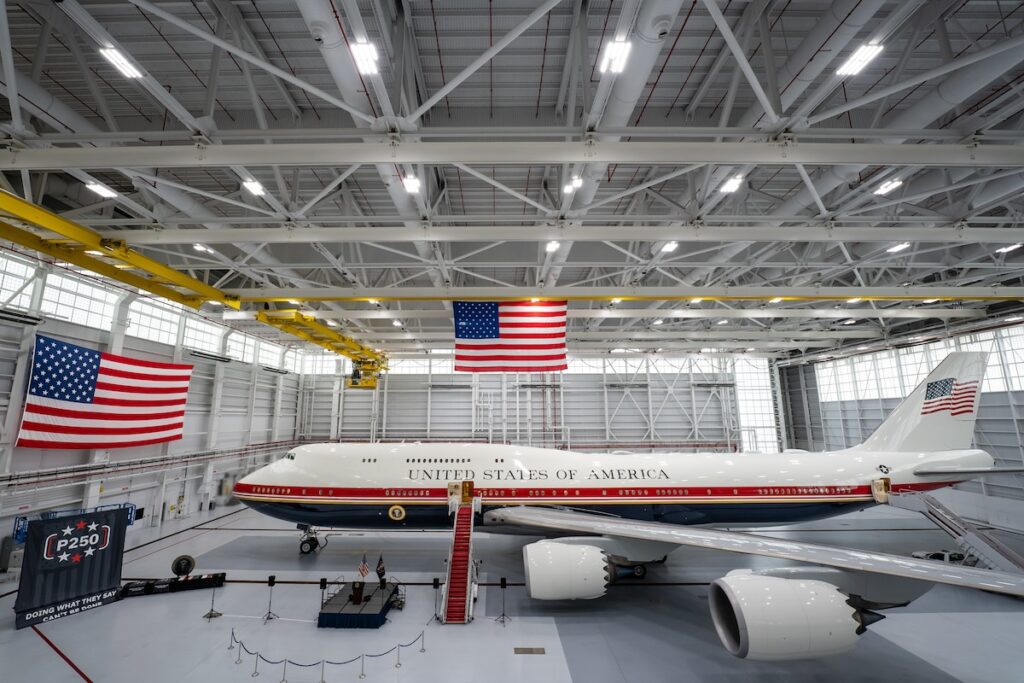
President Donald Trump explained during his remarks unveiling the new Air Force One at Joint Base Andrews on Friday that he personally asked Qatar’s Amir for use of the country’s newly built 747 because the existing presidential fleet had grown too old, telling the crowd that “a normal president wouldn’t do this” but that the United States needed to be “represented properly” given its military and economic standing.
“A Normal President Wouldn’t Do This”
Trump described the circumstances that led him to seek use of the Qatari aircraft, framing the decision as a departure from how previous presidents had typically approached the question of presidential air travel. “We were waiting for — I call them the normal 747s — and I asked the Amir if we could use the brand new 747 that he got,” Trump said. “When we first heard about 800 hours — 800 hours for an airplane is essentially — I think Troy you could say that’s a brand new plane. And I said we’d like to use it for a little while because the planes are pretty old. Our planes are old.”
He acknowledged that his approach broke from precedent. “See, a normal president wouldn’t do this. A normal president wants to stay away from aircraft. We don’t want to order any aircraft so that everybody thinks — but our country has to be represented properly,” Trump said. “That includes — we have the greatest military in the world. We have the greatest aircraft anywhere in the world. Military fighters and bombers and the B2 bomber. You saw what that did.”
A Plane Ordered Years Ago, Still Not Delivered
Trump connected his decision to the long-delayed delivery of the permanent VC-25B aircraft Boeing has been contracted to build. “And we should have a plane and we’re going to have — as you know we ordered two for a long time ago. They ordered and they’re coming in,” Trump said. “And the hangar was built for the large plane. The other plane is such a difference in size. But there will never be one like this. This is very unique. This is considered the world’s most luxurious plane when it was built. It was built at a level that will probably never be seen again.”
A Decade of Delays
The remarks reflect a long-running dynamic in the Air Force One replacement program. Boeing’s contract to build two new VC-25B aircraft has faced years of delay, with deliveries originally targeted for 2024 now expected no earlier than 2028. Plans to replace the current Air Force One aging planes with two new VC-25B aircraft have been in effect for about a decade, but a lack of properly cleared workers and supply chain issues caused the plans, originally scheduled for a 2024 delivery, to be delayed.
With the long-term replacement program still years from completion and the existing VC-25A fleet showing signs of age after more than three decades of service, the Air Force pursued the Qatari aircraft as an interim solution. With the Boeing VC-25B deliveries delayed past its initial 2024 target and VC-25A heavy maintenance cycles extending, an interim capability became an absolute imperative, according to the Air Force’s own description of the program’s rationale.
The Aging Fleet’s Final Flight
The aircraft Trump’s remarks referenced as “pretty old” had been in continuous presidential service since 1990. Trump’s return from the G7 summit earlier this month was the last planned trip aboard the VC-25A, the modified Boeing 747-200 that has flown American presidents for more than three decades. Over its lifetime, that aircraft traveled to 96 countries on 223 international trips and flew over six million miles, according to figures Trump cited during his remarks.
The reliability of the aging fleet had also come under scrutiny in recent months. Earlier this year, Air Force One was forced to turn back during a trip to Davos, with the White House citing a “minor electrical issue,” and Trump subsequently flew on a smaller aircraft, suggesting the second VC-25A was unavailable at the time.
Qatar’s Role in Closing the Gap
The aircraft now serving as the interim Air Force One originated as a luxury 747-8 built for Qatar’s royal family, delivered to Qatar Amiri Flight in 2012. Trump thanked Qatar’s leadership directly during his remarks for making the aircraft available, describing the Amir, Sheikh Tamim bin Hamad Al Thani, as having been generous in providing the jet at a moment when the U.S. fleet faced what Trump called “a little bit of a log jam.”
The Pentagon formally accepted the aircraft as a gift from the Qatari government, after which it underwent a roughly ten-month retrofit process led by the Air Force in partnership with Boeing and L3Harris to install secure communications, defensive systems and other modifications required for presidential use.
Framing the Decision Around National Image
Trump’s remarks tied the decision to use the Qatari jet to a broader argument about how the United States projects strength abroad, an argument he extended in other parts of his speech when describing the new aircraft’s size and capability relative to other world leaders’ jets. He argued that allowing the presidential fleet to fall behind in age and capability did not reflect the country’s military and economic standing, pointing to the United States’ defense capabilities, including its fighter and bomber fleets, as part of the same rationale.
What Comes Next for the Fleet
With the interim aircraft now beginning its commissioning process, the Air Force has said both the Qatari-origin jet and the remaining VC-25A aircraft will remain available for use, with the Presidential Airlift Group selecting the appropriate aircraft for each mission based on operational requirements. The long-term VC-25B aircraft Trump referenced as having been “ordered a long time ago” remain under development, with delivery still projected for 2028 at the earliest.