
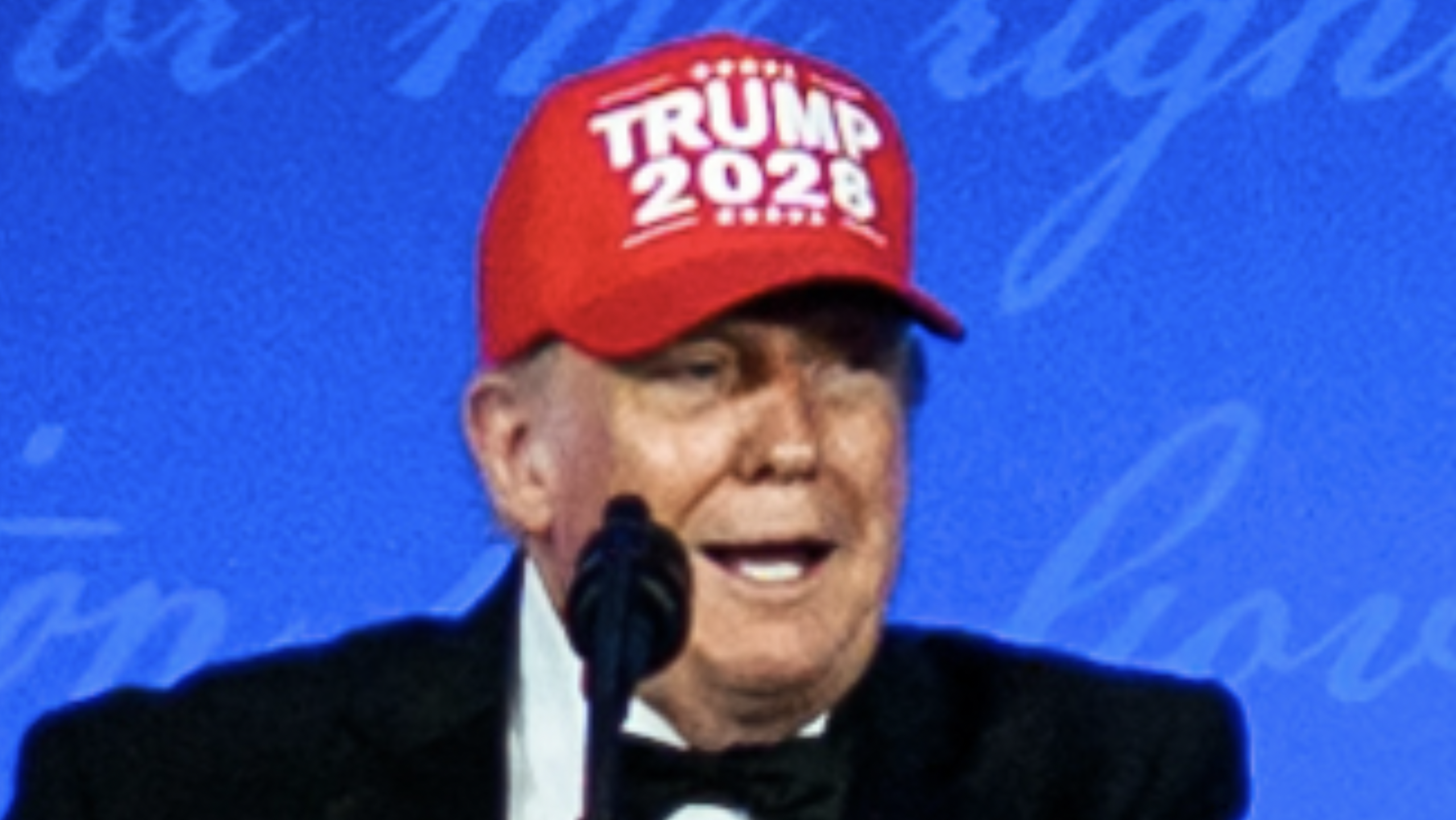
President Donald Trump told a crowd at General Motors’ Milford Proving Ground on Monday that he is “a little bit upset” at the prospect that someone else could be sitting in the Oval Office in two and a half years, framing the transition with a word he emphasized on its own: “may.”
“I’m a little bit upset because in two and a half years you may have a different president, may, and that president will be saying how great the economy is,” Trump said, going on to complain that a successor would take credit for factories he said are being built at a record pace. “I got some guy or woman who is going to take credit for that. Will you please remember that I did it, okay.”
The remark came just three days after Trump made his most direct public statement to date about seeking a fourth term in office, telling a ballroom of journalists at the White House Correspondents’ Association Dinner on Friday that he intends “to run for a fourth term as president of the United States.” At that event, held at the Waldorf Astoria in Washington, Trump pulled a red “Trump 2028” hat onto his head and told the crowd, “I won three times. Now I’m going to do it again.”
Under the Constitution, no individual may be elected president more than twice. The 22nd Amendment, ratified in 1951 following Franklin D. Roosevelt’s four consecutive election wins, states plainly that “no person shall be elected to the office of the President more than twice.” Trump has been elected twice, in 2016 and 2024, after losing the 2020 election to Joe Biden — a loss he has continued to describe, without evidence accepted by courts or election officials, as having actually been a win.
Legal scholars across the political spectrum have largely dismissed theories that would allow Trump to serve beyond two elected terms. Yale Law School’s Akhil Reed Amar has noted that even under a reading of the amendment focused narrowly on the word “elected,” the 12th Amendment would independently bar Trump from serving as a running mate’s vice president, since it disqualifies anyone constitutionally ineligible to be president from also being vice president. Harvard’s Laurence Tribe has said he does not believe even a Trump-shaped Supreme Court would uphold a third term, predicting the court would rule unanimously that the amendment “means what it was intended to mean.”
Monday’s “may” comment fits a pattern of ambiguous signaling Trump has employed on the subject for more than a year. In October 2025, aboard Air Force One during a tour of Asia, Trump appeared to rule out a third term altogether, telling reporters, “if you read it, it’s pretty clear I’m not allowed to run,” while floating a Vance-Rubio ticket for 2028. That statement followed months of the opposite posture: in a March 2025 interview with NBC News, Trump said “there are methods” by which he could serve a third term, and fact-checkers who examined the theory at the time found legal experts describing it as “implausible.”
The idea resurfaced again in December 2025, when the Wall Street Journal reported Trump had discussed with attorney Alan Dershowitz a draft book examining whether a third term was constitutionally possible, with Dershowitz reportedly telling Trump the Constitution was “not clear” on the matter. Around the same period, Tennessee Republican Rep. Andy Ogles introduced a resolution to amend the 22nd Amendment specifically to permit Trump to seek a third term — a change that would require two-thirds majorities in both chambers of Congress and ratification by three-quarters of state legislatures, a bar cleared only 27 times in American history.
House Speaker Mike Johnson has previously characterized Trump’s third-term talk as a form of political trolling rather than a genuine legal strategy, saying he has discussed “the constrictions of the Constitution” with Trump directly and does not “see the path” to a third term, while noting Trump “has a good time with that trolling the Democrats, whose hair is on fire by the very prospect.”
Monday’s remarks in Milford did not repeat the explicit “fourth term” language from Friday’s Correspondents’ Dinner speech, instead framing the same underlying idea more obliquely — through the conditional word “may” rather than a direct assertion. The rhetorical shift left open the same ambiguity that has characterized Trump’s comments on the subject since well before his second inauguration: whether the remarks reflect a genuine intention to test the constitutional limit on presidential terms, or a recurring rhetorical device aimed at needling political opponents.
No sitting president has served more than two terms since the 22nd Amendment took effect in 1951. Any attempt by Trump to appear on a ballot for a third or fourth term would almost certainly draw immediate legal challenges from state election officials, who determine ballot eligibility under both state and federal law, as well as scrutiny from a legal community that has so far shown little appetite for the theories floated in support of an extended presidency.
The economic boasts that accompanied Monday’s remark — record factory construction, a “blowing away” of his first-term economic record, and 401(k) growth Trump pegged at over $32,000 per account — could not be independently verified against Monday’s speech alone, though Trump has made similar claims about manufacturing investment and market performance throughout the summer.