
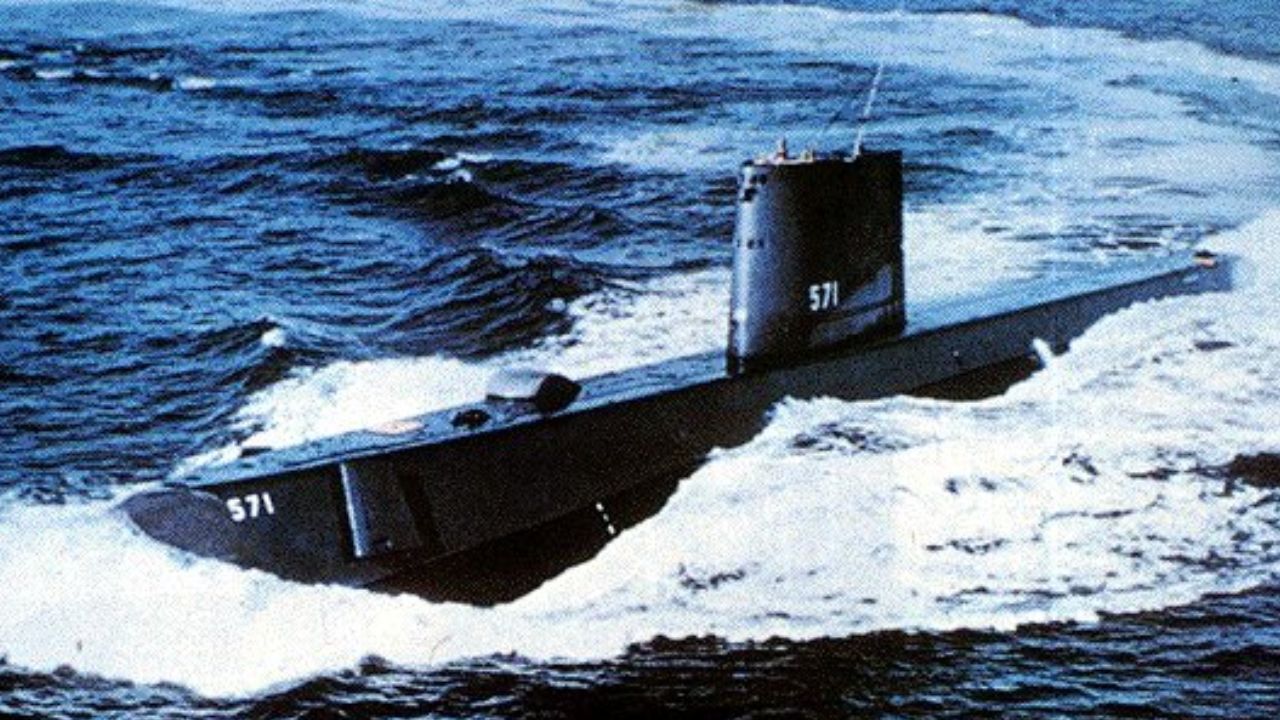
Some naval platforms arrive as incremental upgrades. Others reset the baseline so abruptly that everything before them feels like a different era. The U.S. Navy’s USS Nautilus (SSN-571) belongs to that second category: widely credited as the first nuclear-powered submarine to enter service, and the boat that proved nuclear propulsion at sea was not a science project but an operational reality. The U.S. Navy Naval History and Heritage Command (NHHC) treats Nautilus as the spearpoint of the nuclear submarine era, a view echoed in overviews from the Smithsonian and Guinness.
What made the shift feel “overnight” to mid-1950s submariners wasn’t a single gadget—it was the way nuclear power rewrote the endurance equation. A submarine’s ability to stay submerged was no longer fundamentally tied to battery capacity and access to air. Diesel-electric boats could be highly effective, but sustained underwater speed and persistence came with a built-in penalty: the need to recharge, and the tactical exposure that often accompanied snorkeling or surfacing. Nautilus changed the rules by removing that propulsion constraint as the defining limit.
USS Nautilus (SSN-571) — “first nuclear-powered submarine” as the centerpiece system
Nautilus was built to prove nuclear propulsion at sea, and it did so decisively. NHHC’s historical overview credits it as the first nuclear-powered submarine to enter service, a status also supported by the Smithsonian and Guinness. The “first” is significant not as trivia, but as a boundary line between two operating concepts: submarines that could only temporarily live underwater, and submarines that could treat submergence as their default condition.
That distinction is often oversimplified as “making every diesel boat obsolete.” The more accurate claim needs tighter limits. As a modern U.S. Naval Institute (USNI) discussion emphasizes, diesel-electric submarines remained—and remain—valuable for cost-effective, coastal, and shallow-water roles, and later gained additional persistence through technologies like AIP. What Nautilus outclassed was the diesel-battery paradigm for 1950s blue-water missions that demanded sustained speed and endurance while fully submerged.
“Underway on nuclear power” (first run) + commissioning date (key narrative beat)
The most important early milestone wasn’t a wartime engagement; it was the moment Nautilus first operated at sea propelled by nuclear power. That was the point where the old endurance model—submerged until the batteries forced a recharge cycle—stopped being the defining framework. Smithsonian’s treatment provides the reactor designation and performance context, and NHHC documents the early record-setting submerged cruising that made the change tangible. Wikipedia is commonly used as a secondary check on the commissioning timeline, but the operational meaning comes through most clearly in Navy history and museum-grade summaries.
Writers also need precision with the language around this milestone. The phrase “Underway on nuclear power” is strongly associated with the Nautilus story, but it should not be presented as a verbatim quote without primary-style confirmation. USNI’s historical treatment of Nautilus development is a more appropriate environment for technical-history phrasing. The narrative does not require quotation marks to land the point: the submarine’s endurance was no longer defined by its need to access air.
S2W reactor / STR (Westinghouse) — the enabling technology
Nautilus was more than a new hull form; it was a propulsion breakthrough built around a specific early pressurized-water reactor plant. Smithsonian identifies the reactor as S2W and provides performance context, while Wikipedia’s S2W reactor entry supports the designation lineage—STR redesignated as S2W—and the Westinghouse attribution. In operational terms, this was the “engine that ended snorkeling” as a routine requirement for propulsion endurance.
That said, nuclear propulsion should be described with discipline. “Nuclear-powered” does not mean “literally unlimited.” The technical reality, consistent with USNI’s framing, is that nuclear propulsion removes the fuel-and-air constraint that defines diesel-electric endurance at speed, but submarines still face limits from food, maintenance, and crew endurance. The revolution was not infinite endurance; it was the ability to sustain submerged operations without the periodic exposure built into the battery-recharge cycle.
1955 record submerged endurance run (1,381 miles in ~90 hours) — concrete proof point vs diesel limits
Capability becomes hard to dismiss when it is measured, and NHHC provides one of the clearest early data points. In 1955, Nautilus conducted a submerged endurance run of 1,381 miles in 89.8 hours. Guinness repeats the record in both kilometers and miles, reinforcing that this was recognized beyond internal Navy reporting. For the era, the message was straightforward: a submarine could cover long distances underwater for days while retaining freedom from the surface.
The comparison still needs to be framed carefully. This run does not, by itself, numerically prove superiority over all diesel submarines under all conditions—battery state, speed, and whether snorkeling is permitted all matter. But it works as a clean contrast with the operational compromises typical of the period: slower submerged movement to conserve battery power, and recurring exposure to recharge.
Operation Sunshine / under-ice transit to the North Pole (3 Aug 1958) — the “impossible mission” moment
If the 1955 endurance run supplied the proof, the 1958 Arctic voyage delivered the defining demonstration. NHHC records Nautilus’s 1958 under-pole voyage and return, and the Department of Energy/NNSA Naval Nuclear Propulsion Program summary confirms the central fact: the submarine reached the geographic North Pole on August 3, 1958. The Eisenhower Library likewise summarizes the under-ice feat, reflecting how quickly it became a national-level event as well as a Navy milestone.
Under-ice operations also make the propulsion advantage tangible. When the surface can be inaccessible, a submarine that must surface or snorkel to recharge is structurally constrained by geography and timing. Nuclear propulsion reduces that specific vulnerability by allowing long-duration submerged movement without the recharge cycle as an operational driver. Some summaries also include additional distance figures—“1,830 miles under ice” appears in some tellings—and any single distance/time detail should be tied to one named source rather than blended into an unsourced superlative.
Diesel-electric “Achilles’ heels” (endurance, charging, speed) — define what “obsolete” means
To justify the claim that Nautilus changed undersea warfare “overnight,” the article has to define what changed in the tactical math. USNI’s 1970 Proceedings discussion contrasts pre-nuclear performance limits and describes how nuclear propulsion enabled high-speed, deep-submerged operations that non-nuclear boats struggled to sustain. A CRS-derived summary captured in the context makes the same point in plain terms: at high submerged speeds, endurance for non-nuclear submarines could be measured in hours because it was battery-limited.
That is the defensible meaning of “obsolete” in this story: mission-specific strategic outclassing, not universal irrelevance. In the 1950s blue-water context—pursuit, evasion, and long transits while remaining submerged—the diesel-electric model was disadvantaged against a platform that could stay down and keep moving without exposing itself to recharge. USNI’s modern perspective remains important: today’s diesel-electrics, particularly with AIP and other advances, are not universally obsolete. The break described here is anchored to the fleet-boat/snorkel-boat era and the demands of sustained submerged speed and endurance.
Admiral Hyman G. Rickover + Electric Boat (Groton) — the people/industrial ecosystem behind the leap
Revolutions in military capability require more than an idea; they require leadership, standards, and an industrial base capable of delivering. Admiral Hyman G. Rickover’s role is inseparable from how the U.S. Navy moved nuclear propulsion from concept to fleet reality, enforcing the rigor and program discipline early nuclear operations demanded. The industrial ecosystem mattered as well: Electric Boat in Groton was part of the practical foundation that turned an ambitious propulsion concept into an operational warship.
Together—Rickover’s programmatic drive, Groton’s shipbuilding capacity, and the Westinghouse plant at the heart of the boat—Nautilus made sustained submerged operations feel immediate and decisive. NHHC’s service history, Smithsonian’s technical context, and the institutional record reflected in USNI show why Nautilus was not only first, but formative. After Nautilus, the central question for submarine warfare shifted: not whether submarines could remain underwater, but how navies would fight once they could.