
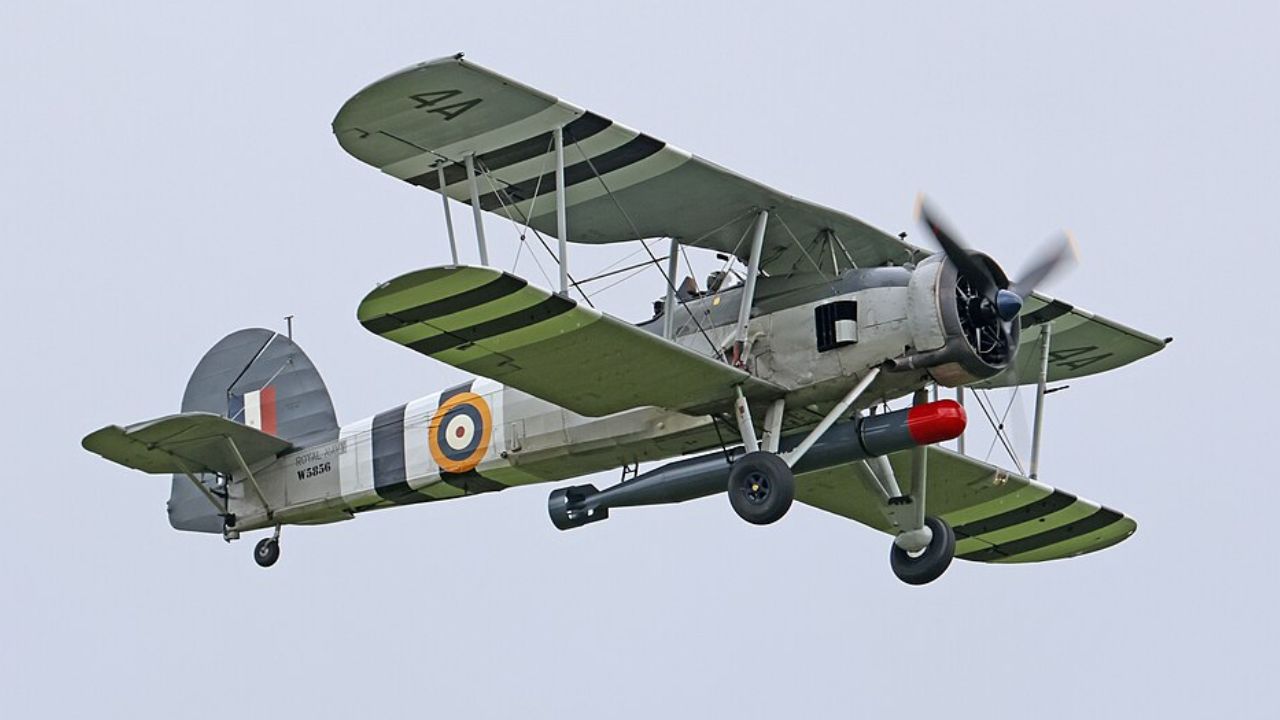
Military history is full of supposedly “obsolete” kit that refuses to behave like a museum piece. In May 1941, a fabric-and-metal biplane torpedo bomber helped decide the fate of one of the era’s most modern battleships—not by sinking her outright, but by taking away the one thing a hunted ship cannot afford to lose: the ability to steer and escape.
The Fairey Swordfish story matters because it links tactical persistence—carrier aircraft flying in brutal weather and fading light—directly to an operational outcome: preventing Bismarck from reaching safety and enabling the Royal Navy to bring her to battle. It’s also a reminder that “obsolete” is often a narrative label, not a clean measure of usefulness.
Fairey Swordfish (Fleet Air Arm torpedo bomber)
Wikipedia’s overview of the Fairey Swordfish captures the central irony. In 1941, the Fleet Air Arm was still sending slow, “obsolescent” biplanes into frontline combat, and yet those aircraft achieved major successes—most famously the attack that helped stop Bismarck. The “obsolete biplane” framing is fair in the sense that the Swordfish looked and performed like an earlier era compared with newer designs. But it was not a dead end: it remained useful in specific roles, including torpedo attack profiles where controllability at low speed and range could matter as much as speed.
That nuance is the practical lesson. Armed forces often keep using systems that are outclassed on paper because they still fit a tactical niche. In this case, that niche was getting a torpedo hit on a fast battleship at sea, in conditions that narrowed the defender’s advantages.
HMS Ark Royal (aircraft carrier)
The decisive chapter runs through the carrier HMS Ark Royal, the launch platform for the late-day strike on 26 May 1941. Wikipedia’s HMS Ark Royal (91) page describes Swordfish being re-armed and launched at 19:15, leading into an attack near sunset that scored multiple torpedo hits and affected Bismarck’s steering. Different accounts may summarize the sequence and timing slightly differently, but the core point holds: carrier aviation projected force at the critical moment, with little daylight left to work with.
For readers, the near-sunset timing is more than atmosphere. Attacks in fading light compress reaction time and complicate identification and coordination—pressures that get worse in heavy weather and rough seas. In the Bismarck chase, that timing helped turn a pursuit into a closing trap.
The “crippling” mechanism — torpedo damage to steering gear/rudder
What “crippled” Bismarck was not simply being attacked, but the specific effect of at least one torpedo hit on her ability to steer. A UK official postwar publication in The London Gazette describes a 26 May hit (noted around 2105) as the “immediate and principal cause” of Bismarck being brought to action, stating that it “demolished her rudder.” Other summaries use different wording—“jammed rudder” or “wrecked steering gear”—so the most careful way to state the outcome is that torpedo damage to the steering made effective escape impossible.
This is the uncomfortable engineering lesson behind the drama. Even a heavily protected ship can be operationally defeated by damage to a relatively small, mission-critical subsystem. Once steering was compromised, the strategic question shifted from “can she get away?” to “can she be held until heavy units arrive?”
Force size and attack conditions — 15 Swordfish in severe weather
The second, decisive strike is commonly described as 15 Swordfish attacking in exceptionally bad conditions. Wikipedia’s Operation Rheinübung article characterizes it as a second strike of 15 Swordfish in “almost impossibly bad weather,” and a technical/history paper hosted by the Institute of Marine Engineering, Science & Technology library also notes 15 aircraft and severe conditions. The practical takeaway is straightforward: the attackers were fighting the sea and sky as much as the target.
That context also keeps the “obsolete biplane” idea grounded. The result wasn’t a magic advantage of old technology; it was a mission carried through in a narrow window of conditions, with persistence, timing, and a weapon landing where it mattered most.
Earlier FAA strike: HMS Victorious Swordfish torpedo hit (25 May 1941)
Ark Royal’s evening attack wasn’t the first time Swordfish reached Bismarck. The Royal Navy’s commemoration note on 820 Squadron highlights that Swordfish from HMS Victorious struck Bismarck with a torpedo on 25 May 1941, but the damage was “not sufficiently” decisive to stop her escape on its own. A U.S. Naval History & Heritage Command write-up adds that the Victorious strike involved nine Swordfish and that the damage was minor.
Including that earlier strike keeps the story accurate. Bismarck was not undone by a single cinematic moment; she was pressured by a sequence of contacts and attacks, with the later steering damage changing what was possible for both sides.
Primary British operational perspective — Admiral Tovey dispatches
Wartime commanders did not have forensic certainty; they had reports, observations, and inference. The HMS Hood Association’s hosting of ADM 234/509 “Official Dispatches” includes Admiral Tovey’s commentary on reports of Bismarck making unexpected course alterations after the torpedo-bomber attack—information he interpreted as suggesting rudder damage. That belief mattered because it shaped how British forces could close, shadow, and plan the final engagement.
Read this way, the episode is not a tidy, pre-scripted turning point but a real-time problem. Commanders had to connect behavior at sea—anomalous course changes—to a likely cause and then act on that judgment while the situation was still fluid.
What “crippled” enabled — night shadowing, destroyer attacks, then final surface action (26–27 May 1941)
Calling the Swordfish attack “crippling” can mislead if it implies Bismarck immediately sank. The more accurate meaning is operational: steering damage prevented her from reaching safety (notably France), enabling British forces to keep contact and bring overwhelming surface power to bear. Wikipedia’s Operation Rheinübung links the jammed-rudder outcome to the loss of Bismarck’s ability to reach Brest, while the Last battle of Bismarck summary places the final battle across 26–27 May 1941.
In plain terms, the torpedo damage helped turn a fast-moving pursuit into a contained endgame. With Bismarck effectively trapped, British units could shadow through the night, press with destroyer attacks, and then fight the final surface action the next day. The Swordfish did not “sink her with one hit”; they helped remove the exit.
Named individuals for color/credibility — “Jock” / John Moffat
Popular retellings often attach a human face to the moment, and “Jock” (John) Moffat is frequently named in that role. The caution is the same as with timing and damage language: individual-credit narratives can compress a complex, multi-aircraft attack into a single protagonist and a single torpedo. Still, the persistence of Moffat’s name in public memory reflects what the episode represents—aircrew flying slow aircraft into heavy weather and intense defensive fire to achieve a result out of all proportion to the platform’s supposed obsolescence.
That is why the Swordfish-versus-Bismarck story endures. It isn’t a fairy tale of old beating new. It’s a demonstration that “outdated” does not mean irrelevant—and that under the right conditions, with the right tactics and a little fortune in where a weapon lands, an unfashionable aircraft can help decide the fate of a modern battleship.