
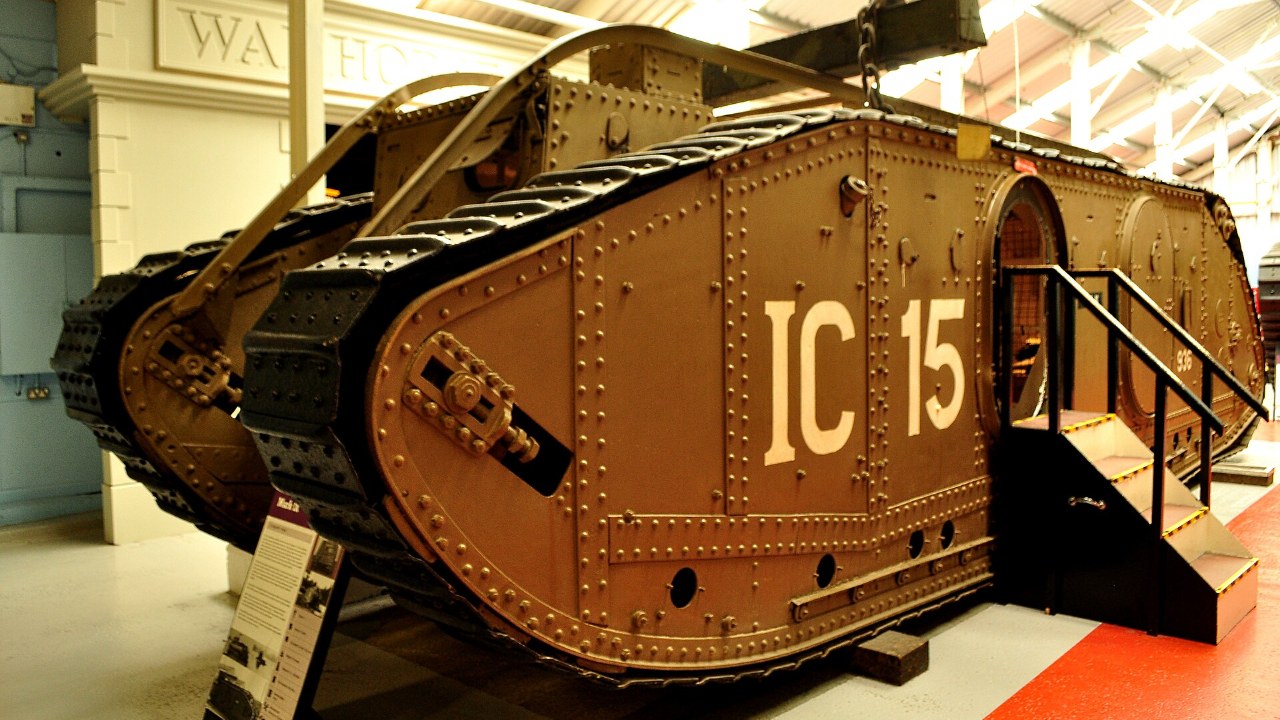
Moving infantry across a First World War battlefield alongside the tanks was a problem Britain tried to solve with a dedicated machine: the Mark IX, built by Marshalls of Gainsborough as the first purpose-built infantry carrier. The Tank Museum in Britain holds the only one left. In November 1918, one Mark IX fitted with buoyancy equipment was tested on Hendon Reservoir and became the first amphibious tank.
The type arrived too late to matter in combat. The Armistice ended the war before the order could be filled, and the Mark IX never went into battle.
The museum lays out the vehicle’s record on its collection page for the Mark IX. “The Mark IX was designed to solve the problem of moving infantry across the battlefield with the fighting tanks,” it states, and “the Mark IX was the first purpose built Infantry Carrier.” The page is plain about the outcome: “The Mark IX was never tested in battle.”
The production story is short. “Though an initial order for 200 vehicles was placed, it appears that only 36 were built – with our vehicle being the only surviving example,” the museum states. Elsewhere on the same page it puts the sequence plainly: “Of an order for 200, it appears 36 were built before the order was cancelled after the Armistice.” The vehicles were numbered from 901, and the museum’s example is 936.
Britain did not return to the idea quickly. “The concept of the Infantry Carrier was dropped until nearly half way through the Second World War, at least as far as Britain was concerned,” the museum’s entry concludes.
Doors where the guns used to be
The Mark IX gave up the side gun mountings of the fighting tanks. Per the museum, “large doors replaced the gun sponsons, and there was space inside for up to 30 armed troops, with provision for them to shoot through loopholes.” The same entry says the vehicle could instead carry up to 10 tons of stores, “such as ammunition or fuel, or be modified into an armoured ambulance.”
The museum’s specification list gives a crew of four, a weight of 37 tons, a top speed of 3.35 mph, 10 mm of armor, and two .303 machine-guns. Those figures describe a slow, heavy vehicle whose purpose was to keep riflemen under armor until they reached the fight.
The museum also documents another attempt at the same job. Its history of the lengthened Mark V* records that “experiments suggested that up to 15 men and 4 machine guns could be carried” in that fighting tank. The same account adds that “conditions inside the tank meant they were near enough incapacitated when they got out.” The Mark IX, designed from the start with room for 30 troops, took on the same problem with a purpose-built hull.
Hendon Reservoir and the “Duck”
The Mark IX’s other first came on water. “In November 1918 one Mark IX was fitted with buoyancy equipment and tested on Hendon Reservoir, making it the first amphibious tank,” according to the Tank Museum.
Film of the amphibious version survives. The Imperial War Museums holds a 1918 reel catalogued as “Tanks Mark IX Duck, Mark IV Hermaphrodite and Medium B”, which the museum describes as documenting trials at Bovington Camp in autumn 1918. In it, per the catalogue, the Mark IX Duck enters a pond, swims partway across and reverses out, then turns within its own length before leaving nose-first.
The Hendon trial came in November 1918, the 200-vehicle order was cancelled after the Armistice, and vehicle 936 remains the one physical example of the type the museum calls the first purpose-built infantry carrier.
Top image: The Mark IX infantry carrier at The Tank Museum, Bovington. Image Credit: Mightyhansa — CC BY-SA 4.0 / Wikimedia Commons
This article was produced with the assistance of AI and reviewed by Combat Rated editors prior to publication.