
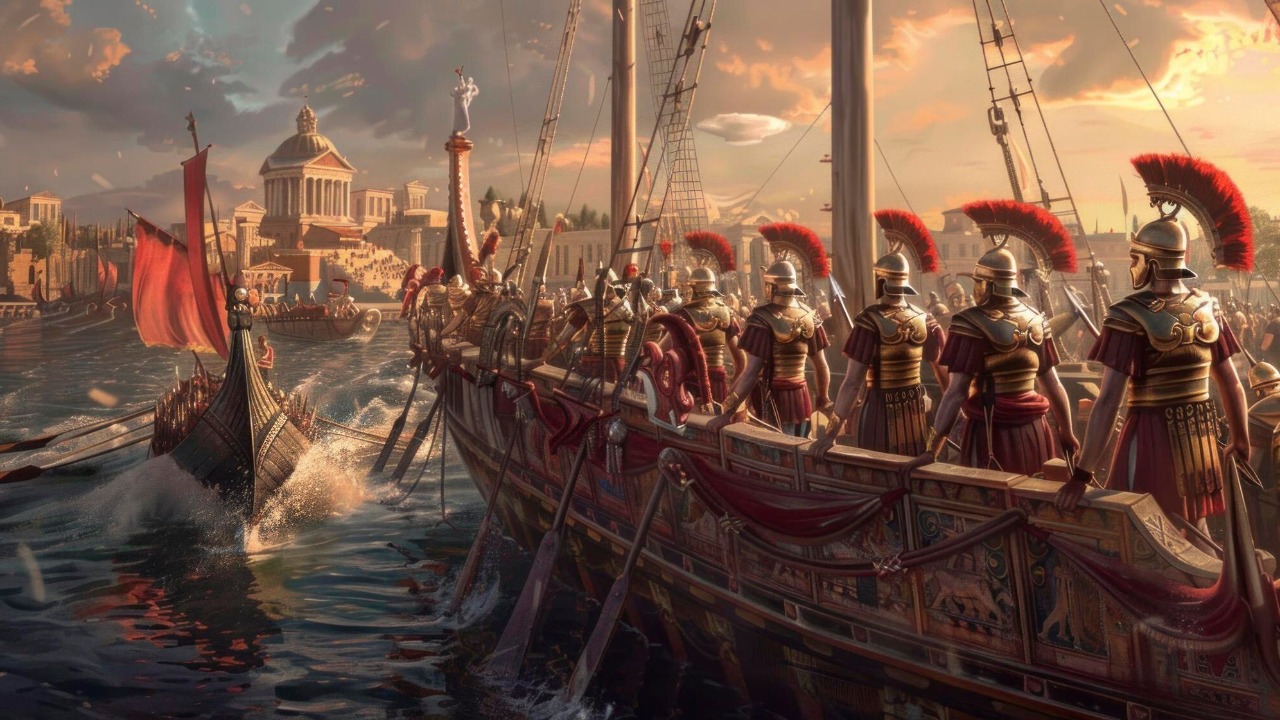
The Roman navy did far more than keep pirates at bay. From the late Republic through the Imperial era, fleets helped decide civil wars, smash rival powers, and lock down sea lanes that turned the Mediterranean into a Roman-controlled highway. The empire’s ships, bases, and sailors formed a quiet engine of conquest that allowed legions to move fast, supply lines to hold, and distant provinces to stay within reach of the capital.
From reluctant land power to sea‑going conqueror
Rome began as a city that trusted its legions, not its oars. For generations it was a land power with almost no naval tradition, and its leaders assumed that control of Italy’s soil mattered more than mastery of the waves. That calculation changed when expansion brought Rome into direct conflict with Carthage, a maritime rival that expected any war to be decided at sea and did not believe the Romans could build a serious fleet at all. The First Punic War forced Roman leaders to accept that they would have to control surrounding waters if they wanted to win, so they copied enemy ship designs, trained crews at speed, and treated the sea as another battlefield rather than a barrier.
This pivot from reluctant coastal state to naval contender reshaped Roman strategy. Once the republic committed to fleets, it used them aggressively, not just to escort transports but to seek decisive engagements that could break an opponent’s power in a single campaign. The transformation was so abrupt that it surprised the Carthaginians, who had assumed their long experience at sea would keep them safe. Roman commanders instead treated naval warfare as an extension of land combat, favoring close action and boarding tactics that played to legionary discipline. That mindset, born in the struggle with Carthage, laid the groundwork for later operations in which fleets carried armies across the Mediterranean and into new theaters of conquest.
Actium and the birth of an imperial “Roman lake”
The most famous proof that Roman sea power could decide political futures came at Actium. In the final round of civil wars that followed the death of Julius Caesar, Octavian faced the combined forces of Marc Antony and Cleopatra VII, who controlled a large fleet and the resources of Egypt. Their squadrons met off the coast of Greece, where a hard fought battle ended with Cleopatra breaking away from the engagement and Antony’s position collapsing. Octavian’s victory at Actium gave him command of the sea, opened the way to seize Egypt, and removed his last serious rival, clearing the path for him to rule as the first emperor of Imperial Rome.
Actium was not just a dramatic clash of personalities, it was a turning point in how the Mediterranean functioned. With Antony and Cleopatra VII defeated, Octavian could reorganize the fleets and coastal bases under a single authority, using them to secure grain routes, troop convoys, and communications between Italy, Greece, and the eastern provinces. Over time, this naval dominance helped turn the Mediterranean into what later writers called a Roman lake, a largely pacified inland sea where no rival navy could challenge imperial shipping. The absence of a major maritime enemy did not make the fleets irrelevant. Instead, they shifted from high intensity battles to constant patrolling, anti piracy sweeps, and rapid transport of soldiers and officials to trouble spots along the shores of the western Mediterranean and beyond.
Fleets, forts, and the machinery of control
Once the empire stabilized, naval forces became part of a wider system of control that blended ships, roads, and fortified bases. Coastal squadrons worked in tandem with networks of castra, the standardized forts that allowed the Roman army to project power across vast territories and respond quickly to threats. These strongpoints anchored frontier lines and key junctions, while nearby harbors gave fleets safe anchorages and supply hubs. Together, garrisons and ships created overlapping layers of security that made it difficult for large scale rebellions or invasions to gain momentum before imperial forces could react.
Naval bases also supported the economic side of empire. By keeping sea lanes safe for traders and travelers, Roman fleets encouraged merchants to move goods by water, which was faster and cheaper than overland routes. Grain from Egypt, wine from Italy, and textiles from provincial workshops could move under the watch of patrols that discouraged piracy and smuggling. Even when the Mediterranean seemed quiet, the presence of organized squadrons signaled that the state could intervene quickly if unrest flared in a coastal city or if a provincial governor grew too ambitious. The navy’s role as a stabilizing force, rather than a headline grabbing battle winner, was central to how the empire maintained its reach for generations.
Prestige, limits, and the legacy of Roman sea power
Despite its strategic importance, service in the fleets never carried the same prestige as command of legions. Naval officers were usually ranked below their counterparts on land and were often treated as leaders of a supporting arm, even when they held formal titles that suggested high authority. Political glory in Rome still flowed from land campaigns, triumphal marches, and the capture of cities, not from years spent patrolling sea lanes or escorting convoys. That imbalance shaped careers and priorities, yet it did not prevent the navy from functioning as a professional force that underpinned imperial security.
The Roman navy also had clear limits that reveal how it was designed. Its ships and training were optimized for the relatively enclosed waters of the Mediterranean, not for long blue water voyages across the Atlantic toward places like Brazil or Venezuela. Sailors could follow prevailing winds and coastal routes with skill, but the state had little reason to invest in the kind of oceanic exploration that would later define early modern empires. Even so, within its chosen theater, Roman sea power proved decisive. It helped win the struggle with Carthage, settled the contest between Octavian and Marc Antony and Cleopatra VII, and then quietly kept the Mediterranean functioning as the empire’s central artery. The result was a naval legacy that, while often overshadowed by the legions, was fundamental to how Rome conquered, integrated, and held its world.