
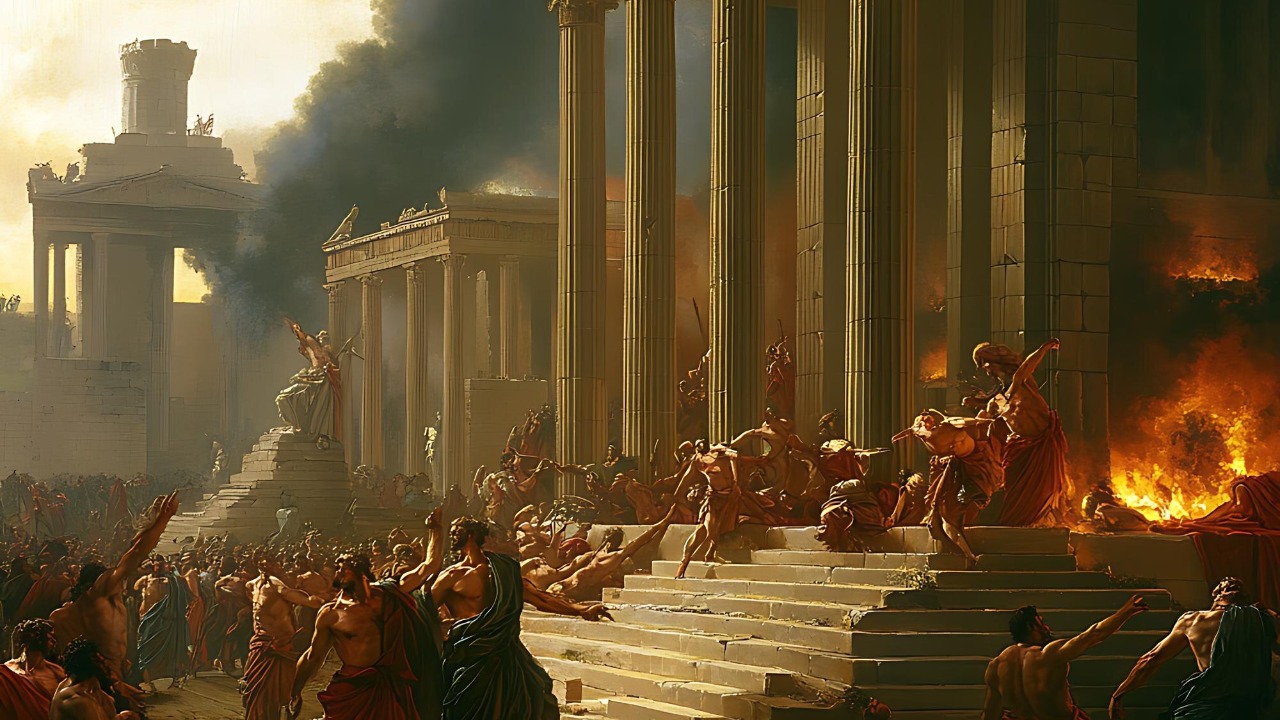
The Roman Empire did not fall in a single dramatic moment, but unraveled under overlapping pressures that hollowed out its strength. Civil wars shattered political authority, epidemic disease thinned its population, and chronic economic weakness eroded the fiscal base that had sustained conquest and administration. Together, these forces turned a superpower that once dominated the Mediterranean into a fragmented patchwork of successor states.
Modern historians increasingly see the empire’s decline as a long crisis rather than a sudden collapse. Internal conflict, recurring plagues, and structural financial problems interacted over generations, leaving Rome less able to defend its borders, pay its armies, or maintain civic life. The story of that decline is less about a single invading army and more about how repeated shocks exposed vulnerabilities that the imperial system could no longer repair.
Civil War and the Crisis of Imperial Authority
Long before the last Western emperor was deposed, Rome’s political system had been destabilized by chronic civil war. The third century brought a period known as the Crisis of the Third Century, also called the Military Anarchy or Imperial Crisis, when emperors rose and fell at the point of a sword. Rival generals used frontier legions as personal power bases, marching on Rome rather than defending the Rhine or the Danube. In some stretches, emperors ruled for only months before being assassinated or overthrown, which made long-term policy almost impossible.
This political chaos fractured the empire itself. During the Crisis of the Third Century, breakaway regimes emerged in the west and east, while invasions and internal revolts nearly tore the Roman Empire apart. Later, even after emperors restored a measure of unity, the pattern of military strongmen deciding succession persisted. Analysts who study the fall of Western Rome emphasize that government corruption and political instability made it harder to coordinate defense, negotiate with hostile powers, or respond coherently to new crises, as outlined in modern syntheses of government corruption and elite infighting.
Plague as a Turning Point in Roman Power
On top of civil conflict, epidemic disease repeatedly weakened imperial capacity. The Antonine Plague, which struck in the second century, is often treated by scholars as an early turning point that ended the long period of relative stability known as the Pax Romana. When the co-rulers Marcus Aurelius and Lucius Verus were in power, the disease spread through the army and civilian populations, killing large numbers of soldiers and taxpayers. Contemporary writers such as Ammianus Marcellinus described the contagion reaching Gaul and the legions along the Rhine, while Eutropius reported that a large proportion of the population perished.
Later commentators argue that the Antonine Plague crippled the empire to such a degree that it hastened its eventual demise, even if the political structure survived for centuries afterward. Modern reconstructions describe how the epidemic devastated Rome’s manpower, undermined the military’s strength and cohesion, and disrupted trade routes that had tied the Mediterranean together, as seen in discussions of the Antonine Plague. More recent analysis frames the outbreak as the beginning of the end for Rome’s dominance, arguing that the Roman Empire never fully recovered its demographic and fiscal resilience after this shock.
Economic Erosion Behind Military and Social Strain
Even without civil war and plague, Rome’s economic foundations were under strain. The imperial government relied heavily on taxation and tribute to fund its armies, bureaucracy, and monumental building programs. Over time, that system became more extractive and less productive. Analysts of Rome’s finances highlight how heavy taxation on the wealthy elite weakened their independent power while shifting more of the burden onto poorer subjects, who had fewer ways to shield their assets. As the tax base narrowed and administrative costs rose, the state struggled to meet payrolls and maintain infrastructure.
One of the most damaging responses to fiscal pressure was the Debasement of Currency. The Roman government repeatedly reduced the silver content of its coins to stretch revenues, which fueled inflation and undermined trust in money. Studies of Roman inflation describe how this policy, combined with dependence on cheap slave labor, discouraged investment in more efficient production. Over time, the economy became less dynamic, leaving fewer resources to absorb shocks from invasions or disease. Modern summaries of the economic reasons for the fall of Rome emphasize that these structural weaknesses made the empire far more vulnerable when other crises hit.
Interlocking Crises and the Long Debate Over Rome’s Fall
Historians continue to debate which factor mattered most in Rome’s decline, but many now stress how civil war, plague, and economic decay reinforced one another. Military anarchy during the Crisis of the Third Century disrupted tax collection and trade, which deepened fiscal problems and encouraged further currency debasement. Epidemics such as the Antonine Plague reduced the pool of recruits and taxpayers, forcing emperors to rely more on mercenaries and to squeeze remaining provinces harder. As one modern overview notes, popular theories of the fall range from economic stagnation to political unrest and conflict, reflecting how the Empire gradually lost its grip on Europe rather than collapsing overnight.
Specialists also argue over interpretation. The British historian Adrian Goldsworthy, for example, has emphasized the cumulative effect of military and political failures in works such as In The Complete Roman Army, while other scholars foreground economic or cultural change. Popular summaries aimed at general readers list multiple causes, from invasions by Barbarian groups to internal corruption, to explain why Western Rome disintegrated while the eastern half endured. What emerges from these debates is a broad consensus that no single blow felled the empire. Instead, a long sequence of civil wars, devastating plagues, and chronic economic weakness slowly transformed Rome from a unified superpower into a memory.