
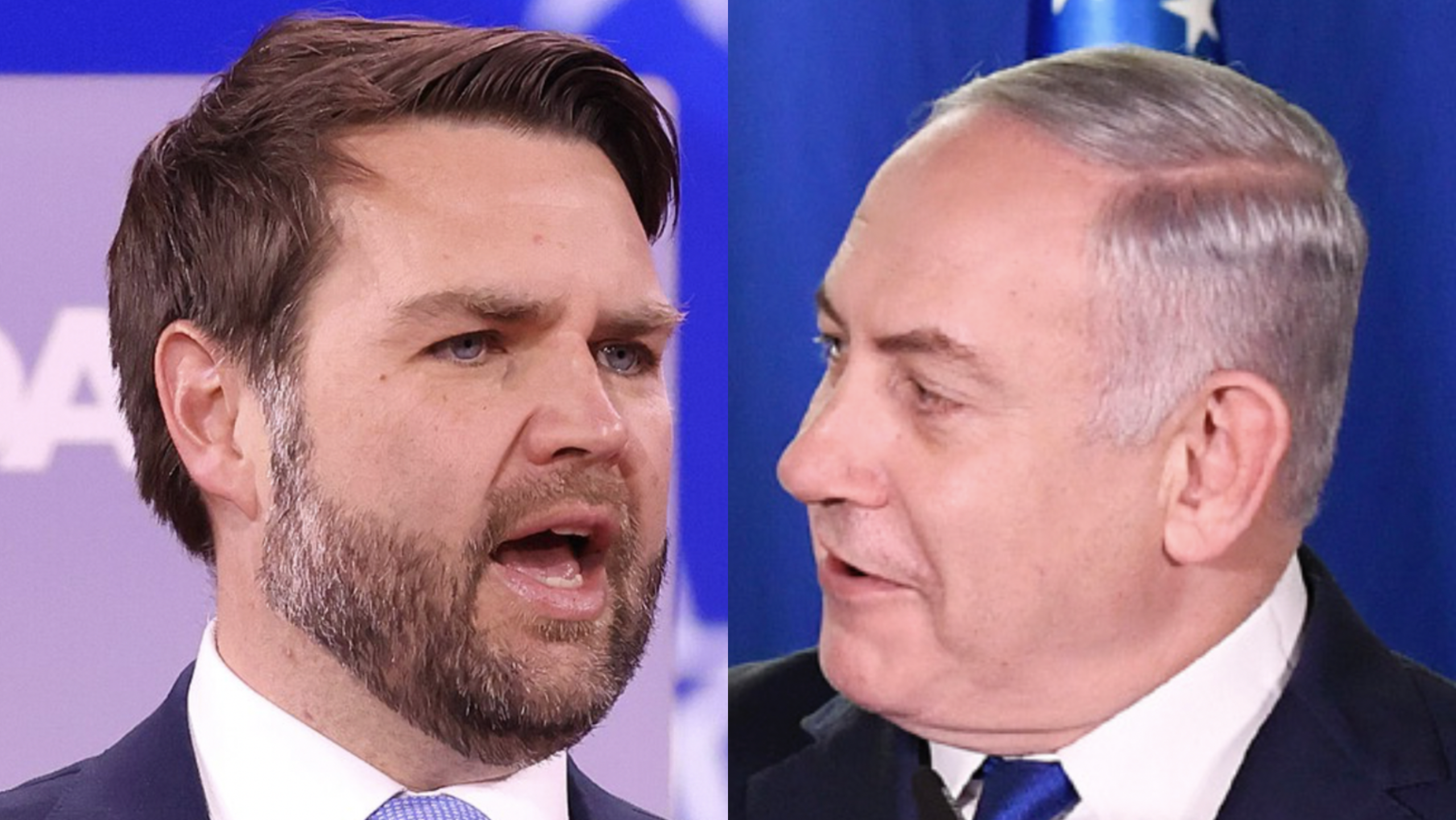
Vice President JD Vance delivered a pointed rebuke to members of Prime Minister Benjamin Netanyahu’s cabinet on Thursday, warning Israeli officials that publicly attacking President Donald Trump amounts to targeting the only powerful ally Israel has left in the world — and one whose country has been financing and building the bulk of Israel’s air defenses throughout the three-month conflict with Iran.
Speaking at a White House press briefing on June 18, Vance was asked about an Axios report indicating that Netanyahu was “fuming” over the memorandum of understanding the United States reached with Iran, and that Israel does not consider itself bound by the MOU’s Lebanon provisions. The vice president declined to engage in hypotheticals about whether continued Israeli strikes on Beirut could torpedo the deal, saying the president’s expectation is that all parties — “the Israelis, the Arabs in the region” — would work together toward its completion.
But Vance did not hold back on what he described as a deeply troubling pattern among elements of Netanyahu’s governing coalition.
“What I will say, and this does bother me, is that you’ve seen people within BB’s cabinet who have come out and attacked the deal and in some ways very personally attacked the president of the United States,” Vance said. “Donald J. Trump is the only head of state in the entire world who is sympathetic to the nation of Israel at this moment in time and he happens to be the head of state of the world’s superpower.”
The message carried a sharp edge. “If I was in the cabinet of the Israeli government, I might not be attacking the only powerful ally that I have anywhere left in the entire world,” the vice president said.
Vance then turned to what he called the material reality underpinning the U.S.-Israel relationship — a reality he said some Israeli officials appeared to be ignoring. “Over the last three months, two-thirds of the defensive weapons that have protected your homeland have been built by American hands and paid for by American tax dollars,” he said. “The problem for Israel is not Donald J. Trump. And anybody in Israel who thinks their biggest problem is the president of the United States needs to wake up and smell the reality of the situation that country is in.”
The remarks came amid a widening rift between Washington and Jerusalem over the terms of the U.S.-Iran agreement, which was signed as a memorandum of understanding and is set to be formally executed in Geneva on Friday. According to the MOU’s terms, as obtained by multiple news organizations, the agreement calls for an immediate and permanent end to hostilities across all fronts, including Lebanon — a provision Israel has said it does not consider binding on its military operations against Hezbollah.
Netanyahu’s far-right coalition partners, including National Security Minister Itamar Ben-Gvir and Finance Minister Bezalel Smotrich, have been among the most vocal opponents of the deal. Netanyahu himself has not publicly attacked the agreement, though he declared Monday that Israel’s “struggle is not over” and pledged to maintain Israeli forces in southern Lebanon security zones “for as long as necessary.”
President Trump has made no secret of his frustration. At the G7 summit in Évian-les-Bains, France, earlier this week, Trump called Netanyahu “crazy” and said that “without me, there would be no Israel,” adding that Netanyahu should be “very thankful” for the deal given Iran’s pre-war nuclear trajectory. Trump also criticized Israeli strikes on Lebanese residential areas, saying “you don’t have to knock down an apartment house every time you’re looking for someone.”
The context for Vance’s remarks about defensive weapons is significant. The United States has supplied Israel with air defense interceptors, including those used against Iranian ballistic missile and drone salvos during the conflict that began February 28, 2026, when the U.S. launched Operation Epic Fury. Since that date, the Trump administration has also notified Congress of its intent to sell more than $23 billion in arms to regional partners, including Israel, much of it processed through emergency sales that bypass standard congressional review.
Vance made clear the administration has no intention of abandoning the peace process because of Israeli cabinet members’ objections, and that the president’s expectation of unified allied support remains firm. He also did not signal that U.S. security commitments to Israel were in any immediate jeopardy — but the vice president’s warning was unmistakable: the relationship is not unconditional, and those within Israel’s government who are working against the deal are doing so at significant risk.
Israel was not included in the negotiations leading up to the MOU and was denied an advanced draft, according to reporting by NBC News. The country’s exclusion from the process has become a defining political liability for Netanyahu, who faces national elections before the end of October. In a survey from the Israeli Democracy Institute published two weeks ago, more than 57 percent of Israelis said they believed ending the conflict under the currently discussed framework would not be compatible with Israel’s security interests.
The administration has said it communicates with Israeli officials, including Netanyahu himself, nearly daily. Vance confirmed Thursday that the U.S. has not withdrawn recognition of Israel’s right to self-defense — only the expectation that the self-defense not undermine a peace framework the vice president described as fundamentally good for Israel and the entire region.
“The Israelis just like everybody else have to respect this peace process,” Vance said, “that is fundamentally good for them and good for the entire region.”