
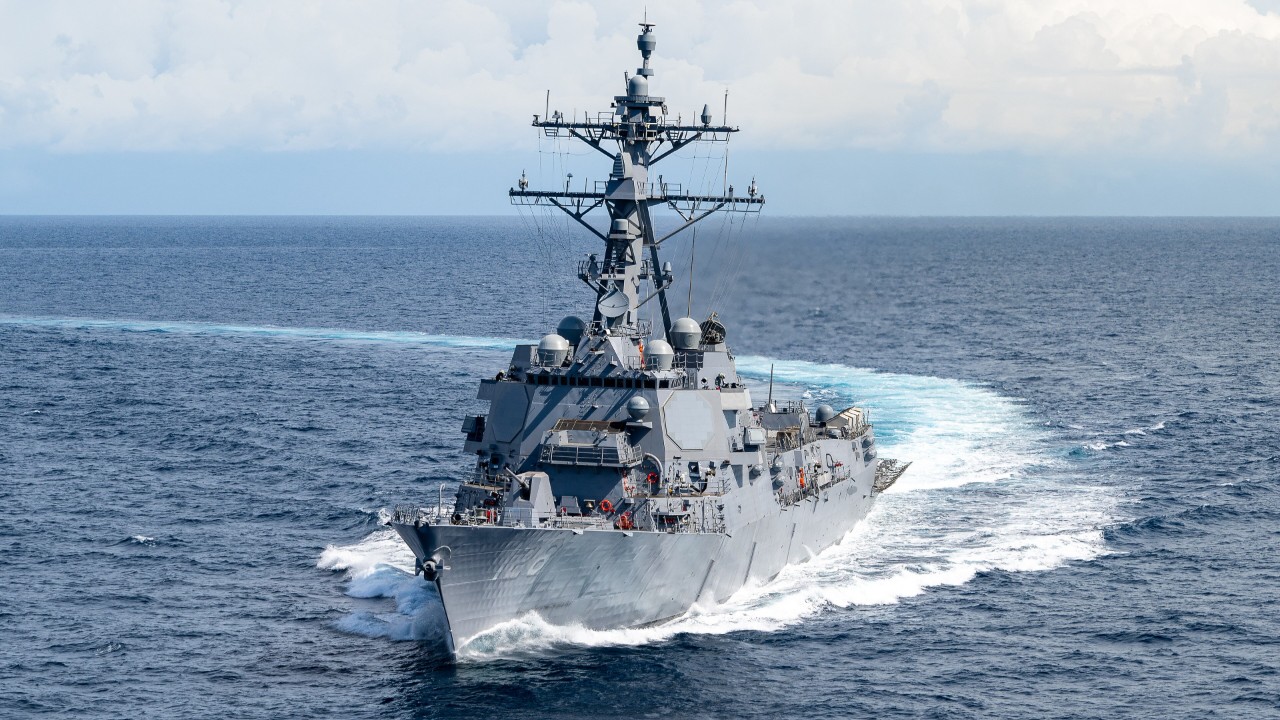
USS Ted Stevens (DDG 128) is now a commissioned warship. The Flight III Arleigh Burke-class guided-missile destroyer went into active service on Oct. 3, 2026, at a formal ceremony in Whittier, Alaska. Her combat system pairs the AN/SPY-6(V)1 Air and Missile Defense Radar with the Aegis Baseline 10 combat system, and her next destination is a permanent homeport in Norfolk, Virginia.
The Navy counts her as the second Flight III destroyer to enter active service. Capt. Mary Katey Hayes commands the ship, which carries the motto “Lead with Courage.”
Those details come from the Navy’s commissioning release, datelined Whittier, Oct. 3, 2026. It says the destroyer “is built around the AN/SPY-6(V)1 Air and Missile Defense Radar (AMDR) and Aegis Baseline 10 combat system, delivering a generational leap in simultaneous Anti-Air Warfare (AAW) and Ballistic Missile Defense (BMD).” In plain terms, the ship is designed to track and engage aircraft and ballistic missiles at the same time. That is the Navy’s description of what the design is built to do.
Hayes addressed the crew and guests at the ceremony. Per the release, she said:
“We are ready to answer our nation’s call. We are ready to defend freedom, whether the winds of war blow near the rugged coast of Alaska, or in the far reaches of the globe.”
From Pascagoula to Whittier
The ship was built by HII’s Ingalls Shipbuilding division in Pascagoula, Mississippi. HII announced it had delivered Ted Stevens to the Navy on Dec. 29, 2025, describing the Flight III variant as carrying the AN/SPY-6(V)1 radar and Aegis Baseline 10. Ingalls President Brian Blanchette said at the time that the delivery “reflects the strong momentum of our destroyer program as we accelerate Flight III production and bring enhanced capabilities to the fleet.”
Naval Sea Systems Command recorded the same handover from the government side. Its Dec. 29, 2025 acceptance notice says delivery followed at-sea and pier-side trials, and that Flight III ships pair the SPY-6(V)1 radar with upgrades to electrical power and cooling capacity for added warfighting capability.
Capt. Jay Young, the Arleigh Burke-class program manager at Program Executive Office Ships, said in that notice that the delivery “will provide our Fleet with another critical warship with advanced capabilities.” NAVSEA listed four more Flight III destroyers in production at the time: the future USS Jeremiah Denton (DDG 129), USS George M. Neal (DDG 131), USS Sam Nunn (DDG 133) and USS Thad Cochran (DDG 135).
A rare Alaska ceremony for a pilot’s namesake
Alaska’s News Source called the Whittier site “a rare move for a ceremony typically held at major fleet hubs.” The station reported on March 12, 2026, that the last Navy ship commissioning in Alaska took place in 2013, when USS Anchorage was commissioned at the Don Young Port of Alaska in Anchorage. Ted Stevens is therefore not the first Navy ship commissioned in the state, but such ceremonies there are infrequent.
Acting Secretary of the Navy Hung Cao led the Oct. 3 ceremony, according to the release. Catherine Ann Stevens, wife of the ship’s namesake, served as sponsor, with daughters Susan Stevens Covich and Lily Stevens Becker as co-sponsors.
The ship is named for Ted Stevens, who served in the U.S. Senate from 1968 to 2009. Before that, per the Navy release, he was a World War II Army Air Forces pilot who flew transport missions in the China-Burma-India theater, earning two Distinguished Flying Crosses and two Air Medals.
The Navy’s stated next step is a long one. Following post-commissioning operations, the release says, USS Ted Stevens will transit from Alaska to her permanent homeport in Norfolk, Virginia, “fully prepared to deploy worldwide.”
Top image: USS Ted Stevens (DDG 128) underway during acceptance trials before her delivery to the Navy. Image Credit: U.S. Navy/Huntington Ingalls Industries — Public domain / Wikimedia Commons
This article was produced with the assistance of AI and reviewed by Combat Rated editors prior to publication.