
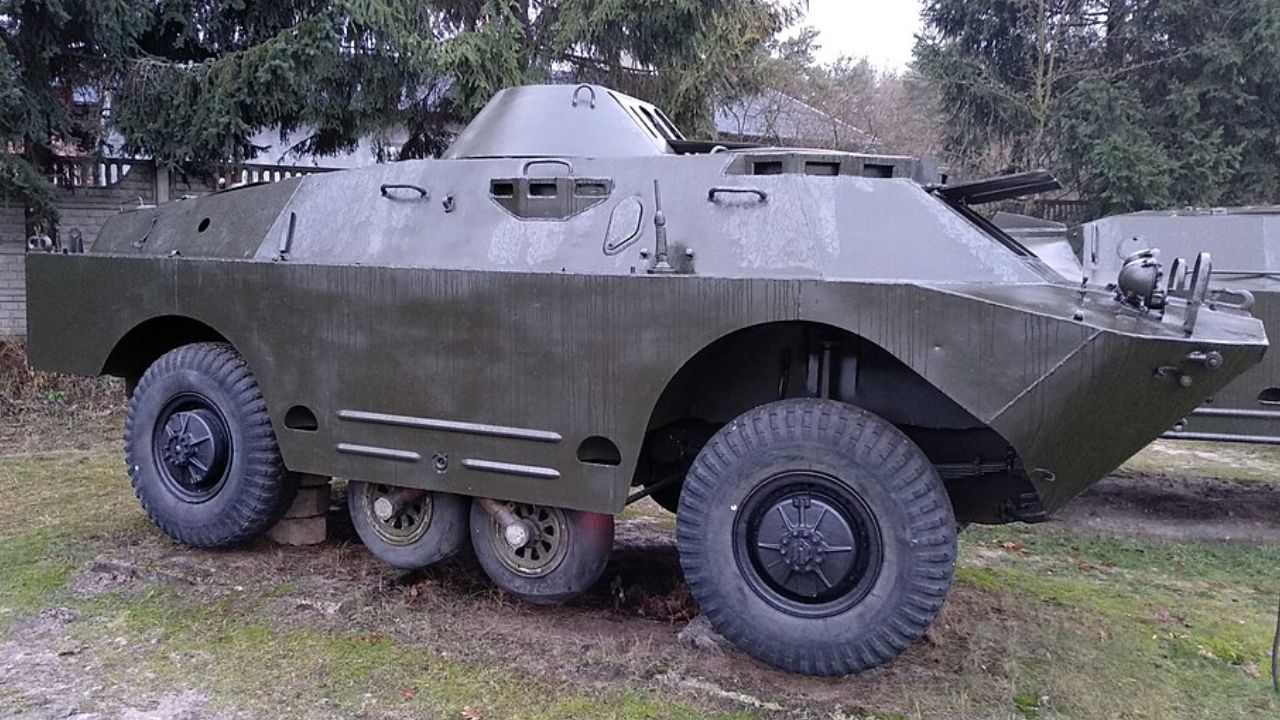
A scout car that never tried to be fancy
The BRDM-2 doesn’t look like it’s auditioning for a sci‑fi movie, and that’s kind of the point. Built in the Soviet era as a reconnaissance and patrol vehicle, it was designed to go where roads quit and to keep going when maintenance was more of a suggestion than a schedule. Think of it as the outdoorsy friend who shows up in scuffed boots, shrugs at bad weather, and still gets the job done.
Even today, the BRDM-2 keeps popping up in photos, military parades, and the occasional grim frontline snapshot. Its staying power isn’t because it’s the fastest or the newest. It’s because it balanced mobility, simplicity, and just enough protection to make reconnaissance a little less terrifying.
What the BRDM-2 is, in plain terms
At heart, the BRDM-2 is a 4×4 armored reconnaissance vehicle that can also swim. Crews used it to scout routes, screen flanks, carry out patrols, and generally be the unit’s eyes and ears without immediately announcing, “Hello, we’re here!” It’s compact enough to weave through rough terrain, yet roomy enough for a small crew and the gear that always seems to multiply on real missions.
Unlike a tank, it wasn’t built to slug it out. It was built to see, report, and survive long enough to bring back useful information. That mission focus shaped everything: the hull shape, the weight, the amphibious setup, and even some quirky engineering choices that still get people talking.
Rugged simplicity: why armies kept it around
The BRDM-2’s charm is how straightforward it is. It’s not loaded with delicate electronics by default, and many versions were meant to be serviced with basic tools and a practical mindset. In places where supply chains get messy and workshops are improvised, that kind of design feels less like a compromise and more like a strategy.
There’s also the “it’ll do” factor. A vehicle that can patrol, recon, escort, and sometimes act as a general utility platform is valuable even when it’s not glamorous. If you’re outfitting a force on a budget—or maintaining older equipment because replacement is slow—something reliable and familiar has real appeal.
Mobility that’s more clever than flashy
For reconnaissance, mobility is life insurance. The BRDM-2 was built to move quickly over uneven ground, with a relatively light armored hull that didn’t demand tank-level logistics. It’s not a sports car, but it’s quick enough to reposition, probe, and disengage before trouble gets too close.
One of its most distinctive features is the pair of small auxiliary wheels tucked under the belly. They can be lowered to help the vehicle cross trenches or obstacles that might otherwise high-center it. It’s a very “Soviet engineer with a deadline” solution—odd-looking, practical, and surprisingly effective when terrain gets rude.
Amphibious by design, not by wishful thinking
The BRDM-2 can swim, and it was meant to do it without elaborate prep. Water crossings are a classic headache for military planners, and a scout vehicle that can slip across rivers expands the routes a unit can use. That matters in reconnaissance, where predictability is basically an invitation to get spotted.
Amphibious capability also fits the vehicle’s broader philosophy: keep moving, keep options open. It’s not about comfort—it’s about getting to the far bank without waiting for a bridge or a ferry. And yes, it’s always a little surprising to see something that looks like a metal loaf of bread confidently paddling across water.
Protection and firepower: enough to argue, not enough to brawl
The BRDM-2’s armor is there to stop small-arms fire and shell splinters, not to tank direct hits from heavy weapons. That’s typical for reconnaissance vehicles, which rely more on speed, concealment, and distance than brute force. The goal is to survive an ambush long enough to escape and report, not to win a stand-up fight.
Many BRDM-2 variants mount a turret with a heavy machine gun paired with a lighter coaxial weapon. That setup gives it bite against soft targets and can discourage opportunistic attacks. But nobody should confuse it with an infantry fighting vehicle; it’s a scout with teeth, not a heavyweight.
Creature comforts? Not really, but it wasn’t built for comfort
If you’re wondering about crew comfort, the BRDM-2’s answer is basically, “You’ll live.” Space is tight, visibility can be limited depending on hatches and periscopes, and entry/exit isn’t always graceful. Recon vehicles often trade comfort for a smaller silhouette and better survivability, and the BRDM-2 leans into that trade.
That said, the compact design did help it stay nimble and easier to conceal. In reconnaissance, being hard to see can matter more than having legroom. Still, anyone who’s spent hours inside one probably has opinions—and none of them involve the phrase “luxury ride.”
Why it spread so widely (and why it’s still showing up)
The BRDM-2 was exported broadly and produced in large numbers, which means it ended up on multiple continents and in a long list of inventories. When a platform becomes common, it also becomes easier to support: spare parts circulate, mechanics learn the quirks, and training pipelines stay alive. That network effect is powerful, especially for countries that can’t easily refresh fleets with brand-new vehicles.
On top of that, it’s been adapted into command vehicles, ATGM carriers, police-style patrol platforms, and various local modernization packages. Some upgrades focus on better radios and sensors, others on improved engines, and some even on reworking the interior to make the crew’s day less miserable. The core idea stays the same: keep the simple hull, update what matters, and stretch the service life.
The modern battlefield reality check
It’s also true that the BRDM-2’s original strengths face modern pressures. Drones, thermal sights, precision munitions, and widespread anti-armor weapons have made “lightly armored and visible” a tougher lifestyle choice. Reconnaissance is still essential, but the survivability math has changed, and older vehicles need better tactics and sometimes significant upgrades to operate safely.
That doesn’t mean the BRDM-2 is irrelevant. It means crews and commanders have to use it wisely—leaning on speed, cover, deception, and smart routing rather than assuming armor will save the day. In a way, that brings it back to its roots: the BRDM-2 works best when it’s treated like a scout, not a mini tank.
A balanced design that explains its long career
The BRDM-2’s story is less about cutting-edge technology and more about a well-judged compromise. It offered reconnaissance units a vehicle that could move fast enough, cross bad terrain, swim when needed, and carry a small punch—all without being fragile or overly complicated. That balance is why it became so widespread and why it keeps resurfacing decades later.
It’s not the newest tool in the shed, but it’s a tool that still works. And in military logistics, “still works” can be more impressive than it sounds. The BRDM-2’s rugged simplicity didn’t just help it survive rough terrain—it helped it survive history.