
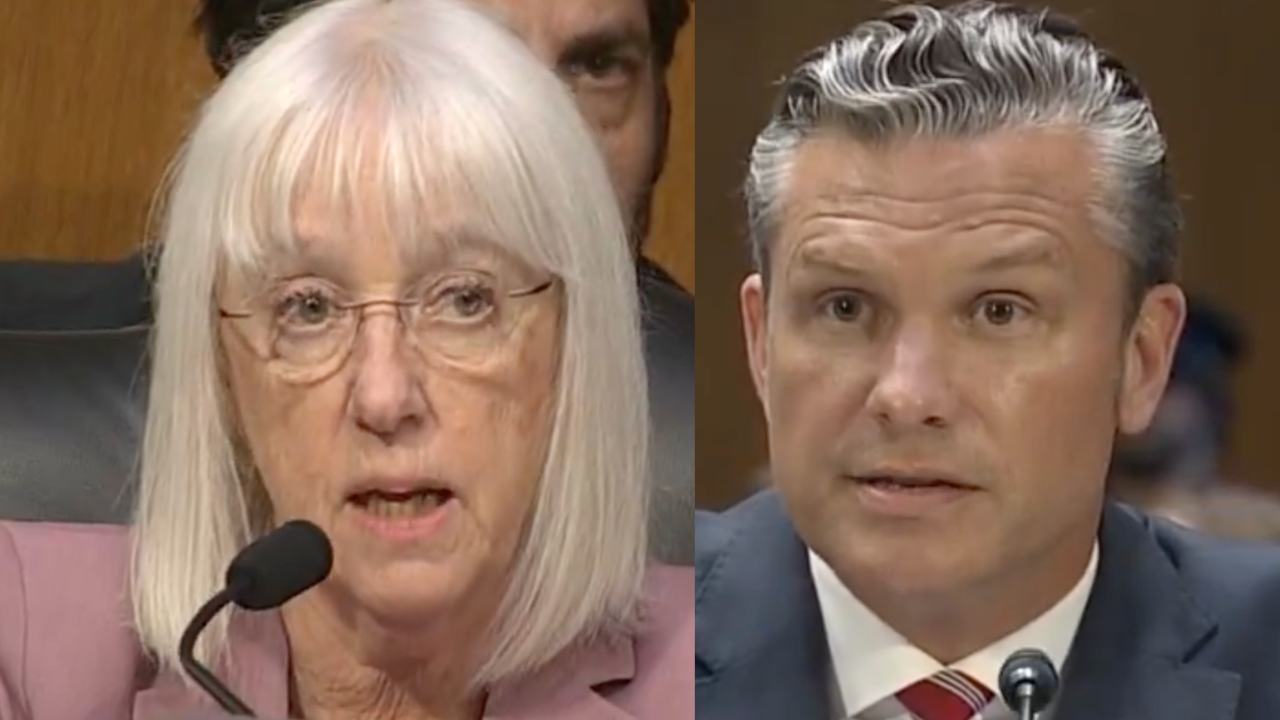
Sen. Patty Murray of Washington said bipartisan budget negotiations have broken down because Republicans are pushing a lopsided increase in military spending compared with domestic programs, abandoning a funding formula both parties have relied on for years.
“Republicans in Congress have been pushing hard to give Trump everything he wants, a massive increase in war funding while families get left behind,” Murray said at a July 29 Senate Democratic leadership press conference, according to the Senate Appropriations Committee’s official transcript of her remarks. “Sorry, but no.” Murray raised similar concerns the same day on X, writing that “Congress is not an ATM for Trump’s forever wars.”
Murray, Vice Chair of the committee, said she has tried to preserve a longstanding budget practice known as parity, in which defense and nondefense spending receive roughly equal percentage increases. “I’ve worked in good faith to try to land a bipartisan topline funding agreement to ensure that we do invest in families, not defense contractors,” Murray said. “But time and time again Republicans have made clear they cannot be where they have been for years on parity, the compromise that has guided many funding deals, which provides roughly equal increases for defense and nondefense. This time, Republicans want to deliver over four new dollars in defense funding for every dollar in nondefense.”
Murray said her caucus would not accept that ratio. “Because of that, my Democratic colleagues and I have been clear we will not accept their topline and will instead continue to push for a fair, bipartisan topline like the ones we reached the last three years, which allowed us to draft and pass good bipartisan bills,” Murray said.
Murray tied the imbalance directly to the administration’s proposed defense budget. “A $1.5 trillion war budget. That is a nearly half a trillion increase,” Murray said. “For families here at home, for things like housing and child care? A 10 percent cut.” She added that the administration’s separate $87.6 billion supplemental request, which includes $67.1 billion in additional Pentagon funding tied to the Iran war, compounds the disparity further.
Murray detailed specific elements of that supplemental request during a July 21 Senate Appropriations Committee hearing, where she pressed Defense Secretary Pete Hegseth on why the request bundled in spending unrelated to Iran. According to the committee’s official release on that hearing, the request includes more than $18 billion in munitions funding already sought separately in the fiscal year 2027 budget, $800 million to continue the National Guard’s deployment in Washington, D.C., more than $1 billion for Army border patrol operations, and $900 million for U.S. Southern Command’s boat strikes in the Caribbean.
“Your Department received $150 billion last year in the Republicans’ ‘Big Beautiful Bill.’ And it also received a record $839 billion for fiscal year 2026, more money than you asked for last year,” Murray told Hegseth at the hearing. “Combined, that is a $1 trillion budget for the year, and your Department has yet to spend half of the reconciliation funds. Despite that, you are here today asking for tens of billions of dollars more.”
Hegseth defended the funding request by attributing the department’s needs to the prior administration. “Why this kind of spending is needed is because of the gross negligence and neglect of the Biden administration inside our department,” Hegseth told Murray. “They ran it like a bureaucracy, abandoned our strength posture around the world, so we’re having to reestablish deterrence.”
Murray warned the standoff over the defense-nondefense ratio would delay the full-year appropriations process, saying Congress will instead need a continuing resolution to fund the government into December while she and Appropriations Chair Susan Collins work out the underlying disagreement. She noted the stakes are compounded by an “infrastructure cliff” arriving Oct. 1, when more than $65 billion in annual Bipartisan Infrastructure Law funding is set to expire.
Murray has served as the Senate Appropriations Committee’s top Democrat since 2023, and previously chaired the panel from 2023 to 2025 when Democrats held the Senate majority, giving her a lead role in each of the last several years’ bipartisan funding negotiations that she said had preserved rough parity between defense and nondefense spending.
The parity practice Murray referenced has governed congressional appropriations negotiations for roughly a decade, with both parties generally agreeing to raise defense and nondefense discretionary spending by similar percentages each cycle to secure enough votes to pass funding bills in the Senate, where 60 votes are typically needed to overcome a filibuster.
Neither the White House nor Senate Republican leadership has issued a direct public response to Murray’s characterization of the funding ratio.