
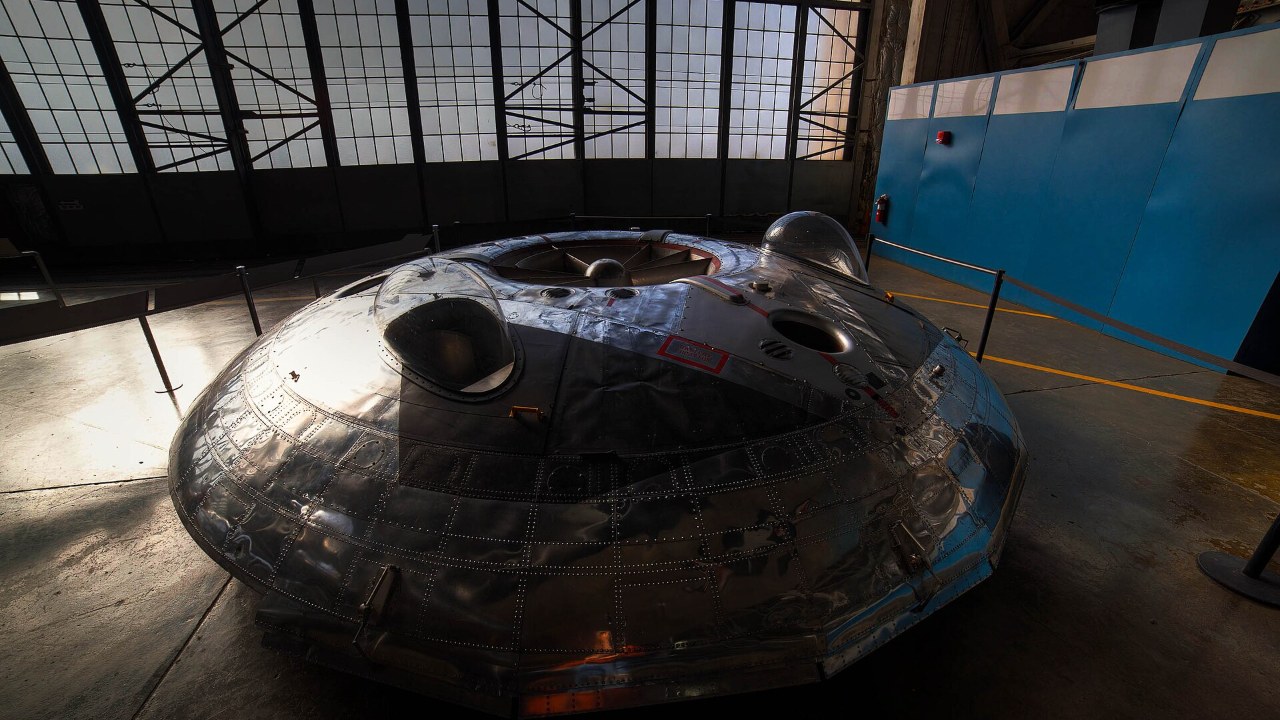
At Fort Eustis, Virginia, the U.S. Army Transportation Museum keeps a flying saucer in pieces. It is the second of two Avrocars, a circular, jet-driven test craft built in Canada and taken over by the U.S. Army and Air Force in 1958. It never got more than a few feet off the ground in controlled flight, and the program was cancelled in December 1961.
The Avrocar was supposed to hover, skim the ground on a cushion of air and then accelerate to high speed at altitude. What the flight tests found instead was a machine that wobbled out of control above three feet and could not get past 35 mph.
The Army’s own account is on the U.S. Army Transportation Corps history page for the museum’s Avrocar exhibit. It states that the second prototype underwent flight tests and that “If it flew more than three feet above the ground, the Avrocar displayed uncontrollable pitch and roll motions, which the Avro engineers called ‘hubcapping.'” The page continues: “The Avrocar could only reach a maximum speed of 35 mph, and all attempts to end the hubcapping failed. The project was cancelled in December 1961.”
Two services, one saucer
The design came out of A.V. Roe (Avro) Aircraft Limited, later Avro Canada, as an attempt at a supersonic vertical takeoff and landing fighter-bomber in the early 1950s, according to the Army page. Its engineers used exhaust from turbojet engines to drive a circular “turborotor.” Thrust directed downward would build a cushion of air under the craft; thrust directed rearward would push it forward and up.
The Canadian government provided initial funding in 1952 but dropped the project when it became too expensive, and Avro offered it to the United States. The Army and Air Force took it over in 1958 with different goals. Per the Army page, “the Army wanted to use it as a subsonic, all-terrain troop transport and reconnaissance craft, but the USAF wanted a VTOL aircraft that could hover below enemy radar then zoom up to supersonic speed.” The two sets of requirements, the page says, “differed too much.”
The designation VZ-9AV broke down simply: “VZ” for experimental vertical flight, “9” for the ninth concept proposal and “AV” for Avro. Air & Space magazine’s May 2003 history of the program, by Graham Chandler, credits the concept to British engineer John Carver Meadows Frost, who conceived it in 1952, and reports that “In December 1961, having spent a total of $10 million on the program, the Pentagon canceled it.”
What the wind tunnel and the flights showed
The warnings started small. Scale-model tests at Wright-Patterson Air Force Base, Ohio, indicated that “the cushion of air under the Avrocar would become unstable just a few feet off the ground,” per the Army page, and the craft would be incapable of supersonic speed. Testing continued to see whether something useful could be built for the Army.
The first prototype, serial number 58-7055, went to NASA’s Ames Research Center at Moffett Field, California, where wind tunnel tests “proved that the aircraft had insufficient control for high speed flight and was aerodynamically unstable,” the Army page says. Air & Space reported that the Air Force had the craft tested in Ames’ 40- by 80-foot wind tunnel, a facility whose blades first turned in June 1944, according to an Arnold Air Force Base article marking the tunnel’s 80th anniversary. The Air Force’s Arnold Engineering Development Complex has operated it under a lease with NASA since 2006, the same article says.
The second prototype’s flight tests then “validated the wind tunnel tests,” in the Army’s words. Hubcapping, the pitching and rolling that set in above three feet, was never solved.
The craft that failed those tests was small. The Army page lists the Avrocar’s technical notes:
- Crew: two
- Engines: three Continental J69-T9 turbojets of 927 pounds of thrust each
- Wingspan: 18 feet
- Height: 4 feet, 10 inches
- Weight: 4,620 pounds empty
Where the two Avrocars ended up
The National Museum of the U.S. Air Force fact sheet on the VZ-9AV states that the first prototype came to the museum in Dayton, Ohio, in 2007. The Army’s exhibit page describes that first airframe as the one “which never flew.” The second, the flight-test vehicle, went to the Army Transportation Museum at Fort Eustis, where, the Army page notes, the cost to restore it “would be extremely expensive.”
Before its move to Ohio, the first Avrocar sat at the Smithsonian’s Garber facility in Suitland, Maryland, Air & Space reported in 2003. One saucer is now on display in Dayton and the other is stored at Fort Eustis, where the Army has placed a piece of it in its Cold War and experimental exhibit area.
Top image: The Avrocar on display at the National Museum of the United States Air Force. Image Credit: Alvintrusty — CC BY-SA 3.0 / Wikimedia Commons
This article was produced with the assistance of AI and reviewed by Combat Rated editors prior to publication.