
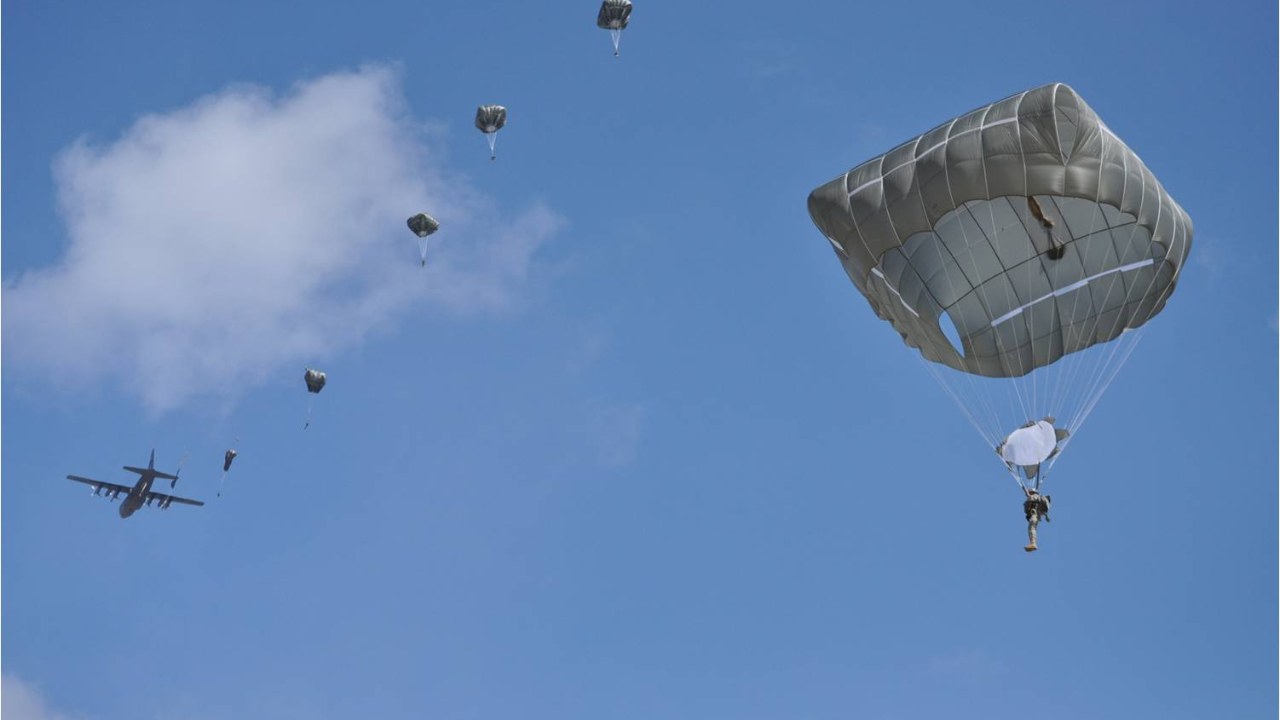
In the 1950s, a paratrooper, his parachute and his combat load together averaged about 300 pounds. By 2007 paratroopers were carrying more equipment, and the T-10 canopy the Army had used since that earlier decade was being asked to lower a heavier man to the ground. The answer was the T-11, designed to bring jumpers down at an average of 18 feet per second with a quarter less impact force than the T-10.
Those were design targets set out when the Army began testing the new system in 2007. The fielding plan that went with them, and what Army researchers later measured on the drop zone, tell the rest of the story.
The Army’s Program Executive Office Soldier laid out the requirement in an Army News Service article dated March 23, 2007. It described the Advanced Tactical Parachute System (ATPS) T-11 as having “a significantly slower rate of descent averaging 18 feet per second, resulting in a 25 percent reduction in impact force over the T-10.” The same article said the T-11 used “a canopy with a 28-percent larger surface area than the T-10, while weighing only seven pounds more.”
Built for a 400-pound jumper
The weight problem drove the design. “The T-11 is designed to carry a paratrooper with a total jump weight of 400 pounds safely to the ground,” the 2007 article stated, compared with the roughly 300-pound average of the 1950s, when the T-10 entered service.
Lt. Col. John Lemondes, then PEO Soldier’s product manager for clothing and individual equipment, said in that article that the main canopy design gave a “much smoother deployment sequence,” which he expected to mean fewer jumper-related injuries. Operational testing had begun in January 2007, the article said, with XVIII Airborne Corps paratroopers scheduled to make more than 3,200 test jumps.
A later Army article, from Fort Lee on Oct. 15, 2009, described the canopy as “larger and square-shaped,” contributing to a slower descent rate, and said the T-11 was designed to carry “about 100 pounds more” than the T-10. That article also noted the T-10 had been in service more than 50 years.
A 2014 deadline that was a plan
The 2007 article included a schedule: the 75th Ranger Regiment and Army airborne training schools would receive the T-11 in 2008 and 2009, the 82nd Airborne Division in 2009 through 2011, “and T-10s will be replaced Armywide by 2014.” That was a plan written at the start of testing, not a record of what happened.
Later Army articles show where the program actually stood at points along the way. The 2009 Fort Lee piece reported that the 75th Ranger Regiment and the Airborne School had received the T-11 and repeated that the rest of the Army would field it by 2014. On March 16, 2010, according to an Army article published March 25, 2010, Airborne School students jumped the T-11 for the first time, and the 361 members of C Company, 1st Battalion (Airborne), 507th Parachute Infantry Regiment, graduated after making that jump.
What the injury data showed
The test that mattered most was the one the 2007 article predicted: fewer injuries. In February 2014, the U.S. Army Public Health Command reported on a study by its Injury Prevention Program covering three years of jumps by the 82nd Airborne Division, the 18th Airborne Corps and the 18th Air Support Operations Group, all at Fort Bragg, N.C.
According to that Army article dated Feb. 24, 2014, the T-10 carried “a risk of nine injuries per 1,000 jumps,” against “only 4.5 injuries per 1,000 jumps when using the T-11 parachutes.” Joseph Knapik, a research physiologist with the command, said in the article:
“Overall injury risk was reduced by half with the T-11 parachute compared to the T-10.”
The same 2014 article said the Army had begun using the T-11 in 2010 and was increasing production, “with 14,000 systems already in place at Fort Bragg.” It is the most recent dated status figure in the Army records reviewed for this article.
Top image: Airborne School students at Fort Benning, Ga., make the first jump with the T-11 parachute in March 2010. Image Credit: U.S. Army photo — Public domain / Wikimedia Commons
This article was produced with the assistance of AI and reviewed by Combat Rated editors prior to publication.