
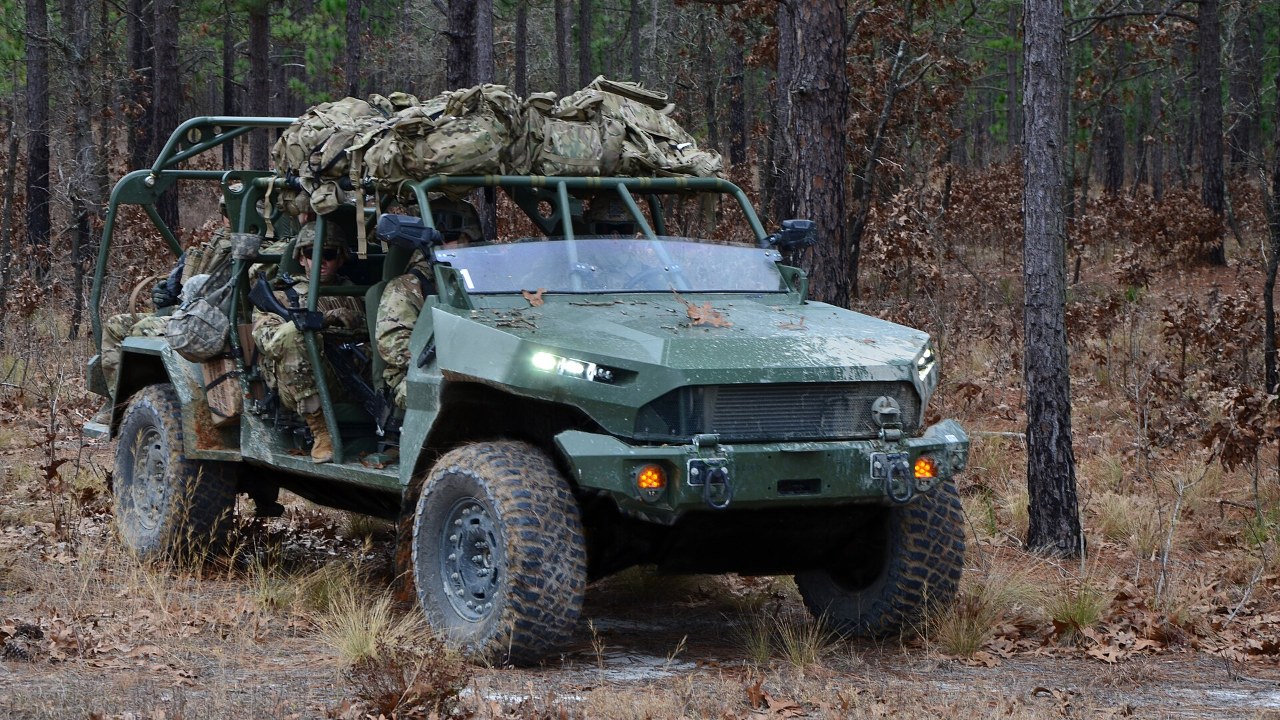
When the Army started the Infantry Squad Vehicle program in 2019, it set a procurement objective of 649 vehicles. By February 2026, the Army’s procurement and position objectives for the nine-passenger truck stood at 11,582. An Army acquisition official calls that “about an 18-fold increase from the original requirement.”
The growth came in steps over seven years, passing 900, 2,593 and 5,733 vehicles along the way. The 11,582 number is an objective, the count the Army has set as its requirement, not a total of vehicles bought or delivered.
The figures come from an Army article published Aug. 19, 2026 by Jacqueline Hames. “The Infantry Squad Vehicle program began in 2019, with a procurement objective of 649 vehicles,” the article says. “In February of 2026, the Army established the current position objective and procurement objective at 11,582 vehicles.”
From 649 to 11,582
The Army article traces each increase. “The number of vehicles required increased to 900 in February 2021,” it says. “It increased two more times and was set at 2,593.”
The next jump came with a second version of the vehicle. In April 2025, the Army approved the ISV utility variant and raised the procurement objective to 5,733 “vehicles across both variants,” per the article. Ten months later, in February 2026, the objective was set at 11,582.
The Army article does not say how many of the 11,582 vehicles are funded or under contract. The Defense Contract Management Agency gave one measure of deliveries in an April 22, 2026 article: its team has delivered “approximately 1,000 ISVs” to the Army over the previous five years.
A troop carrier built from a commercial truck
The ISV is, in the Army’s words, “an ultra-light tactical vehicle that carries nine passengers and their equipment.” It was designed to work alongside the Joint Light Tactical Vehicle and the Humvee, which the Army article says can be too heavy for some tasks. “So, the Army chose to develop a new, ultra-light troop transport vehicle,” it says. Soldier touchpoint events informed how it evolved, according to the article.
The builder is GM Defense LLC in Concord, North Carolina, and “the vehicle is based on the Chevrolet Colorado ZR2 truck,” according to the DCMA article. The agency says the ISV can be carried under a UH-60 Black Hawk helicopter, can “fit inside a CH-47 Chinook,” and is capable of “low-velocity air drops from both the C-17 and C-130 Hercules.” DCMA also reported that its team accepted 173 A1-variant vehicles on March 31, 2026.
Speed from off-the-shelf parts
The program’s pace comes from how it was bought. The Army used “commercial off-the-shelf solutions and minimal military modifications,” the Army article says, rather than a traditional acquisition process that can take four to 10 years, according to John Hufstedler, the product director for ground mobility vehicles at PAE Maneuver Ground. The result: “the first unit being equipped within 24 months.”
Hufstedler said discipline about requirements mattered. “A few key requirements were transportability, [but] mobility and payload and resisting requirements creep,” he said in the Aug. 19 article.
Susan Fung, Portfolio Acquisition Executive Maneuver Ground’s mobile brigade combat team deputy project manager, is the official who put the growth in proportion. The jump to 11,582 is “really equivalent to about an 18-fold increase from the original requirement,” she said in the Army article.
The ISV family is still growing. According to the Army article, the team is developing an ISV heavy variant with enhanced onboard power generation and storage for next-generation command and control equipment. That variant is in development; the Army article gives no production date for it.
Top image: An Army Infantry Squad Vehicle, Jan. 24, 2020. Image Credit: Michael J. Malik — Public domain / Wikimedia Commons
This article was produced with the assistance of AI and reviewed by Combat Rated editors prior to publication.