
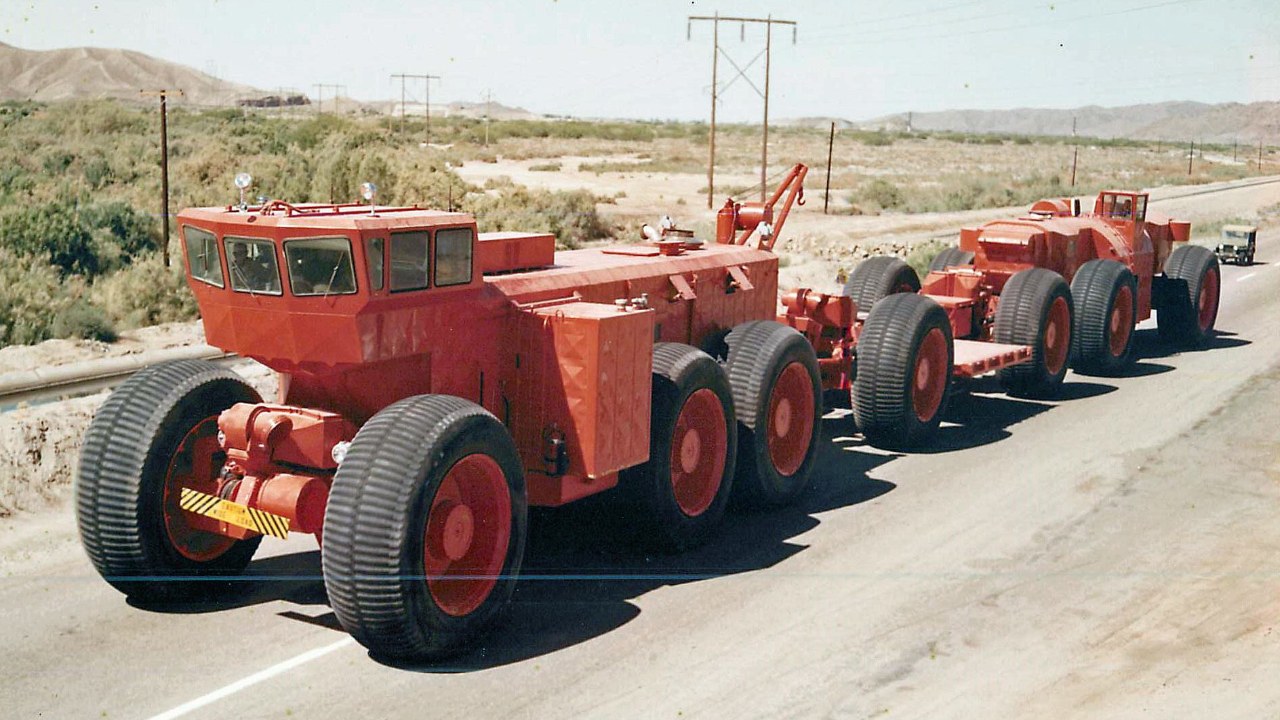
Five hundred seventy-two feet, 13 units and 54 driven wheels: that was the TC-497 LeTourneau Overland Train the Army tested at Yuma Proving Ground, Ariz., in 1962. The Army’s own account calls it the longest rubber-tired vehicle in the world at the time. It never reached the field, and when it was sold for scrap in 1968, only the control car was kept.
That control car went back to the proving ground. As of the Army’s January 2023 account, it was on static display at the post’s Howard Cantonment Area.
The record comes from a Jan. 26, 2023 Army article by Mark Schauer, written when science and technology YouTuber Calum Gillies came to film a segment on the machine. “Built for a crew of six, the 572-foot long, 13 unit TC-497 LeTourneau Overland Train could haul 150 tons of cargo,” the article states, from personnel carriers and Jeeps to construction equipment and cargo containers. It describes the train as a 54-wheel-drive welded aluminum vehicle that “was the longest rubber-tired vehicle in the world.”
A road train for places with no roads
The idea came out of World War II. Schauer’s article says the overland train was “the result of logistical support problems encountered in World War II in areas without adequate highway and rail networks.”
The machine’s power layout is described in a March 12, 2025 history by David Doyle in Military Trader. According to Doyle, the TC-497 used four Solar 10MC gas turbine engines rated at 1,170 horsepower each, which supplied power to 54 wheel-mounted traction motors. He puts its weight at 300 tons empty and 450 tons loaded, says it could maintain about 20 miles per hour on level ground, and says it was completed in February 1962 before testing at Yuma. Doyle adds that each cargo car could carry 15 tons, and he writes that the train is “officially recorded as the longest land vehicle ever built,” a broader claim than the Army’s rubber-tired wording. Its builder traces back to Robert Gilmour LeTourneau, who, Doyle notes, established his company in California. Those figures and details come from Doyle’s article, not from the Army’s 2023 piece.
Overtaken by the helicopter
The train worked; the timing did not. The Army article says it “performed well during testing” but was “rendered obsolete by heavy lift helicopters like the S-64 Skycrane before it could be fielded.”
The Army’s account of what happened next is brief. “The overland train was sold for scrap in 1968, but the control car was spared,” it says. The surviving car then spent years as an advertising piece for a Yuma RV dealership before it returned to the proving ground in the late 1990s, according to Schauer.
Not every account agrees on the details. Doyle’s Military Trader history says the train was sold at auction in 1971 and that “the power car” survives at the Yuma Proving Ground Heritage Center. The Army’s 2023 article gives 1968 and identifies the survivor as the control car on display at the Howard Cantonment Area.
The control car at Yuma
The surviving car has had some care. In 2019, volunteers from YPG’s Travel Camp, led by retired Army noncommissioned officer Mark Sandercock, spent several weeks cleaning and painting its interior, the Army article says. “The LeTourneau vehicles have always captivated my audience,” Gillies told the Army during his visit.
The Army’s 2023 account ends where the train’s story does: one control car, restored inside, standing on a desert post more than six decades after the 1962 trials. Per the Army, it is the one piece of the 572-foot train that was not sold for scrap.
Top image: The Army’s LeTourneau Overland Train during testing at Yuma Proving Ground, Arizona. Image Credit: U.S. Army photo via Mark Holloway — Public domain / Wikimedia Commons
This article was produced with the assistance of AI and reviewed by Combat Rated editors prior to publication.