
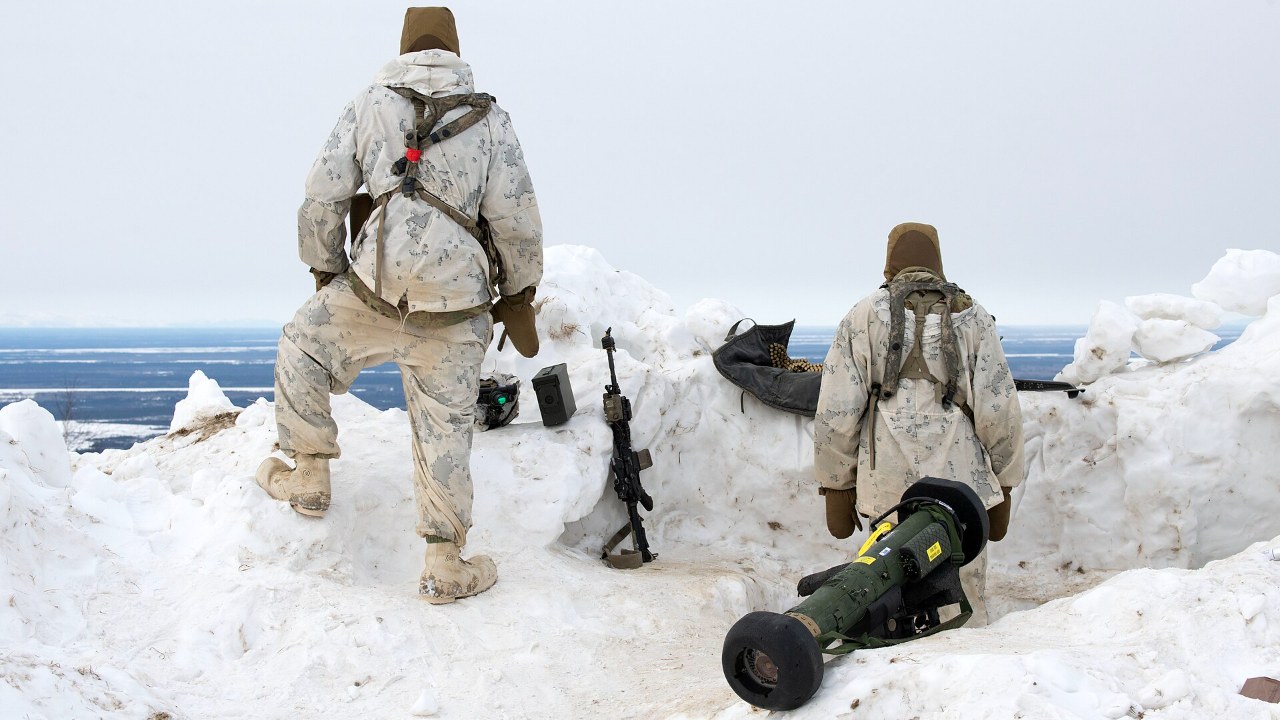
Five layers, 15 sizes and roughly six months from concept to delivery made up the Cold Temperature and Arctic Protection Systems, or CTAPS. The Army began issuing it to the 11th Airborne Division in Alaska on Feb. 13, 2023. Soldiers there had reported that the legacy Extended Cold Weather Clothing System, known as ECWCS, did not meet the demands of Alaska’s extreme cold.
The push came from the top. The Army directed the requirement in June 2022, to outfit soldiers in Alaska for winter field training, and the first sets reached soldiers at Fort Wainwright and in Anchorage the following February. The development effort from concept to delivery “took only six months,” per the Army.
Those figures come from an Army article published March 1, 2023 by Zachary Catron of PEO Soldier Public Affairs. At the height of the fielding, the article said, vendors were producing “between 250-400 sets of CTAPS per day,” and “300-500 Soldiers are being issued CTAPS every day.”
Six months on top of seven years
The six-month figure describes the sprint to field CTAPS, not the whole program. According to a companion Army article dated April 4, 2023 by Jane Benson of DEVCOM Soldier Center Public Affairs, the Soldier Center designed CTAPS as an upgrade to ECWCS and the program began in 2016. A Technology Transition Agreement moved its handoff to Product Manager Soldier Clothing and Individual Equipment forward by two years, to fiscal 2023, under a direct requirement.
The April article said limited user evaluations had drawn on “over 350 Soldiers and Airmen,” with focus groups and surveys feeding the design during prototyping. “Soldier input has been used to inform the CTAPS program since its inception in 2016,” project officer James Murdock said in that article.
The March article describes how the Army compressed the final stretch. Within three days of receiving the directed requirement, PEO Soldier, DEVCOM and arctic subject matter experts with the Vermont National Guard “conducted a complete design review and finalized the initial design for production.” Within 10 days of the contract award to two prime contractors, pre-production samples of the government-designed CTAPS were in hand. The article does not name the contractors.
The five CTAPS layers
CTAPS is built as a set of layers soldiers combine for the conditions. The March 2023 article lists five:
- Base layer (L1): next-to-skin moisture management.
- Lightweight Insulated Layer (L3): insulation with vented underarms.
- Softshell Uniform (L5): the primary outer garment, worn in place of the Army Combat Uniform.
- Cold-Wet Weather Uniform (L6): a breathable hard-shell rain layer.
- Extreme Cold Weather Parka and Trousers (L7): the outermost layer, for maximum insulation during static missions.
The system is made in the Operational Camouflage Pattern and comes in “15 different sizes,” per the Army. “We have been finding that most Soldiers actually wear a size down from what they were wearing in the ECWCS system,” Murdock, project officer for Product Manager Soldier Clothing and Individual Equipment, said in the March article. The April article lists venting, pass-through pockets between layers, adjustability features and expansion gussets for body armor and load-carriage systems among its design features.
Murdock described the conditions the gear was built for. Alaska-based soldiers face “the most austere conditions,” he said in the April article, with temperatures reaching minus 70 degrees Fahrenheit and 50 mph gusts. He called CTAPS “a holistically integrated cold weather clothing system.”
Fielding to the 11th Airborne
The 2023 fielding was sized to the division’s training calendar. The March article said the team aimed to equip up to two brigade combat teams before a March 2023 training exercise, and that support staff would remain in Alaska “for up to four months to support every soldier receiving this premier system.”
The Army’s account also credited the soldiers who tested it. Murdock said in the March article that the team knew it had a unique system when soldiers were still wearing CTAPS well after initial testing had ended. Sgt. Maj. Daniel Rose, the Program Executive Office Soldier sergeant major, told small-unit leaders that CTAPS was meant to help them fight in the Arctic and that their feedback would shape its future development.
By the Army’s March 2023 count, that feedback loop was running at a pace of 300 to 500 soldiers a day, each leaving with a five-layer system that had gone from a June 2022 directive to the field in Alaska in about six months.
Top image: 11th Airborne Division infantrymen in Alaska during JPMRC-AK 23-02, March 30, 2023. Image Credit: U.S. Army (Arctic Warrior) — Public domain / Wikimedia Commons