
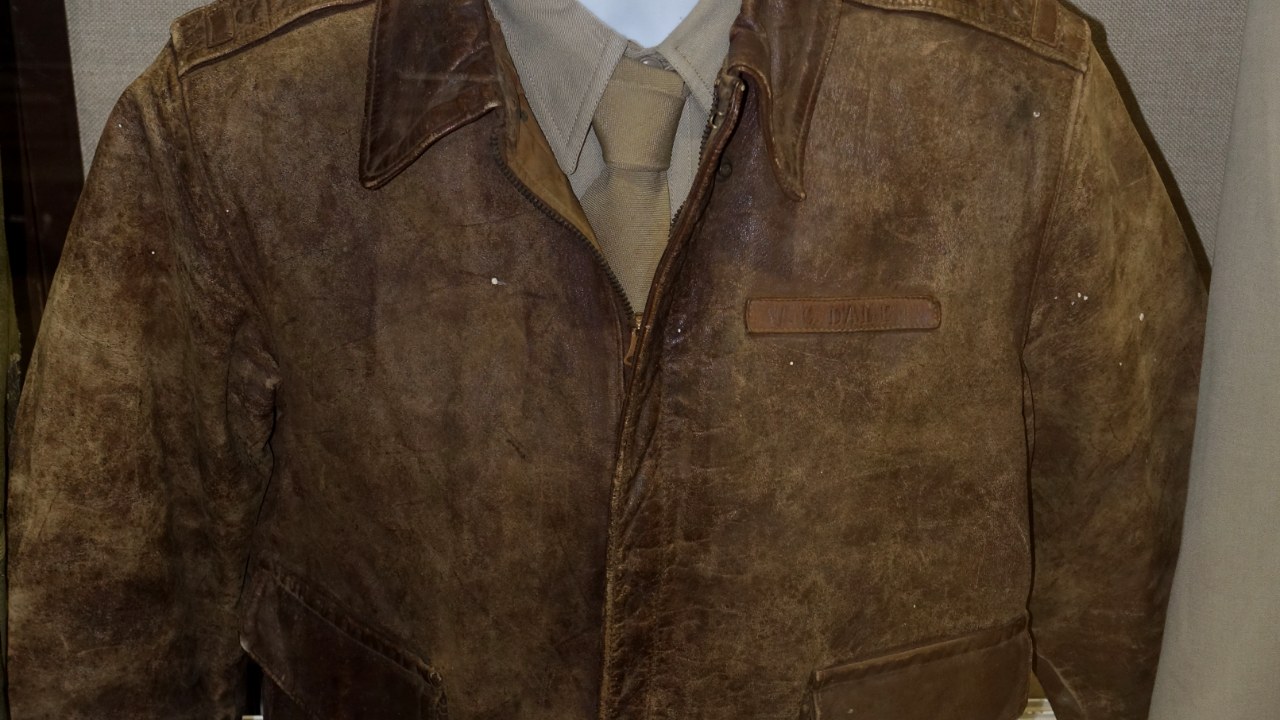
Tech. Sgt. Bernard Mechanic’s leather flight jacket carries 37 hand-painted bombs on its right breast, one for each completed mission. It is a Type A-2, the waist-length horsehide jacket that the U.S. Army Air Corps created in 1931 by ordering changes to its older Type A-1. The Smithsonian’s National Air and Space Museum, which holds Mechanic’s jacket, says the A-2 is still issued by the U.S. Air Force.
The design changes were small, and they stuck. A zipper replaced the buttons, a leather collar replaced the knit one, and the result became the jacket most associated with American aircrews in World War II.
The museum lays out the origin in its collection record for Mechanic’s jacket, inventory number A20181345000: “In 1931, the United States Air Corps issued an order to update and modify the Type A-1 flight jacket.” The record continues: “The new jacket was designated — Type A-2. This jacket became associated with American pilots serving on every front during World War II and is still issued by the U.S. Air Force today.” The statement about current issue is the museum’s, in a catalog record that carries no publication date.
What the 1931 order changed
The museum spells out the two changes that separated the A-2 from the A-1: “replacing the button down front with a zipper and the knit collar with a leather drop fall collar.” The same language appears in the Smithsonian’s record for a second A-2 in its collection, the jacket of navigator Dr. Thomas N. Weems of the 69th Bombardment Squadron, which flew the Martin B-26 Marauder. That Weems jacket record lists its maker as Aero Leather Clothing Co.
The museum’s physical description of Mechanic’s jacket reads like a spec sheet for the type: “waist length seal brown horsehide jacket with brown knit wool cuffs and waist band; brass zipper down front; two front flap pockets with hidden snaps; stand and fall collar with snaps; brown rayon lining; shoulder straps.” The museum lists the jacket’s manufacturer as Bronco Mfg. Co., a different contractor from the one that made the Weems jacket.
The Army Air Corps Museum, in its library listing for Hell-Bent for Leather: The Saga of the A-2 and G-1 Flight Jackets by Derek Nelson and Dave Parsons, describes the A-2 as “adopted by the Army Air Corps in 1931 as functional protective clothing for open-cockpit aircraft.” The same listing says the book covers “the discontinuation of the A-2 in 1943 due to leather shortages and its eventual restoration to military use in the 1980s.”
Bernard Mechanic and Operation Tidal Wave
Mechanic’s jacket is the one the Smithsonian chose to tell the A-2 story. According to the museum, “He served as a gunner/radio operator with the 376th Bomb Group 9th Air Force” flying Consolidated B-24s. He wore the jacket during Operation Tidal Wave on Aug. 1, 1943, the low-level raid on the Ploesti oil refineries.
The museum’s record says the plan called for 177 B-24s flying at 300 to 500 feet to evade German radar. “Sgt. Mechanic was awarded the Distinguished Flying Cross for his bravery during this mission,” the record states. The front of the jacket carries two leather tags reading “T/SGT B. MECHANIC, RADIO OP. GUNNER,” and the left shoulder carries an embroidered Air Corps winged-star insignia.
The jacket came to the museum as a gift from Mark L. Machanic, the sergeant’s nephew, per the record’s credit line. It is listed on display in the Jay I. Kislak World War II in the Air gallery at the National Air and Space Museum in Washington.
Painted Ladies and Flak-Bait
The A-2’s plain leather back became a canvas. “Many pilots and aircrews modified their jackets with custom artwork that depicted the name of their aircraft,” the Smithsonian notes, adding that the jackets “are nick named ‘Painted Ladies'” after the pinup art that often matched an aircraft’s nose art.
One of the best-known examples in the collection belonged to Tech. Sgt. Darnell, radio operator on the Martin B-26 Flak-Bait. The museum’s record for the Flak-Bait jacket describes a “painting of Martin B-26 and 65 bombs on back of jacket.” The bomber itself is in the Smithsonian’s care as well. The museum’s Flak-Bait research project page says Marauder 41-31773, assigned to the 449th Bombardment Squadron, 322nd Bomb Group, and its crews “flew more missions than any other American aircraft during World War II.”
Mechanic’s 37 bombs and Darnell’s 65 put both jackets on the museum’s record as working gear, the product of the same 1931 order. The Smithsonian’s position, stated in the Mechanic record, is that the design is still being issued to Air Force aircrews more than 90 years after the Air Corps ordered it.
Top image: A World War II Army Air Corps A-2 leather flight jacket, owned by Lt. Col. W. C. Dale, on exhibit at the Oregon Air and Space Museum in Eugene. Image Credit: Daderot — CC0 / Wikimedia Commons
This article was produced with the assistance of AI and reviewed by Combat Rated editors prior to publication.