
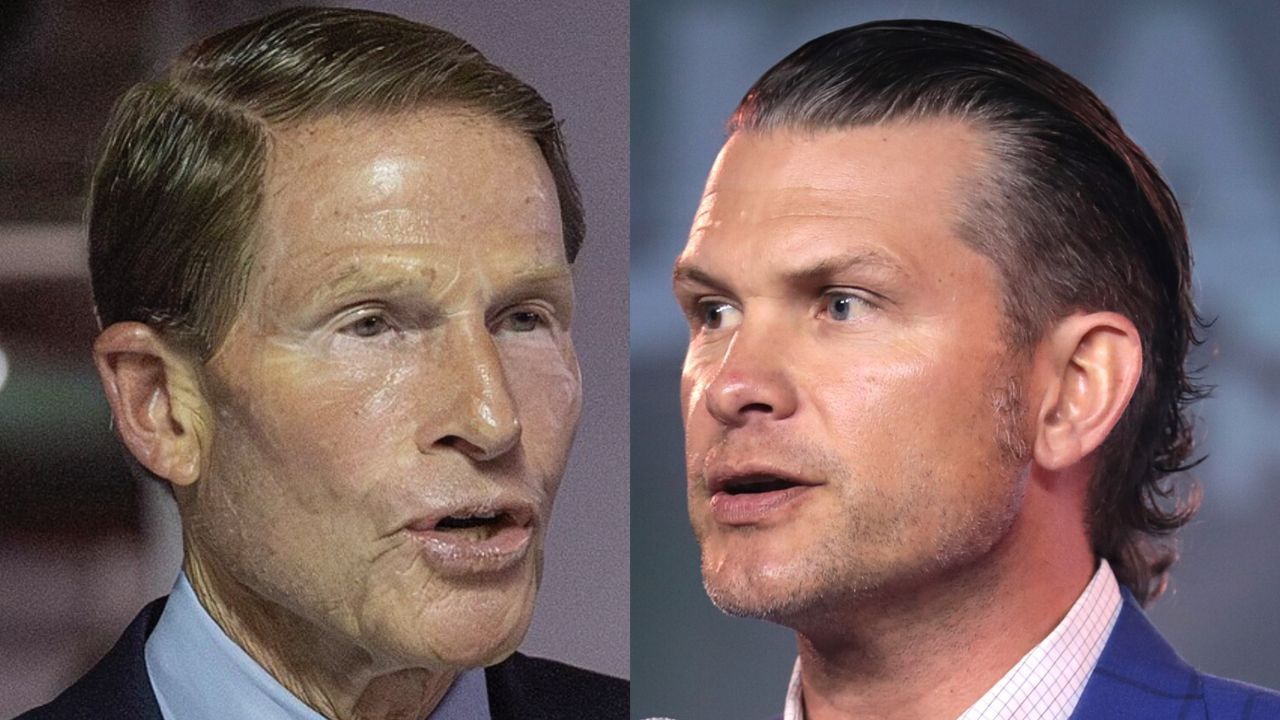
Sen. Richard Blumenthal (D-Conn.), a member of the Senate Armed Services Committee, accused Defense Secretary Pete Hegseth on Friday of turning the planned execution of Fort Hood shooter Nidal Hasan into a “gruesome inhumane spectacle.” In a post on X, Blumenthal said the Trump administration is using the moment to “wield power like a bloodthirsty dictatorship.” The remarks came days after the Pentagon confirmed that the first military execution in more than six decades will be livestreamed.
The Post
Blumenthal published the statement at 6:00 PM on Oct. 9, 2026. It reads in full:
“Secretary Hegseth is turning the Fort Hood execution into a gruesome inhumane spectacle. Livestreaming the execution does not provide the victims justice—it’s an excuse for the Trump Administration to wield power like a bloodthirsty dictatorship.”
The post responds directly to reporting from CBS News that the Trump administration had approved a plan to execute Hasan, a former Army major, by firing squad. Chief Pentagon spokesman Sean Parnell announced the decision late on Oct. 6, saying the method was recommended by Hegseth and approved by President Donald Trump.
How the Plan Unfolded
Parnell wrote on social media that the Secretary of the Army would set the time and place of the execution, adding, “Judgement day for Hasan has finally come.” An email sent to victims’ families set the date as Dec. 3, and Fort Hood referred questions to Army headquarters.
The question of public access arose Wednesday, when Hegseth was interviewed aboard the USS Abraham Lincoln while visiting a carrier crew that supported the Iran war. He said the execution would take place at Fort Hood and that “We’ll make sure that people are able to watch it, that it’s public.” Asked whether Hasan had made any final requests, Hegseth brushed off the question. On Thursday, Pentagon officials clarified that the execution would be livestreamed and that more details would follow, while the White House referred questions to the Pentagon.
Acting Army Secretary Adam Telle set the execution for Dec. 3, 2026, at Fort Hood, the same post where the attack took place. The execution is scheduled for 1 p.m. Trump also addressed the case during remarks Wednesday night, saying the military would “deliver final justice to an evil killer.”
The Case Behind the Execution
Hasan, a former Army psychiatrist, killed 13 people and wounded more than 30 in the 2009 shooting at Fort Hood. He was convicted in a 2013 court-martial and sentenced to death. Hasan acknowledged at trial that he was the shooter, saying he opened fire on fellow soldiers to protect Islamic insurgents from U.S. forces. He represented himself, and in an unusual turn clashed with his own standby attorneys, who feared he was seeking the death penalty. The Supreme Court declined to review his case last year.
If carried out, the execution would be the military’s first of a service member since 1961, when a soldier was hanged for raping and attempting to murder an 11-year-old girl. A firing squad is also a rare method. South Carolina used one three times last year, the first such executions since 2010. The federal government typically relies on lethal injection for civilian cases, though the Justice Department said earlier this year that officials should consider firing squads, electrocution and lethal gas. Legal experts say Hasan could also file a habeas petition in civilian court, which could significantly delay the execution.
A Backdrop of Failed Executions
The announcement arrived days after a botched execution in Tennessee that drew international attention. Christa Pike survived two lethal doses of pentobarbital, and her lawyers said she remained in critical condition afterward. Gov. Bill Lee stayed all remaining executions this year, and the state’s prison chief later resigned. The episode has intensified scrutiny of how the death penalty is carried out in the United States, and the Pentagon’s plan for a public broadcast lands in that climate.
Blumenthal’s Record on Hegseth and Trump
Blumenthal’s post is the latest in a long run of criticism of Hegseth. In January 2025, he took to the Senate floor to urge colleagues to reject the nomination, calling Hegseth “probably the most unqualified nominee” for the post in recent history and citing his mismanagement of two veterans’ organizations and accounts of alcohol abuse and sexual misconduct. At Hegseth’s confirmation hearing, Blumenthal entered tax forms from both organizations into the record.
In December 2025, Blumenthal criticized Hegseth after a Pentagon inspector general report found that his use of a commercial messaging app to share classified information put U.S. servicemembers at risk. He argued that Hegseth escaped discipline only because he sits at the top of the chain of command.
His warnings about concentrated power extend to the president. On the Senate floor during the Iran war powers debate, Blumenthal said arbitrary and reckless uses of war power are more likely under an autocrat, and that “Donald Trump is workshopping a war.” In a statement after Trump’s State of the Union address, he called the speech “another misstep by a misguided would-be autocrat” and said he is “more convinced than ever that our democracy is in danger.”
Impeachment Efforts Against Hegseth
House Democrats introduced six articles of impeachment against Hegseth on April 15, 2026, accusing him of abuse of power, war crimes and other wrongdoing, with the resolution led by Rep. Yassamin Ansari of Arizona. The Pentagon dismissed the effort as “just another Democrat trying to make headlines.” Impeachment begins in the House, and with Republicans holding majorities in both chambers, the articles are not expected to pass.
What Comes Next
With the Dec. 3 date set, the Pentagon has said more details on the livestream are coming. Hasan’s potential civilian-court challenge could still change the timeline. Blumenthal’s post shows that opposition to the plan is forming around the decision to broadcast the execution as much as around the execution itself, and it ties that decision to his broader argument about how the Trump administration uses executive power.