
Bruyères sits in a valley in northeast France, ringed by four wooded hills that Allied planners labeled A, B, C and D. In October 1944 those hills stood between the 442nd Regimental Combat Team and the town. By the night of Oct. 18, 1944, the regiment of Nisei soldiers had taken Bruyères, and Oct. 18, 2026 marks 82 years since that day.
Its soldiers were Nisei, which the Army defines as American-born sons of Japanese immigrants. Before the Vosges, the regiment had come through a year of stateside training and a summer in the Mediterranean, according to the Army’s own history of the unit.
The American Battle Monuments Commission put the date on the record in its release for the 80th anniversary of the liberation, published Oct. 3, 2024: “On Oct. 18, 1944, after heavy fighting, the men of the 442nd Regimental Combat Team liberated the town of Bruyères.” The commission describes the unit as “composed almost entirely of Nisei” and calls it “the most highly decorated regiment in U.S. military history for its size and length of service.” ABMC marked that anniversary with a ceremony at its Epinal American Cemetery, which the release places in the foothills of the Vosges Mountains.
From Camp Shelby to the Vosges
The regiment was activated on Feb. 1, 1943, according to the Army’s March 15, 2025 profile of the unit. After a year of training at Camp Shelby, Miss., it deployed to the Mediterranean in May 1944. The Army’s profile says the Hawaii-born Nisei made up about two-thirds of the regiment and that the rest came from the mainland. Some volunteered from Hawaii, the profile says, and others from the 10 relocation centers on the mainland.
The 100th Infantry Battalion formally became the 442nd’s first battalion on Aug. 10, 1944, per the same Army profile. For the push into France, the regiment was attached to the 36th Infantry Division “for the drive into the Vosges Mountains.”
Getting there was its own operation. The U.S. Army Center of Military History’s day-by-day chronology of the 100th Battalion and 442d Infantry records a motor convoy that left for an assembly area near Pouxeux on Oct. 9. The chronology says “the trip covered 450 miles and was made under adverse conditions of rainy weather and slippery roads.” The 3rd Battalion made the move by rail in boxcars.
Four hills and a town of 4,000
The attack opened on Oct. 15, 1944. The chronology states the regiment’s aim plainly: “The primary objective was the capture of the city of BRUYERES, a city of 4,000 population.”
The Go For Broke National Education Center’s account of the Vosges campaign gives the plan of attack. Under Maj. Gen. John Dahlquist, the 36th Division’s commander, the 100th Battalion went at Hill A and the 2nd Battalion at Hill B. For three days, the center’s history says, the infantrymen fought off constant German attacks.
The ground favored the defenders. The Army chronology notes that by Oct. 17 the Germans had fortified the houses at the foot of the hills. Go For Broke’s history says “the Germans had the terrain and the weather on their side.” In the end the 3rd Battalion drove the defenders out of the town itself.
The chronology’s entry for Oct. 18, headed “Fall of Bruyeres,” closes the day this way: “By nightfall the town was under control, although a barricaded group of Germans continued to resist.” The hills were not finished. German shelling of the town went on through Oct. 19, according to the chronology, and the 100th Battalion attacked Hill C on the morning of Oct. 20.
Biffontaine and the rest of October
The fighting rolled east from Bruyères. The chronology records Company C taking Biffontaine on Oct. 23, “fighting the Germans from house to house.” Days later the regiment was sent into the forest for a different mission. The Army’s 2025 profile sums up the period in one line: in four weeks of heavy combat in October and November 1944, the 442nd liberated Bruyères and Biffontaine and rescued a “lost battalion” cut off from the 36th Division.
The regiment’s record from the war, as the Army counts it, includes 21 Medals of Honor and eight Presidential Unit Citations, which the Army’s unit profile calls “unprecedented.” The same profile counts 9,486 Purple Hearts. The 442nd’s motto, the Army notes, was “go for broke.”
The ABMC release notes that Epinal American Cemetery holds about 5,300 American war dead, with more than 450 missing service members named on its walls. Oct. 18, 2026 marks 82 years since the 442nd took Bruyères.
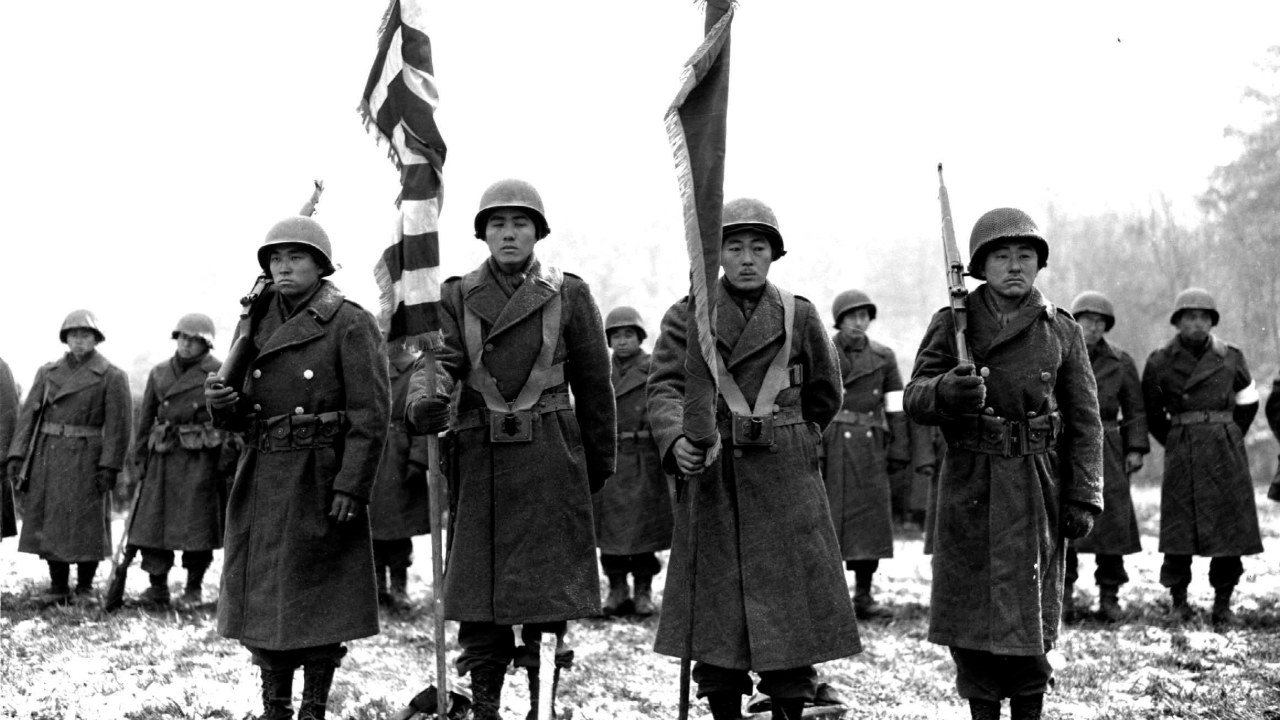
Top image: Color guards of the 442nd Regimental Combat Team at a citation presentation in Bruyères, France, on Nov. 12, 1944. Image Credit: U.S. Army Signal Corps — Public domain / Wikimedia Commons
This article was produced with the assistance of AI and reviewed by Combat Rated editors prior to publication.