
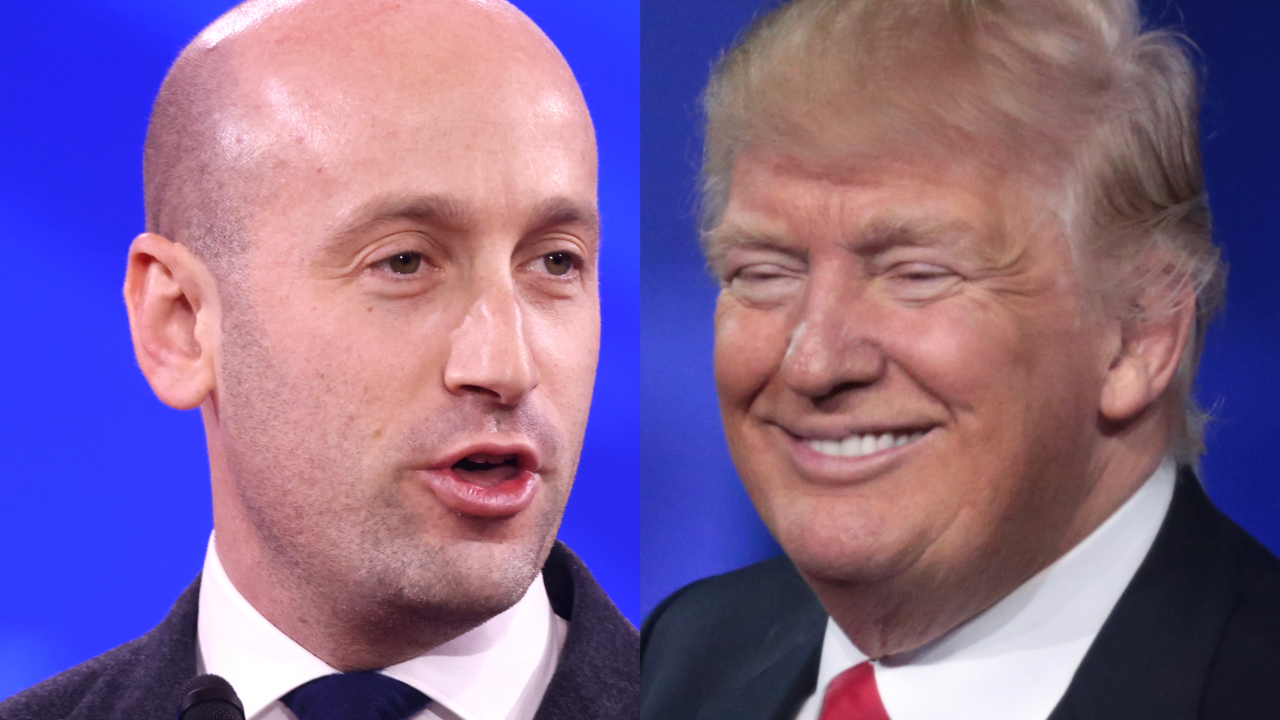
White House Deputy Chief of Staff Stephen Miller defended President Trump’s decision to condition a newly signed U.S.-Saudi nuclear cooperation agreement on Saudi Arabia joining the Abraham Accords, framing the choice as one for Riyadh to make.
“That’s up to the Kingdom of Saudi Arabia,” Miller said when asked whether the condition had effectively paused Saudi Arabia’s nuclear ambitions, according to a clip from The Will Cain Show. “The president has been very clear about his priority to establish a framework for long-term sustainable Middle East peace. No American president in our lifetimes has done more to establish peace in the Middle East than President Trump. In his first term, the Abraham Accords was a breakthrough that nobody thought possible in order to establish that more hopeful future for the region.”
The nuclear agreement Miller addressed was signed July 22 by Energy Secretary Chris Wright and Saudi Energy Minister Prince Abdulaziz bin Salman. Known as a 123 agreement, it establishes the legal framework for a “decades-long, multi-billion-dollar partnership” between the two countries on civil nuclear energy, according to the Department of Energy’s official announcement. The department said the deal would expand American nuclear technology exports, create jobs, and “reinforce global nonproliferation standards” while granting American companies greater access to Saudi Arabia’s nuclear energy program.
The agreement builds on a Joint Declaration Wright and Prince Abdulaziz signed in November 2025 during Saudi Crown Prince Mohammed bin Salman’s visit to the White House, which the administration described at the time as completing negotiations on civil nuclear cooperation, according to the Energy Department’s earlier release on that announcement.
A day after the 123 agreement was signed, Trump added a new condition in a Truth Social post, writing that the deal was “totally subject to Saudi Arabia joining the very respected and successful Abraham Accords.” No official White House document has been published containing that condition, and it was not part of the Energy Department’s announcement of the agreement itself.
Under Section 123 of the Atomic Energy Act of 1954, the president must make a written determination that the agreement will promote and not pose an unreasonable risk to the common defense and security before it can take effect. Once submitted, Congress then has two review periods totaling 90 days of continuous session during which lawmakers could block the deal only through a joint resolution of disapproval, according to a Congressional Research Service report on the process. As of publication, the agreement had been signed by both countries’ energy ministries but had not yet been formally transmitted to Congress, and Trump had not yet made the required written determination.
The same CRS report flagged an unresolved dispute over whether Saudi Arabia would be required to adopt the International Atomic Energy Agency’s Additional Protocol, which allows more intrusive inspections, and to forswear uranium enrichment on its own soil, both standard nonproliferation safeguards the kingdom has previously resisted.
Sen. Ed Markey has raised concerns about the deal’s safeguards since talks began. In a November 2025 letter to Secretary of State Marco Rubio, Markey and other members of Congress wrote that they were concerned the administration was “pursuing an agreement that, without proper safeguards, could enable Saudi Arabia to produce a nuclear bomb,” warning that Saudi Arabia “has, on numerous occasions, expressed its interest in acquiring nuclear weapons,” according to the official letter.
Saudi Arabia has for years resisted joining the Abraham Accords, the 2020 framework normalizing relations between Israel and several Arab and Muslim-majority countries, without a clearer path toward Palestinian statehood, a position that has not changed despite the new condition, according to reporting on the kingdom’s response. Israeli Prime Minister Benjamin Netanyahu’s office welcomed Trump’s new condition, calling potential Saudi accession to the accords “an historic leap forward for peace in the Middle East.”
The original Abraham Accords, signed during Trump’s first term in 2020, normalized relations between Israel and the United Arab Emirates, Bahrain, Morocco and Sudan. The administration has continued to promote the framework’s expansion since Trump returned to office, citing Kazakhstan’s accession in January as part of what it has called “365 Wins in 365 Days.”
Miller separately used the same Fox News appearance to discuss the administration’s immigration enforcement record, highlighting record ICE arrests and what he described as systematic re-vetting of foreign nationals to protect public safety.
Neither the White House nor the Saudi government has indicated a timeline for Riyadh’s decision on the Abraham Accords condition.