
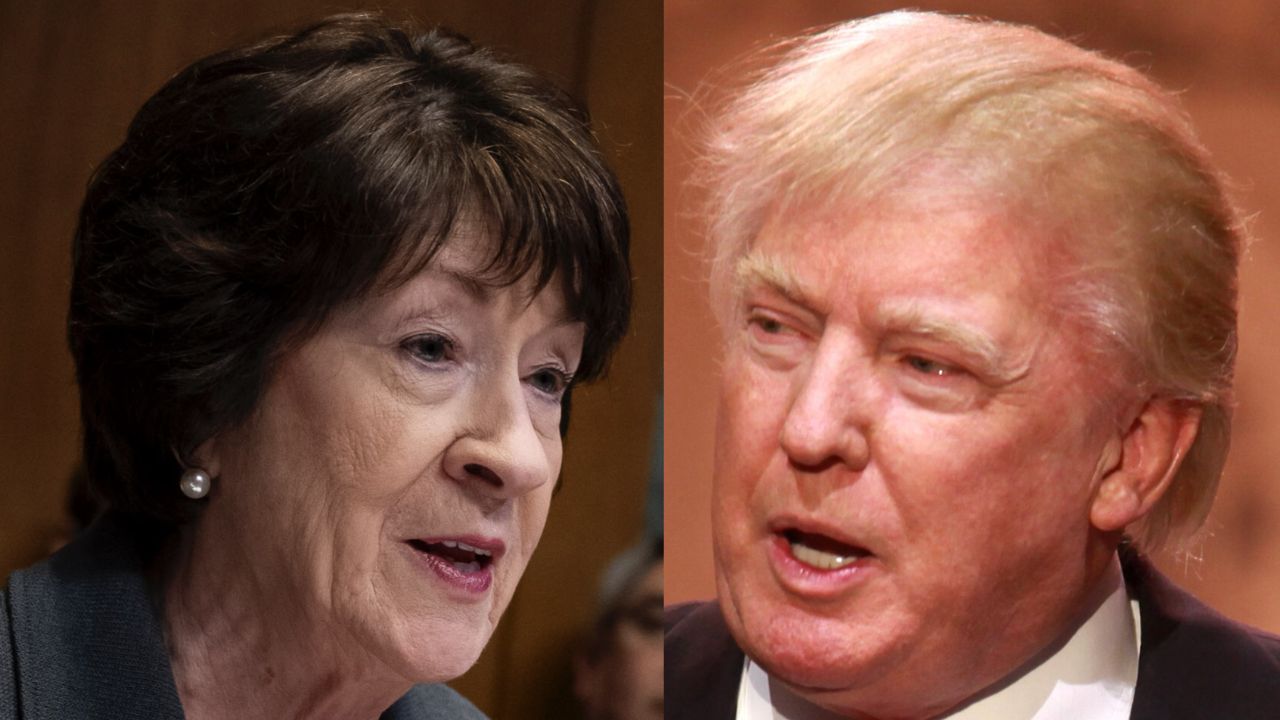
U.S. Sen. Susan Collins, a Maine Republican and a cosponsor of the Russia sanctions law enacted last month, publicly broke with President Donald Trump on Sunday over his decision to lift sanctions on purchases of Russian diesel. She said the president is not following a law he recently signed. The statement adds a senior Republican voice from the Senate’s national security wing to a rapidly widening bipartisan objection to a fuel deal Trump announced with Russian President Vladimir Putin.
The Post
Collins posted her statement on X at 3:45 p.m. on Sunday, Oct. 11, 2026. It read in full:
“I oppose President Trump’s decision to lift sanctions on the purchase of diesel from Russia. I was a cosponsor of the Russian sanctions law, which the President recently signed but is now not following.”
The Announcement That Set It Off
Trump announced on social media Friday that he had struck a deal with Putin in a phone call. He said Russia would immediately supply more than 300,000 tons of diesel to the American and global market. A further 500,000 tons would follow in November, and 1 million tons “immediately thereafter.” Russia would then deliver another 3 million tons “within a short period of time,” he wrote. The announcement was part of an effort to lower high fuel prices, and it surprised lawmakers in both parties.
The Treasury License
The legal mechanism arrived in a notice dated Oct. 9, 2026, signed by Bradley T. Smith, director of the Treasury Department’s Office of Foreign Assets Control. General License No. 135 authorizes transactions otherwise prohibited under Russia-related sanctions regulations, including those tied to the sale, delivery, offloading or importation, “including importation into the United States,” of diesel fuel of Russian origin. The authorization runs through 12:01 a.m. eastern daylight time on April 7, 2027. It does not authorize any debit to an account of the Central Bank of the Russian Federation, the National Wealth Fund or the Ministry of Finance.
A Bipartisan Group Pushes Back
Collins attached to her post a joint statement from six senators, as reported by The Associated Press. Four Republicans and two Democrats signed it: Collins, Lisa Murkowski of Alaska, Thom Tillis of North Carolina and John Curtis of Utah, along with Democrats Jeanne Shaheen of New Hampshire and Richard Blumenthal of Connecticut. They called on the administration to “immediately reverse course” and said it had failed to consult Congress or submit an explanation to justify the decision, as required by statute. “The United States should not provide Putin with a financial lifeline while Russia continues to kill Ukrainian civilians. The Administration must immediately reverse course,” they wrote.
What the Law Says
The law Collins referenced is Public Law 119-111, the Lindsey O. Graham Sanctioning Russia and Iran Act of 2026. Its text describes it as an act “to impose sanctions and other measures with respect to the Russian Federation, as championed by the late Senator Lindsey O. Graham.” It was approved Sept. 18, 2026, after clearing the House in April, passing the Senate in amended form in late July and early August, and winning a final House vote on Sept. 16. Among other provisions, it prohibits the export of U.S. energy to Russia and new U.S. investment in Russia’s energy sector. It also directs the president to raise duties on goods imported from Russia, “including oil, natural gas, liquefied natural gas, petroleum, petroleum products,” to a rate of up to 500 percent.
Waivers, Terminations and the License Question
The statute gives the president a path to relief, but it comes with conditions. A waiver requires a written certification to Congress that it is in the national interest, along with a report explaining the basis. Terminating a sanction on Russia requires certification that Moscow has signed a peace agreement accepted by Ukraine’s government and ceased hostilities. Congress then has 30 days to review, and it can block the termination with a joint resolution of disapproval. The law also states that it does not affect the terms of general licenses the Treasury Department issued before enactment, or the Treasury secretary’s authority to extend or issue new general licenses. That provision is likely to be central to any dispute over whether the new license complies with the law.
Tillis, Barrasso and the Administration’s Defenders
Tillis said on NBC’s “Meet the Press” on Sunday that there is a legitimate case that the president is not following the law if the administration goes through with its diesel purchase plan. “We were very clear that Russia is the aggressor. Russia is the one who can end this war by backing out of territory that they occupied,” he said. Sen. John Barrasso, R-Wyo., defended the president on CBS’s “Face the Nation,” saying Trump is focused on reducing energy costs. “The president is balancing and has to make tough decisions,” he said. He also called the move “just another point of leverage for the president to use against Putin” and urged Trump to enforce the sanctions law.
What Energy Experts Say
The report also quoted Richard Nephew of Columbia University’s Center on Global Energy Policy, who noted that the total amount of diesel appears to be less than what the United States uses in a single day. Nephew said Iran and Russia might benefit more than the U.S. “The Iranians are probably very excited because it shows that there’s a lot of pressure still on the U.S. And the Russians are excited because it puts a big hole in the sanctions regime,” he said. The report added that Trump has recently sought to blame record U.S. diesel prices on Ukraine rather than on the U.S.-led war in Iran, which has elevated world energy prices.
Collins’s Long Record on Russia and Ukraine
Collins’s position on Russia stretches back more than a decade. After Russia’s 2014 intervention in Ukraine, she said she condemned the invasion and stood ready to support Ukraine “through loan guarantees to help stabilize Ukraine’s economy and through targeted sanctions applied to Russian officials.” During Trump’s first term, she joined a group of Republican senators in a letter urging him to pursue a “principled and tough-minded Russia policy,” highlighting Russian aggression in Ukraine, Syria and cyberspace.
“A Badge of Honor”
When Russia launched its full-scale invasion in 2022, Collins called for “the toughest, harshest sanctions imaginable,” and said she would have favored aggressive sanctions earlier, while opposing sending U.S. troops. She traveled to Kyiv in May 2022 and met for two hours with Ukrainian President Volodymyr Zelensky. That June, Russia’s Foreign Ministry added her to its sanctions list, barring her indefinitely from entering the country. “I consider my being sanctioned by Putin’s murderous regime to be a badge of honor,” she said. Her office noted she had backed a $40 billion military and humanitarian aid package for Ukraine and cosponsored the Ukraine Democracy Defense Lend-Lease Act.
Collins and the Iran War
Her stance on the Iran war has been more complicated. After the strikes began in late February 2026, Collins voted on March 4 against a war powers resolution that failed 53-47. In a statement posted on her official site, she said “We cannot tolerate a nuclear-armed Iran” and “Passing this resolution now would send the wrong message to Iran and to our troops.” She also said the administration had complied with the War Powers Act’s 48-hour notification requirement and provided numerous classified briefings.
The 60-Day Deadline
By late April, Collins had changed course. She said the War Powers Act’s 60-day mark meant congressional authorization would be needed to continue the war, and that it was “very likely that I would vote not to authorize further hostilities.” On the eve of the deadline, she voted for a resolution directing the removal of U.S. forces from hostilities against Iran, the first time she joined Democrats on such a vote. “That deadline is not a suggestion; it is a requirement,” she said in a statement. She added that further action “must have a clear mission, achievable goals, and a defined strategy for bringing the conflict to a close.”
Disputing the “Paused” Clock and the Fuel Prices
In mid-May, Collins said Congress must either authorize the war or end it. She rejected the administration’s argument that a ceasefire paused the 60-day clock, a position Defense Secretary Pete Hegseth had outlined in testimony to the Senate Armed Services Committee. She also addressed fuel prices tied to the conflict, saying of Iran’s restrictions on the Strait of Hormuz, “It’s far too easy, as we learned way back in the Iran-Iraq War, for Iran to close or mine that strait.” In July, she was among three Republicans, with Murkowski and Rand Paul, who voted for another Democratic-led resolution, which failed 50-49.
What Comes Next
Collins is seeking a sixth Senate term in the November election. Her post leaves open what Congress can do about the diesel license. The sanctions law gives lawmakers review authority over terminations, but a general license is a separate instrument, and Treasury’s authority to issue one is expressly preserved in the statute. Whether the administration reverses course, as the six senators demanded, or whether Congress takes up the dispute when it returns, will determine if a law signed less than four weeks ago becomes the central test of the Trump administration’s Russia policy.