
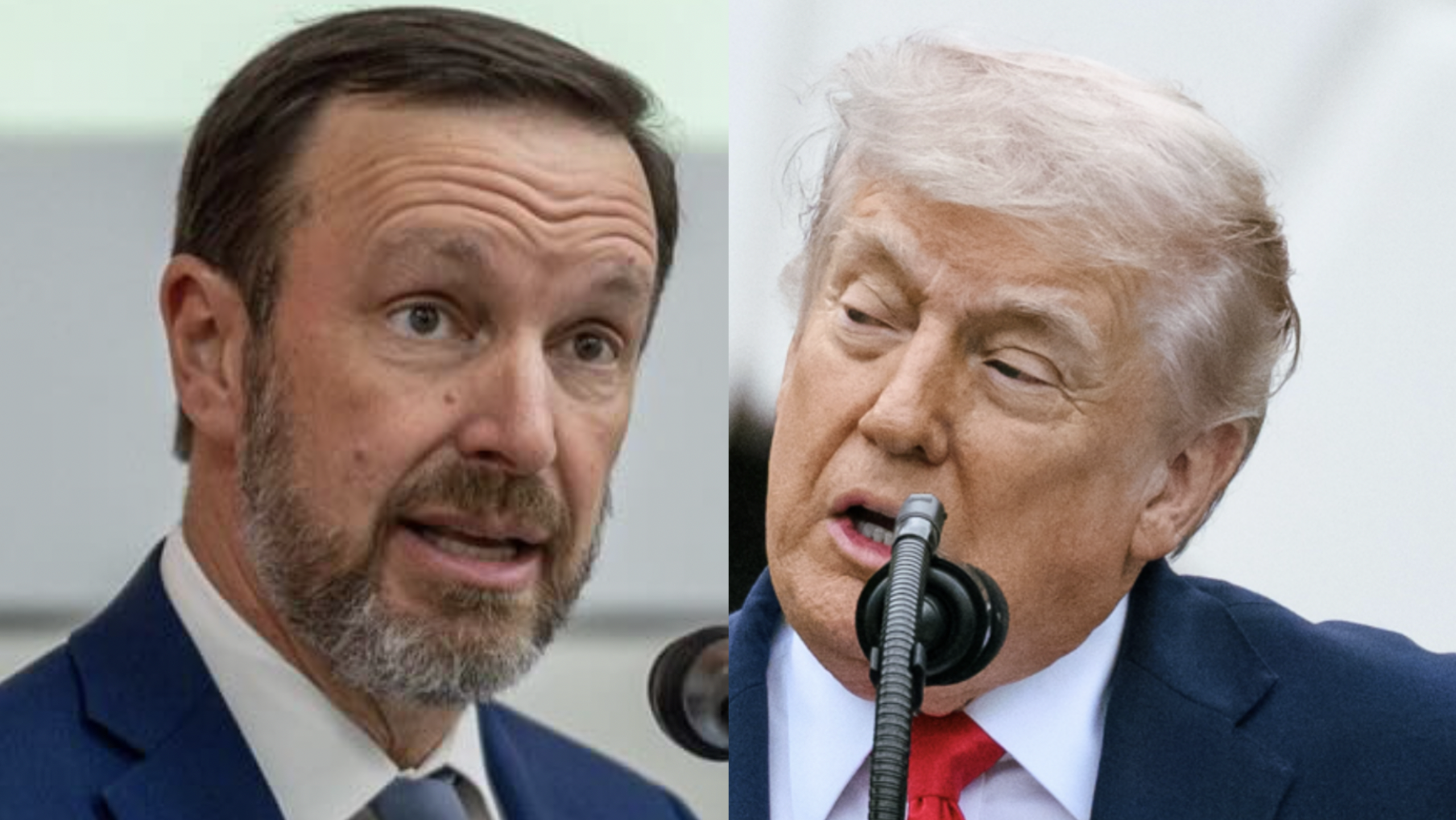
Sen. Chris Murphy on Saturday sharply criticized President Donald Trump and his administration’s handling of negotiations surrounding Iran’s nuclear program, arguing that any potential agreement reached by the White House would likely be weaker than the 2015 nuclear accord Trump withdrew from during his first term.
In a lengthy post published May 9 on X, Murphy said he wanted both an end to the ongoing conflict involving Iran and a renewed agreement limiting Tehran’s nuclear ambitions, but warned that Trump’s approach had severely damaged the prospects for an effective deal. The Democratic senator framed the administration’s handling of the issue as both incompetent and strategically damaging, repeatedly arguing that Trump’s earlier withdrawal from the Joint Comprehensive Plan of Action, or JCPOA, accelerated Iran’s nuclear advancements rather than stopping them.
“I want this war to end – now. And I want a deal that constrains Iran’s nuclear program,” Murphy wrote. “But what we are learning is that any deal Trump gets – and a deal is still very unlikely – is going to be WAY worse than the nuclear deal he cancelled a decade ago.”
Murphy then laid out what he described as the key facts surrounding the current state of negotiations and Iran’s nuclear capabilities. Referring to the Obama-era JCPOA agreement reached in 2015, Murphy said the deal “limited Iranian enrichment to 3% and put a low cap on how much enriched uranium Iran could possess.” He added that the agreement “required Iran to open up facilities to regular inspection to monitor compliance” and that “Iran pledged to never obtain a nuclear weapon.”
The senator argued that Trump’s decision to withdraw from the agreement fundamentally changed the strategic landscape in the region. “When Trump blew up the agreement, Iran put their nuclear program into overdrive,” Murphy wrote. “They made advancements they never made before the JCPOA.”
Murphy pointed specifically to uranium enrichment levels, writing that before the agreement Iran had enriched uranium to 20%, but now had reached 60% enrichment. He added: “Iran can make a bomb in months. Probably 10 of them.”
His comments referenced growing international concern about Iran’s enriched uranium stockpile. According to recent statements from Rafael Grossi, director general of the International Atomic Energy Agency, Iran possesses enough highly enriched uranium that, if weaponized, could potentially be used to construct as many as 10 nuclear bombs. Grossi said much of the material is believed to remain at Iran’s Isfahan nuclear complex, where international inspections have been halted since fighting escalated during last year’s conflict involving Israel, Iran and the United States.
Murphy also argued that the geopolitical conditions surrounding any future agreement are now substantially worse for Washington than they were in 2015. “Trump basically wants a new JCPOA but with a temporary ban on enrichment. He is VERY unlikely to get that,” Murphy wrote.
The senator claimed Iran now possesses leverage it did not have during the Obama administration negotiations, specifically citing control over the Strait of Hormuz and the collapse of the original international coalition that helped pressure Tehran into negotiations. “The 2015 coalition (which included Russia/China) is gone,” Murphy wrote.
Murphy further argued that even if a new agreement were reached, the damage caused by the collapse of the original nuclear accord could not be reversed because Iran had already acquired advanced nuclear knowledge. “Thanks to Trump’s withdrawal from the JCPOA, the regime now knows how to make weapons grade uranium,” he wrote. “No deal can reverse the knowledge they gained. That’s a disaster Trump made.”
The Connecticut senator also questioned whether the Trump administration would be capable of implementing a credible international inspection system similar to the one established under the JCPOA. Murphy said the previous monitoring structure depended heavily on international cooperation and multilateral diplomacy, something he argued Trump had undermined.
“And Trump isn’t going to get the inspections system Obama got – because that relies on international cooperation and no other nation trusts Trump and he rejects multilateralism,” Murphy wrote. “His inspections regime, like everything else he touches, will be full of holes.”
Murphy repeatedly characterized Trump’s approach as incompetent and ineffective, arguing the administration’s handling of the crisis had significantly lowered expectations for a successful diplomatic resolution. “Trump’s ineptitude lowers my expectations for a deal,” he wrote. “And yes, a bad deal could be better than no deal (the most likely outcome still being no deal).”
He concluded the thread with some of his strongest criticism of the administration, writing: “But no one should forget how badly Trump and his team have bungled this. It’s unforgivable incompetence.”
Murphy’s comments come as the financial and military costs of the conflict continue to mount. According to Reuters, a senior Pentagon official told lawmakers last month that the war involving Iran has already cost the United States approximately $25 billion. The Pentagon said much of the spending involved munitions and expanded military deployments throughout the Middle East, where the United States has maintained a significantly larger force posture since strikes against Iran began on February 28.
Defense Secretary Pete Hegseth defended the costs during congressional testimony, arguing the military campaign was necessary to prevent Iran from obtaining a nuclear weapon. The conflict has also contributed to rising fuel prices and broader economic concerns in the United States, with disruptions to oil and natural gas shipments contributing to inflationary pressure ahead of the November midterm elections.
At the same time, international negotiations surrounding Iran’s nuclear program remain stalled. Grossi recently described the current situation as a “completely different ballgame” compared to the 2015 negotiations, citing Iran’s expanded uranium enrichment capabilities, advanced centrifuge systems and new nuclear facilities developed since the collapse of the original deal.
While both Tehran and Washington have publicly expressed interest in reaching a new agreement, major disagreements remain over sanctions, uranium enrichment limits, inspections and regional security concerns. Murphy’s remarks underscored growing criticism among Democrats who argue the Trump administration’s withdrawal from the original JCPOA contributed directly to the current escalation and weakened the chances of achieving a durable diplomatic settlement.