
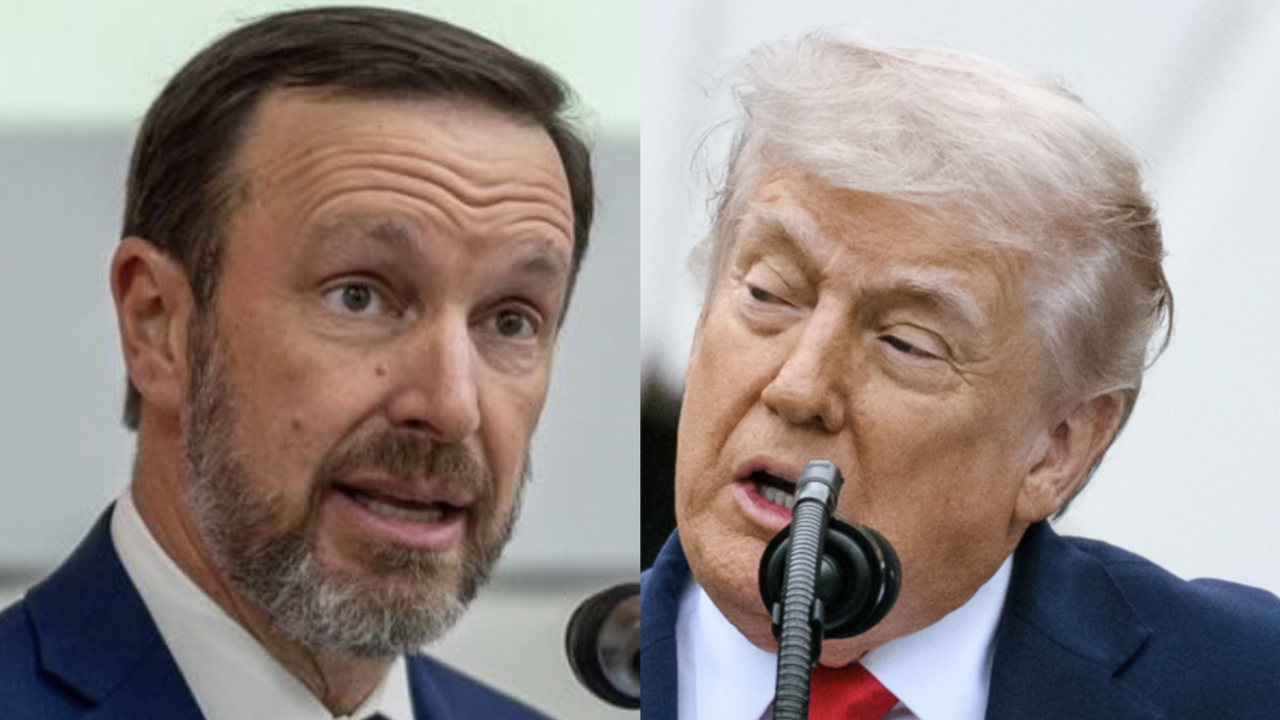
U.S. Senator Chris Murphy (D-Conn.) said Saturday that President Donald Trump’s ongoing war with Iran ranks as the “biggest foreign policy disaster since Iraq,” escalating a monthslong campaign of criticism against the administration’s handling of the conflict as the Strait of Hormuz standoff enters its sixth month with no resolution in sight.
Murphy, a member of the Senate Foreign Relations Committee and one of the war’s most vocal critics in Congress, made the remarks in a post on X early Saturday morning, attaching a screenshot of a Wall Street Journal report on the economic standoff between Washington and Tehran over control of the strait.
“It’s impossible to overhype how disastrous this war has been. It was unwinnable from the start. Trump’s hubris has led to the biggest foreign policy disaster since Iraq,” Murphy wrote.
Senator Points to Wall Street Journal Report on Economic Standoff
The post included a screenshot of an August 14 Wall Street Journal article titled “The Iran War Is Now About Who Blinks First Under Economic Pressure,” which detailed how the Trump administration has doubled down on sanctions and a naval blockade of Iranian ports while Tehran bets that high oil prices will eventually force Washington to relent.
The article quoted Ali Vaez, the International Crisis Group’s deputy program director for the Middle East and North Africa, describing the pattern Iran has drawn from past confrontations with Washington. “Tehran has drawn a simple lesson from every game of chicken with Washington: Hold your nerve long enough, and America swerves first,” Vaez said. “For a system that believes it is fighting for survival…existential threats tend to harden resolve, not impose a price ceiling on resistance.”
Report Details Dueling Pressure Campaigns
According to the Journal’s reporting, Treasury Secretary Scott Bessent has signaled that Washington will impose a “one-two punch” of new financial restrictions on Iran’s economy alongside the continued naval blockade of its ports, aiming to force Tehran to reopen the strait. Vice President JD Vance told Fox News on Thursday that keeping energy prices down was “goal number one,” adding, “And then obviously goal number two is to ensure that Iran never gets a nuclear weapon. I feel confident we’re accomplishing both of those goals.”
White House Press Secretary Karoline Leavitt echoed that framing Friday, telling reporters that “both goals are equally as important to the president,” and that the administration had worked “to keep the markets stable, but also ensuring Iran can never get a nuclear weapon is the president’s priority with respect to the ongoing conflict.”
Trump’s Territorial Remarks Draw Sharp Rebuke From Tehran
The Journal report also noted that Trump, speaking at an event in New York state on Friday, said, “After we finish defeating Iran, which is being very badly defeated, pretty soon I’ll be declaring the Hormuz Strait a territory of the United States.” A White House official later characterized the remarks as having been made in jest.
Iran’s deputy foreign minister, Kazem Gharibabadi, responded on X that “The Strait of Hormuz has been Iranian, is Iranian, and will remain Iranian; this strait will only be closed and opened under Iran’s command.”
Ship Traffic Data Shows Strait Still Largely Closed
Ship-tracking data from Kpler cited in the Journal’s reporting showed that only 13 vessels crossed the strait on Thursday, compared with more than 130 a day before the war began. Nine of those ships used the northern route administered by Iran, and traffic this month has slowed further from an average of 26 vessels a day in July.
Defense Secretary Pete Hegseth said Thursday that the Navy could sustain the blockade on Iran indefinitely, and U.S. officials said the military is preparing to replace the USS Abraham Lincoln aircraft carrier in the region with the USS George Washington amid growing concerns over living conditions aboard the Lincoln and the strain on troops from extended deployments during the war.
Murphy Has Repeatedly Called the War a Historic Blunder
Saturday’s post is the latest in a sustained series of statements from Murphy characterizing the Iran war, which began February 28, as a strategic and humanitarian failure. In June, following the announcement of a ceasefire deal, Murphy took to the Senate floor to argue that the agreement had “functionally eliminated America’s leverage in nuclear negotiations, emboldened the hardliners in the regime and weakened the United States on the world stage.”
“I knew the deal was likely going to be humiliating for the United States of America, but I didn’t know it was going to be this humiliating,” Murphy said at the time, calling the war “the biggest foreign policy blunder of 20 years.”
Senator Has Accused Trump of Profiting From the Conflict
Murphy has also accused Trump of prolonging the war for personal financial gain, pointing to the president’s Truth Social subscription offering and other business ventures. “The war might be continuing, not just because of incompetence, but because the president has found a way to make money,” Murphy said in a Senate floor speech, arguing that Trump has used “constant false promises of an imminent Iran war deal” as part of what Murphy described as a pattern of market manipulation.
“Trump Has Lost This War,” Murphy Told NBC
Earlier this month, Murphy told NBC’s “Meet the Press” that Trump had already lost the conflict on the terms Iran had set. “Donald Trump has lost this war. America is weaker. Iran is stronger,” Murphy said, citing a proposed deal that he said would have paid Iran roughly $100 billion a year to reopen the strait. He said he would nonetheless support “a bad deal” to end the war given the toll on Americans from rising fuel costs.
“The war needs to end because every day that the war continues, America gets weaker, Iran gets stronger, and people here in the United States get screwed, as prices go up, and up, and up,” Murphy said.
Background: A War That Began With a Nuclear Ultimatum
Trump launched the war against Iran on February 28, 2026, with the stated goal of preventing Tehran from obtaining a nuclear weapon. In the months since, the conflict has drawn in a naval blockade of Iranian ports, repeated attacks on commercial shipping in the Strait of Hormuz, a short-lived ceasefire reached in June that collapsed by early July, and a request from the Pentagon for $67.1 billion in additional emergency war funding. The Strait of Hormuz, through which roughly one-fifth of the world’s daily oil supply normally passes, has remained largely closed to traffic for most of the year, contributing to sustained increases in gasoline prices across the United States.
Analysts Warn Standoff Could Persist Through Year’s End
Eurasia Group analysts, cited in the Journal’s report, wrote in a note to clients that “the latent tensions between the U.S. and Iran over the status of the waterway will keep the risk of another crisis—and another closure—relatively high through the rest of 2026.” The report also cited Miad Maleki, a former senior Treasury Department official now at the Foundation for Defense of Democracies, who said Iran’s oil exports have fallen from roughly two million barrels a day before the blockade to near zero, and that the country faces a shortfall of about 29 million liters of gasoline a day. “The blockade can bring the regime to its knees if Washington makes clear that it will not be lifted on a timetable Tehran can wait out,” Maleki said.
Murphy’s Criticism Traces Back to the War’s Outset
Murphy’s opposition to the conflict predates its launch. Alongside Rep. Jim Himes (D-Conn.), Murphy co-authored a USA Today opinion piece warning that the administration was “edging toward a disastrous war with Iran” and urging Congress to “stop the brinkmanship.” When the war began, Murphy issued a statement calling Trump’s strikes “dangerously illegal and a mistake of staggering scale,” asking, “Has he learned nothing from decades of U.S. military disaster in the Middle East?”
Strait Traffic and Fuel Costs Remain Central to the Political Fight
The economic dimension of the war has increasingly shaped the political debate in Washington. Gasoline prices have climbed past $6 a gallon in many parts of the country amid the prolonged closure of the strait, a factor Murphy and other Democrats have cited repeatedly in arguing for an end to the conflict regardless of the terms. Republican leadership has largely continued to back the administration’s economic pressure campaign, with Bessent telling Newsmax that additional sanctions measures would be announced in the coming week.
The Dispute Over Who Holds Leverage
At the center of the current standoff, according to the Journal’s reporting, is a basic disagreement over which side can outlast the other economically. The Trump administration has pointed to internal data on the damage its sanctions have inflicted on Iran’s economy as justification for continuing the pressure campaign, while Iranian officials have expanded their demands for reopening the strait, calling on the U.S. to end the war, lift its blockade, and provide relief from sanctions and frozen assets. Murphy’s Saturday post placed him firmly on the side of those arguing that Tehran, not Washington, currently holds the advantage in that contest.