
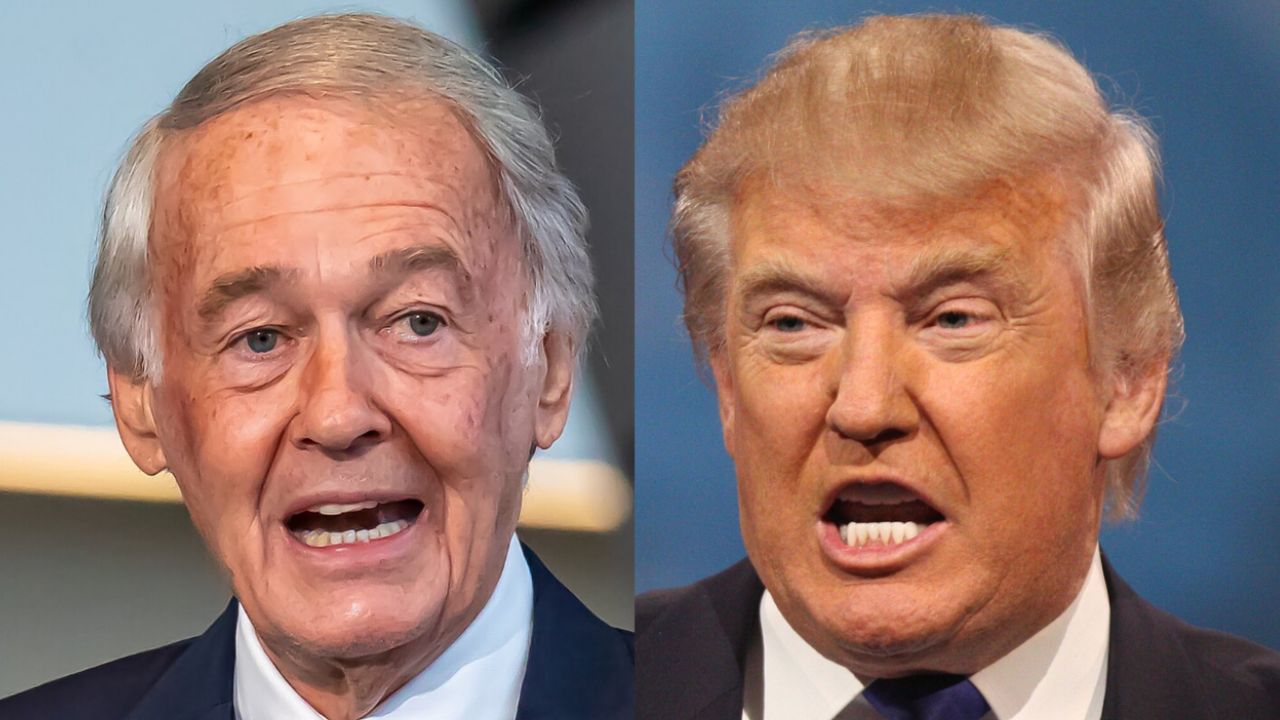
Senator Edward J. Markey (D-Mass.) on Wednesday called on his Republican colleagues to vote to end the United States’ war with Iran, arguing that a wave of election-year defections from GOP candidates proves the conflict has become politically untenable even within President Donald Trump’s own party. The statement, posted to X, landed hours after Trump used his address to the United Nations General Assembly to warn he could “annihilate” the Islamic Republic if a peace deal is not reached.
Markey’s post came as Republican candidates in competitive Senate races, feeling the political weight of a war that has driven gas and diesel prices to record highs weeks before the midterm elections, have begun publicly splitting from the president they have otherwise stood behind for months.
Markey’s Full Statement
Markey published his message on X at 11:46 a.m. on September 23, 2026, writing it in full as follows:
“As Trump threatens to ‘annihilate’ Iran, some Republicans are finally speaking out against his illegal, expensive, and unwinnable war.
But we don’t need words—we need action. I am calling on my Republican colleagues to vote to end this illegal war.”
Attached to the post was a Washington Post article documenting a string of Republican candidates in battleground states urging a faster end to the war, published as polling shows only about one in four Americans support the conflict.
Trump’s UN Warning to “Annihilate” Iran
Markey’s post followed a 37-minute address Trump delivered Tuesday to the UN General Assembly, in which the president framed his decision on Iran as a binary choice between a negotiated rebuilding of the country or its destruction. “I have a big decision to make,” Trump told the assembled world leaders. “Will a deal be made with Iran that lets them rebuild and create a far greater country than it ever was before, maybe one of the greatest in the Middle East or even the world? Or do I annihilate the Islamic Republic and do it quickly, never giving them a chance to kill and destroy people and countries again? Do I drive them into hell with no chance of survival and no hope of future greatness or generations?”
Trump predicted a deal would ultimately be reached, but not before the November 3 midterms, claiming Iranian officials were “waiting to see how I do in the midterm election.” He added, “But I am not running. I gave absolutely no credence and will not give credence to the election when it comes to Iran. It doesn’t even enter my mind. The only thing that does is that Iran will never have a nuclear weapon.”
Later Tuesday, U.S. envoys reportedly met with Iranian officials for roughly three hours on the sidelines of the General Assembly gathering, a development that offered a glimpse of active diplomacy even as Trump’s public rhetoric hardened.
Republicans in Battleground States Break Ranks
The Washington Post article Markey cited details how Republican Senate candidates in Michigan and Iowa moved this week to separate themselves from Trump’s handling of the war, both citing the economic toll on their constituents. On Monday, former Michigan congressman Mike Rogers said in a video statement, “The war with Iran needs to end and end quickly. When it does, energy costs will plummet. But Michigan families can’t afford to wait for that to happen.” He called for a temporary embargo on American diesel exports, arguing that “diesel fuels the trucks that bring groceries to the store” and “the tractors that grow our food.”
Iowa Rep. Ashley Hinson, the Republican Senate nominee, made a similar break with the administration the same day, despite having voted six times against House measures to curb Trump’s war authority, including as recently as the previous week. “Iowans are being squeezed and shouldn’t have to foot the bill at the pump or the checkout line for the war in Iran,” Hinson wrote on X. “We need to use every option at our disposal to provide some relief from high prices.” She said the war “needs to be brought to a successful and immediate end.”
Democrats were quick to characterize both moves as election-year repositioning. Rogers’ Democratic opponent, Abdul El-Sayed, said, “Mike Rogers is only flip-flopping now because gas hit $5 a gallon and diesel prices hit record highs.” Hinson’s opponent, Josh Turek, wrote on X, “It’s easy to send a tweet, but when you had the chance to vote to end this war, you chose not to.”
The Michigan and Iowa candidates were not isolated cases. The previous week, Iowa Representatives Zach Nunn and Mariannette Miller-Meeks, both facing competitive House re-election bids, reversed their prior positions and joined Democrats in voting to limit Trump’s authority to continue the war.
A Consistent Pattern From Markey
Wednesday’s statement extends a position Markey has held publicly since the war’s opening days. After the U.S. strike that launched the conflict on February 28, Markey said, “Trump’s military attack on Iran is illegal and unconstitutional. It was not approved by Congress and holds dangers for all Americans.” He added that “a diplomatic solution remains the best way to permanently and verifiably prevent Iran from acquiring a nuclear weapon.”
Markey has since voted for multiple War Powers resolutions aimed at ending the conflict, all of which have failed in a closely divided Senate. Following an April vote that failed 46-51, Markey said, “Trump’s war of choice on Iran is proving to be a wasteful, unjust, and useless mission as negotiations and the ceasefire remain fragile. Congress never authorized this war, and now we are dealing with the consequences of Trump’s recklessness.”
The Toll the War Has Taken
Markey’s April statement noted that thirteen U.S. service members had died and more than five thousand civilians had been killed in the region at that point in the conflict, figures that have shaped Democratic arguments against continued funding for the war. He has also linked the war directly to consumer costs, noting that gas prices “skyrocketed” as the conflict dragged on.
That economic pressure has only intensified in the months since. By this week, the national average price of gasoline had reached $4.48 a gallon, roughly $1.30 higher than a year earlier, according to AAA, driven in part by Iran’s effective control of the Strait of Hormuz, through which roughly a fifth of the world’s oil exports pass.
Political Backdrop: A White House Also Fighting the Press
Markey’s call for Republican action comes as the Trump administration faces a separate, escalating controversy over press access. Journalists from CNN, MS NOW and Politico were barred from White House grounds and had their credentials revoked last weekend after Trump accused the outlets on Truth Social of “constant ‘reporting’ FAKE NEWS.” This week, Justice Department lawyers defended the ban in federal court, arguing the outlets’ coverage raised national security concerns and that their journalists had failed to act with “professionalism and decorum,” while the news organizations argue the move violates the First Amendment.
Press freedom advocates have widely condemned the ban. Bruce D. Brown, president of the Reporters Committee for Freedom of the Press, called it “unconstitutional,” saying, “The First Amendment is clear that once the White House invites in some journalists, it can’t ban others because it doesn’t like their reporting.”
What Comes Next
With the midterms less than six weeks away, the combination of Trump’s UN warning, rising Republican defections in battleground states, and continued Democratic pressure through War Powers votes suggests the Iran war will remain a defining issue through Election Day. Markey’s Wednesday post signals that Democrats intend to keep pressing Republicans, including those now publicly criticizing the war’s costs, to translate that criticism into votes rather than statements. Whether GOP senators heed that call remains to be seen, but the political calculus for Republicans in contested races appears to be shifting as fuel prices climb and public support for the conflict continues to erode.