
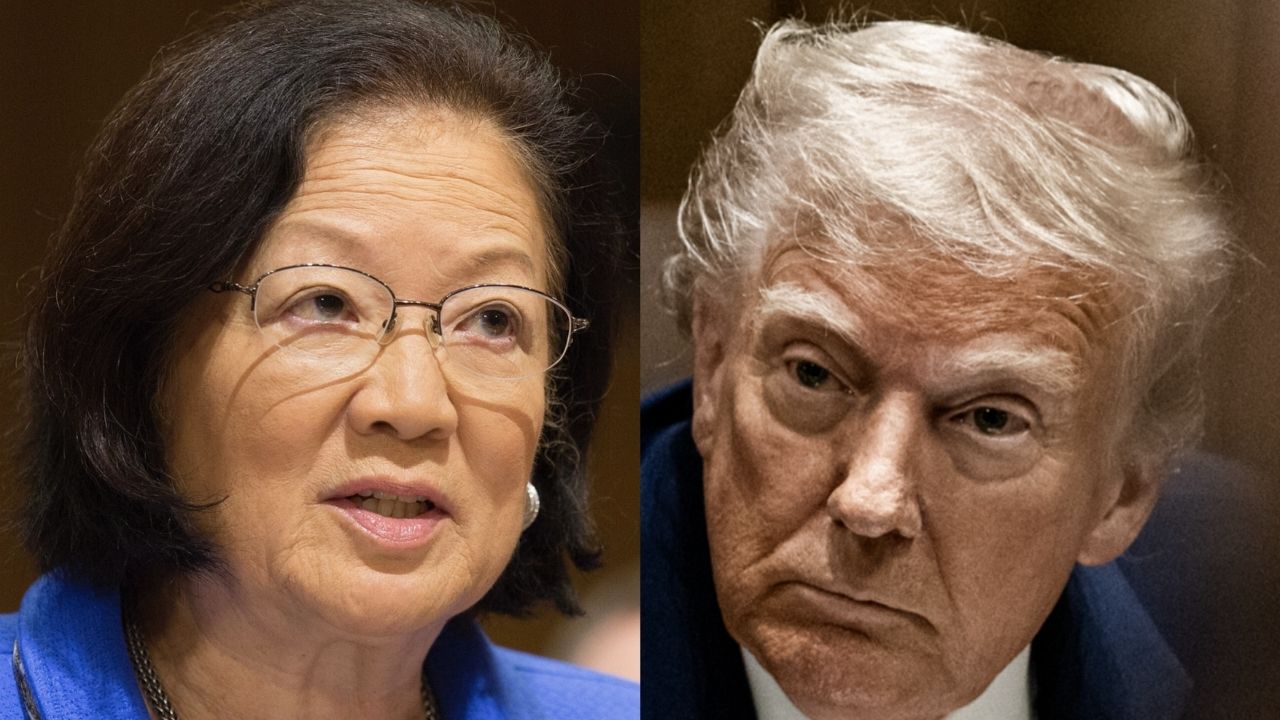
U.S. Senator Mazie Hirono (D-HI) accused President Donald Trump of prioritizing symbolic renaming campaigns over ending the six-month-old war with Iran and rising costs facing American families, arguing in a social media post Saturday that the president’s attention is misplaced while the conflict continues without resolution.
Hirono, a senior member of the Senate Armed Services and Judiciary Committees, posted on X on the morning of Aug. 29, 2026:
“A president who obsessively renames lakes, buildings, gulfs, and even oceans is not ending the illegal war or lowering gas, grocery, or energy prices. Wake up America.” The post was published at 11:22 a.m.
The senator’s post did not name specific geographic features, but it arrived days after Trump signed an executive order renaming Lake Ontario as “Lake America,” the latest in a string of naming changes the president has pursued during his second term. Trump signed that order in the Oval Office on Thursday, Aug. 27, telling reporters the change would take effect “immediately” as tensions over trade with Canada continued to escalate. Trump’s attempt to rename the Great Lake, which straddles the U.S. northern border with Canada, came as a recent breakdown in trade talks between Washington and Ottawa led to new retaliatory tariffs and a rapidly deteriorating relationship.
The formal order, issued by the White House on Aug. 27 and titled “Honoring the American History of the Great Lakes and Renaming Lake Ontario as Lake America,” directs federal agencies to update references to the lake. The Interior Department was instructed to update the Geographic Names Information System within 30 days, and Canadian officials have said they will not recognize the new name.
The Lake Ontario order is only the most recent addition to a longer list of renaming actions Trump has pursued since returning to office. On his first day back in the White House, Trump signed Executive Order 14172, which changed the name of the Gulf of Mexico to the “Gulf of America” and reversed the 2015 decision to rename North America’s highest peak Denali, restoring the name Mount McKinley. Google has said it will implement Trump’s changes once the Department of the Interior updates the Geographic Names Information System, though as of that point Google Maps still referred to the body of water as the Gulf of Mexico.
Trump has also sought to attach his name to federal properties, including a push earlier this year to add his name to the facade of the Kennedy Center. That effort was blocked in the courts. In May 2026, a federal judge ruled that Trump’s handpicked board at the arts venue had unlawfully added his name to the building without authorization, finding that only Congress holds the power to rename it; the name was subsequently removed in June.
The Lake Ontario renaming drew swift mockery from Democratic officials. Illinois Gov. J.B. Pritzker released a video declaring he was renaming Lake Michigan “Lake Illinois” and joking about annexing Green Bay, Wisconsin, in what he framed as a satirical jab at Trump’s Gulf of Mexico order. Wisconsin politicians similarly joked about renaming Lake Michigan after Trump’s order targeting Lake Ontario. Even the Seneca Nation formally requested a reversal of the “Lake America” order.
Political analysts have characterized the renaming push as a liability for Trump heading into the November midterms. One analysis noted that while there was not yet polling on the Lake Ontario move specifically, it appeared likely to be a political dud that would feed into existing perceptions that Trump is more focused on trivial matters than the affordability concerns voters say they actually care about. The same analysis observed that Americans have taken an increasingly dim view of Trump’s penchant for renaming things, including monuments named after himself.
Hirono’s post also referenced the war with Iran, which she and other congressional Democrats have repeatedly described as illegal because it was launched without a formal declaration of war or specific authorization from Congress. The conflict, code-named Operation Epic Fury by the Pentagon, began Feb. 28, 2026, when U.S. and Israeli forces launched joint strikes against Iranian military and nuclear targets. The Department of War has described the operation as striking targets to dismantle the Iranian regime’s security apparatus, prioritizing locations posing an imminent threat.
Saturday’s post marked the approach of the six-month anniversary of the war’s start, a milestone that has been accompanied by renewed hostilities rather than resolution. On Aug. 25, Trump announced he would launch what he called “Operation Economic Outcast,” describing it as an “economic D-Day” amid the nearly six-month-long military conflict with Iran. Experts have said that given Iran’s high threshold for pain and roughly 47 years of experience under various forms of international sanctions, the country is more likely to escalate than capitulate in response to the new economic pressure.
The diplomatic track aimed at ending the war has repeatedly collapsed. The Islamabad Memorandum of Understanding, negotiated between Washington and Tehran and signed in mid-June, was intended to expand on an earlier ceasefire and reopen the Strait of Hormuz to shipping traffic, but the agreement fell apart after disagreements over interpretation and management of the waterway. On July 8, after Iran struck multiple commercial vessels in the Strait of Hormuz and the U.S. responded with strikes on Iranian territory, Trump indicated the memorandum was “over,” and on July 18 Iran’s deputy foreign minister announced the suspension of Iran’s commitments under the agreement, citing an alleged U.S. breach. The 60-day deadline for the two countries to reach a final deal ending the war passed on Aug. 17 without an agreement.
Iran’s government has continued to reject Washington’s characterization of the diplomatic status quo. Iranian Foreign Minister Abbas Araghchi has said the Islamabad memorandum represented an “end to the war” rather than a ceasefire subject to extension, and that Tehran had not decided whether to resume talks with the United States. As of mid-August, formal diplomatic channels between the two countries remained frozen.
Congress has tried and repeatedly failed to force an end to the war through the War Powers Resolution of 1973. Hirono voted in favor of an early attempt in the Senate, sponsored by Sen. Tim Kaine (D-VA), saying at the time that “chaos has spread throughout the region and the lives of six American servicemembers have been tragically lost, with no end in sight to this escalation,” and that Senate Republicans, “by refusing to assert Congress’s power as the only branch of government that can declare war,” were “betraying the American people and empowering Trump’s lawlessness, regardless of the consequences for our country.”
Subsequent war powers votes have followed a similar pattern. The House passed a war powers resolution on June 3 by a vote of 215-208, with four Republicans joining Democrats, after the Senate had voted to advance its own version two weeks earlier by a vote of 50-47. A later Senate attempt to force Trump to end hostilities failed by a vote of 47-49 in July, even as the House passed a similar measure 214-208 the same day, amid an escalating conflict and oil prices topping $100 a barrel. Because the measures are concurrent resolutions, they do not require the president’s signature and have carried no binding legal force.
The economic costs Hirono referenced in her post have been well documented since the war began. Gas prices rose from a national average of $2.975 on Feb. 24, the day before the war’s onset, to $3.198 by early March, according to AAA data, with drivers blaming the president directly for the increase after he had campaigned on lowering prices. Prices continued climbing as the conflict wore on; by mid-May, gas had reached roughly $4.50 a gallon nationally, with inflation accelerating and real wages shrinking as voters blamed Trump for the increases.
Trump has offered shifting responses to the price increases. Early in the conflict, he dismissed the higher costs, telling ABC News the situation was “a little glitch” and that “we had to take this detour.” Trump added in a social media post that short-term higher oil prices, which he said would drop once the destruction of Iran’s nuclear threat was complete, represented “a very small price to pay for U.S.A., and World, Safety and Peace.” A national poll released around the same time found only 36% of registered voters approved of Trump’s handling of inflation and the cost of living, versus 62% who disapproved.
By summer, Trump had shifted from downplaying the increases to attempting to pressure gas retailers directly, posting on social media that prices were “too high considering that oil is now at $68 a barrel, and heading south” and demanding that retailers “DROP YOUR PRICE FOR OUR GREAT AMERICAN PEOPLE!” The U.S. inflation rate stood at 4.2% at the time, according to the Bureau of Labor Statistics, well above the Federal Reserve’s 2% target.
Hirono has raised the war’s toll on service members in prior public statements, including a formal letter to Defense Secretary Pete Hegseth requesting a comprehensive accounting of the number of service members killed, wounded, or injured in support of Operation Epic Fury, and questioning discrepancies in the Pentagon’s public casualty reporting.
Saturday’s post continued a broader pattern in Hirono’s public criticism of the administration, in which she has repeatedly framed Trump’s actions as unlawful or disconnected from the priorities of American families. In a February statement following Trump’s State of the Union address, Hirono said that “prices are soaring, our democracy is under threat, and Donald Trump is focused solely on keeping his power and enriching himself and his billionaire buddies.”
Neither Hirono’s office nor the White House had issued additional public statements responding directly to the renaming-focused post as of Saturday afternoon. The war with Iran, the effort to reopen the Strait of Hormuz, and the political fight in Congress over the president’s war powers remained unresolved as the conflict passed the six-month mark.