
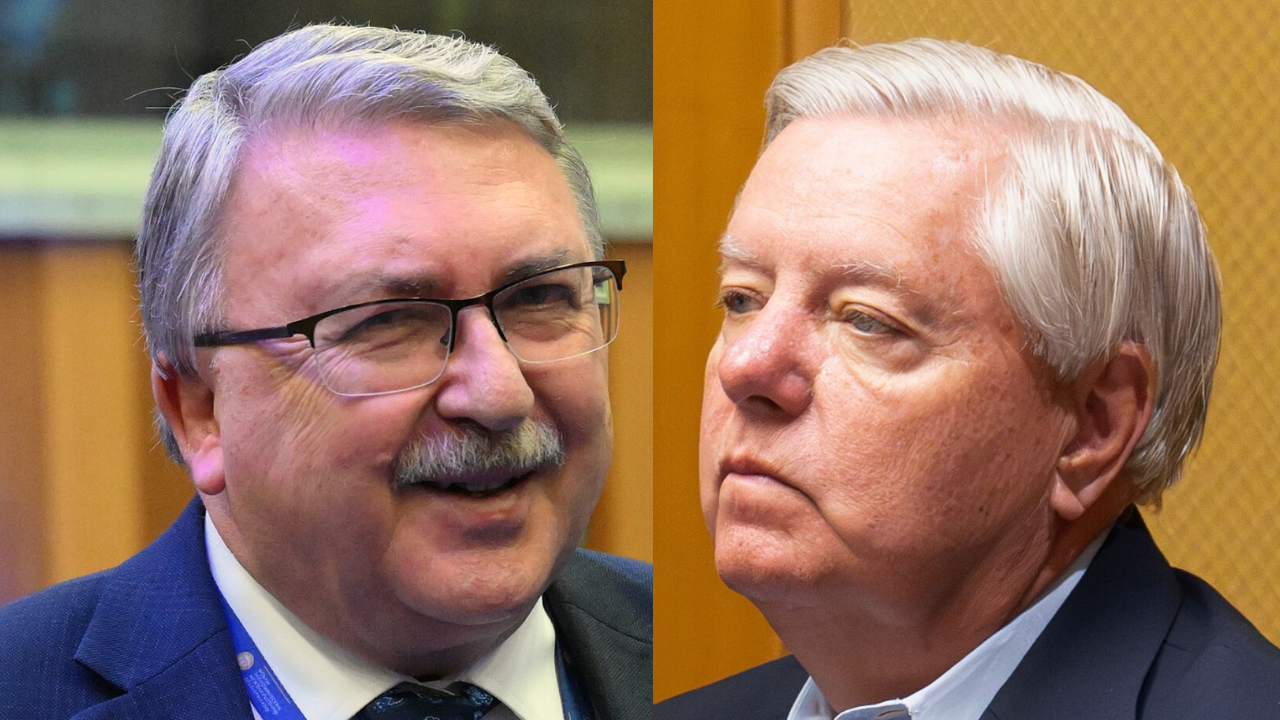
WASHINGTON, May 17, 2026 — Russia’s top arms control diplomat dismissed Sen. Lindsey Graham on Sunday after the South Carolina Republican vowed to introduce legislation imposing sweeping sanctions on China if it invades Taiwan — with Moscow’s envoy to Vienna international organizations calling Graham’s warning little more than personal vanity.
“This gentleman overestimates his role in global history,” Mikhail Ulyanov wrote on X, responding directly to Graham’s remarks on NBC’s Meet the Press.
Graham’s Warning to Beijing
Graham appeared on Meet the Press Sunday and announced he and Sen. Dan Sullivan, R-Alaska, are reintroducing hard-hitting pre-invasion sanctions legislation targeting China over Taiwan. “I want China to know: if you try to take Taiwan by force, here’s what happens to your economy,” Graham said. “The full weight and measure of sanctions and tariffs from the United States will kick in on day one.”
Graham acknowledged that any military response to a Taiwan invasion would ultimately rest with the president alone. “Trump said, ‘It would be up to me and me alone,’ and he’s right about that,” Graham said, framing the legislation as the congressional contribution to deterrence — an economic sword hanging over Beijing that would activate automatically upon an invasion regardless of executive action.
The Bill
The legislation Graham referenced is S. 4065, the Sanctions Targeting Aggressors of Neighboring Democracies with Taiwan Act of 2026 — known as the STAND with Taiwan Act — introduced by Sullivan and Graham on March 11, 2026, and referred to the Senate Committee on Banking, Housing, and Urban Affairs. The bill has seven cosponsors, including Sens. Tammy Duckworth, D-Ill.; John Kennedy, R-La.; Ted Budd, R-N.C.; Pete Ricketts, R-Neb.; David McCormick, R-Pa.; and John Cornyn, R-Texas.
The bill would require the United States to impose a comprehensive suite of sanctions on China — targeting Chinese Communist Party members, Chinese financial institutions, and Chinese entities listed on U.S. securities exchanges — automatically upon a determination that China has initiated a military invasion of Taiwan. It would also prohibit U.S. financial institutions from investing in Chinese economic sectors and ban the transfer of funds involving China.
Sullivan has pushed versions of the STAND with Taiwan Act since 2022, when he first introduced it alongside Graham’s Taiwan Policy Act with then-Senate Foreign Relations Committee Chairman Bob Menendez. That earlier legislation represented what its authors called the most comprehensive restructuring of U.S.-Taiwan policy since the Taiwan Relations Act of 1979.
Who Is Mikhail Ulyanov
Ulyanov is Russia’s Permanent Representative to international organizations in Vienna — a post he has held since January 2018, appointed by President Vladimir Putin. In that capacity he serves as Russia’s lead diplomat at the International Atomic Energy Agency, the Organization for Security and Co-operation in Europe, and the Comprehensive Nuclear-Test-Ban Treaty Organization, among other bodies. He previously served as Director of the Russian Foreign Ministry’s Department for Non-Proliferation and Arms Control from 2014 to 2018 and led Russia’s delegation to the Vienna talks on military security and arms control beginning in 2006.
Ulyanov is a veteran diplomatic provocateur with a well-established presence on Western social media — known for using X to mock American and European officials in English. He has previously dismissed Western sanctions on Russia as having “completely failed,” defended the Assad regime’s use of chemical weapons in multilateral forums, and became an unlikely internet figure after NAFO, a pro-Ukraine online movement, turned one of his dismissive tweets into a meme in 2022.
The Taiwan Backdrop
Graham’s remarks and Ulyanov’s response came days after President Trump concluded a two-day summit in Beijing with Chinese President Xi Jinping — during which Taiwan was a central point of tension. Xi warned Trump that mishandling Taiwan could put the entire U.S.-China relationship in “great jeopardy” and threatened it could lead to “clashes and even conflicts.” Trump told reporters he made “no commitment either way” on Taiwan, and a pending $14 billion U.S. arms sale to the island remained unresolved as of his departure.
China’s foreign ministry announced that Xi accepted Trump’s invitation to visit the United States in the fall — a signal of diplomatic progress that did nothing to resolve the underlying military standoff in the Taiwan Strait. China’s People’s Liberation Army has conducted increasingly large-scale military exercises around Taiwan in recent years, and U.S. defense officials have repeatedly assessed that China is accelerating its timeline for being capable of executing a forced unification by military means.
Graham’s legislation is designed to short-circuit that calculus by making the economic cost of invasion certain and automatic — without requiring a presidential decision under fire. Ulyanov’s four-word dismissal suggested Moscow is not especially concerned about that prospect.