
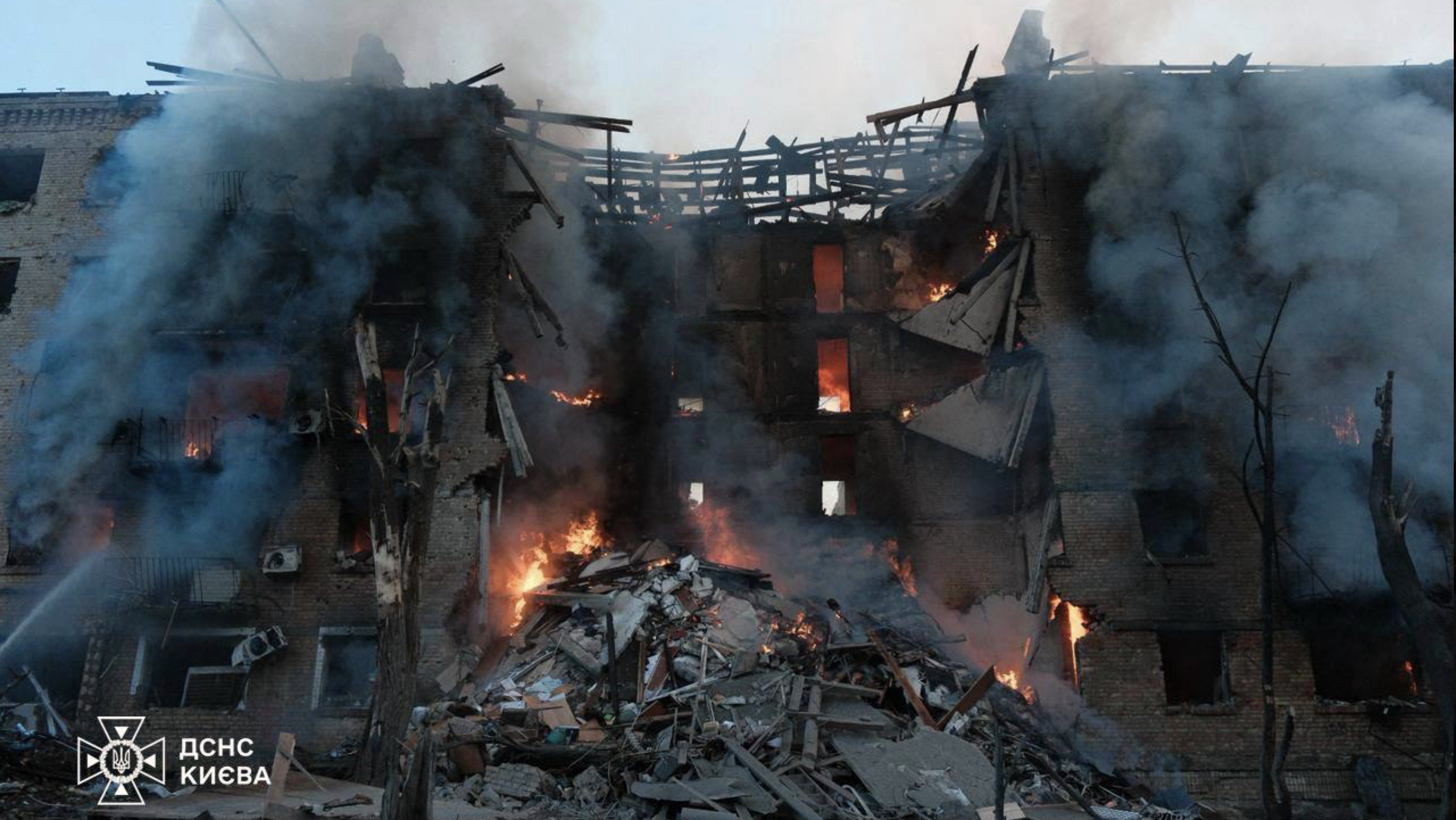
It arrives before most radar systems can react, and by the time sirens sound, the damage may already be done.
Russia used the powerful hypersonic Oreshnik ballistic missile during a mass drone and missile attack on Kyiv on Sunday, marking the third time in the four-year war that Moscow has deployed a weapon it claims is immune to every air defense system on Earth — including those operated by the United States. For military analysts and defense planners across NATO, each of those three launches has raised the same urgent question: is there any answer to it?
What Exactly Is the Oreshnik?
The Oreshnik — whose name translates from Russian as “hazel tree” — is an intermediate-range hypersonic ballistic missile unlike anything previously used on a conventional battlefield at scale. Its name belies what it represents: one of the most sophisticated and feared weapons in Russia’s arsenal.
The missile is derived from the RS-26 Rubezh, a system Russia originally developed as an intercontinental ballistic missile. What makes the Oreshnik particularly dangerous is not just its speed — it’s its design. The novel feature of the weapon is that it can carry multiple independently targetable warheads, each capable of simultaneously striking different targets. That capability is typically associated only with longer-range ICBMs used in nuclear deterrence strategies.
Ukraine’s air force confirmed that an Oreshnik fired in January of this year flew at approximately 13,000 kph — roughly 8,000 miles per hour. That is more than ten times the speed of sound.
“Impossible to Intercept”
Russian President Vladimir Putin has repeatedly and publicly claimed that the Oreshnik cannot be intercepted by any existing air defense system in the world. That claim is rooted in physics as much as politics. At Mach 10-plus speeds, a missile closes distances so rapidly that the window for detection, tracking, targeting, and interception collapses to near-zero. Modern air defense systems — including the U.S.-supplied Patriot batteries operating in Ukraine — were not designed to defeat a weapon moving at those velocities along a ballistic trajectory that can shift mid-flight.
Putin has also said the Oreshnik carries destructive power comparable to that of a nuclear weapon, even when loaded with conventional warheads. Some Western defense experts have pushed back on that characterization, arguing it is overstated. Russia says the Oreshnik is immune to any missile defense system. A U.S. official assessed in December 2024 that the weapon was not a battlefield game-changer, describing it as experimental in nature and suggesting Russia likely possessed only a small number.
From Experimental to Serial Production
That assessment may need revision. Since 2024, Russia has moved the Oreshnik into serial production. Moscow has also supplied the missile to its ally Belarus, placing it within striking distance of multiple NATO member states.
It was the third time Russian forces have used this missile during its full-scale war on Ukraine. The first deployment came in November 2024 against the city of Dnipro. The second struck the western Lviv region in January 2026. In both of those previous strikes, the missile was fitted with inert dummy warheads — a decision analysts interpreted as deliberate signaling rather than an attempt at mass destruction. The point was the launch itself: proof of concept, delivered at Mach 10.
Sunday’s strike against Bila Tserkva, roughly 40 miles from central Kyiv, marked the closest the weapon has come to the Ukrainian capital.
A Weapon Designed to Be Seen
Security experts have assessed that Moscow’s use of the Oreshnik serves a dual purpose. It is a battlefield tool, but it is equally — perhaps primarily — a political instrument. Each launch is a demonstration aimed at NATO capitals as much as at Ukraine. Russia is angry at European nations over plans to deploy troops to protect Ukraine in the event of a ceasefire, and some analysts believe the Oreshnik launches are intended to test Western resolve by raising the stakes of continued military involvement.
Ukrainian air defense forces intercepted most of the drones and more than half of the missiles launched on Sunday — but the Oreshnik was not among those stopped. It never is. That, ultimately, is the entire point.