
For six hours in the jungles near Loc Ninh, South Vietnam, Master Sergeant Roy P. Benavidez fought a personal war to keep a small reconnaissance team alive. Shot, stabbed, and blasted by shrapnel, he refused to stop moving until the last man he could reach was on a helicopter. His Medal of Honor citation would later describe a mission that sounded impossible, yet every detail was carved into his body in the form of 37 separate wounds.
Benavidez’s ordeal began as a voluntary act, not an assigned mission, and unfolded as a relentless cycle of running into fire, dragging men out, and going back again. His six-hour battle was not only a story of individual courage, it was a lesson in leadership, improvisation, and refusal to surrender even when survival seemed unlikely.
The call for help in Loc Ninh
The crisis that drew Roy Benavidez into combat started with a 12-man Special Forces reconnaissance team trapped near Loc Ninh, South Vietnam, after encountering a much larger North Vietnamese Army force. The team, made up of three American soldiers and nine Montagnard fighters, was quickly surrounded and taking heavy casualties as an entire NVA battalion closed in on their position. From a nearby Green Beret outpost at Loc Ninh, where he was assigned to Detachment B56, 5th Special Forces Group Airborne, First Special Forces, Benavidez heard the radio calls that made clear the team would not survive without immediate help, a situation later detailed in accounts of his Medal of Honor actions.
Benavidez was not on the original mission and had just returned from Catholic Mass when he learned that the team was in danger of being overrun. Rather than wait for orders, he volunteered on the spot to join an extraction helicopter heading into the fight, reportedly telling the crew that if they were going, he was coming with them. Armed only with a knife and a medical bag, he boarded the aircraft and flew toward a landing zone already raked by enemy fire, a decision later highlighted in official Special Forces histories of the battle.
Jumping into a battalion’s kill zone

As the helicopter approached the embattled team, the pilots found they could not safely land because of the intensity of NVA fire sweeping the clearing. Rather than turn back, Roy Benavidez chose to jump from the hovering aircraft, hitting the ground and sprinting roughly 75 yards through open terrain to reach the pinned-down soldiers. That dash through a kill zone, with bullets and shrapnel already cutting into his body, marked the beginning of what would become six hours of continuous combat, as described in detailed battle narratives.
Once he reached the team, Benavidez immediately began organizing the survivors, distributing ammunition, and establishing a defensive perimeter under fire. He dragged the wounded to safer positions, treated their injuries with the limited medical supplies he had carried in, and coordinated radio calls for airstrikes and additional extraction attempts. At one point he directed supporting aircraft to strike so close to his own position that he risked being hit by friendly fire, a measure of how desperate the situation had become as the NVA battalion pressed in, a level of risk later captured in his official Medal of Honor citation.
Six hours of wounds, rescues, and hand-to-hand combat
As the battle dragged on, Roy Benavidez was hit again and again, yet he kept returning to the fight. He was shot in the leg, face, and back, and struck by grenade fragments while moving between the perimeter and incoming helicopters, carrying or dragging wounded men to the aircraft. When one extraction helicopter was shot down, he moved to the wreckage, pulled survivors out, and recovered classified documents from the downed aircraft, actions later documented in official biographical accounts of the mission.
The fighting closed to such short range that Benavidez was forced into hand-to-hand combat with NVA soldiers trying to overrun the position. At one point an enemy soldier attacked him with a bayonet, stabbing him and adding to the growing list of serious wounds. Benavidez pulled the bayonet out, drew his own knife, and killed the attacker before returning to the work of evacuating the wounded and holding off the enemy. By the time the final helicopter lifted off with the remaining survivors, he had sustained 37 separate wounds from bullets, shrapnel, and bayonets, a toll later confirmed in detailed NCO histories of the battle.
On the edge of death and the long road back
By the end of the extraction, Roy Benavidez was barely conscious and had lost so much blood that medics initially believed he was dead. He was placed in a body bag alongside the fallen, and a doctor began to zip it closed before noticing a faint sign of life. According to later accounts, Benavidez managed to spit blood into the doctor’s face, a final act of defiance that signaled he was still alive and led to emergency treatment instead of a trip to the morgue, a moment described in detail in official retrospectives.
Survival was only the beginning of another grueling fight. Benavidez spent months in surgery and rehabilitation, facing predictions that he would never walk again because of the severity of his injuries. Earlier in his career he had already battled back from a debilitating mine injury, and after this mission he again forced his body to recover, re-learning how to stand and walk despite the damage. Later profiles of his life describe him crawling at night against doctors’ orders to strengthen his legs, a pattern of determination that matched the resolve he had shown in the jungle and helped explain how he endured the six-hour ordeal in the first place, as reflected in multiple biographical summaries.
Recognition, legacy, and the meaning of those six hours
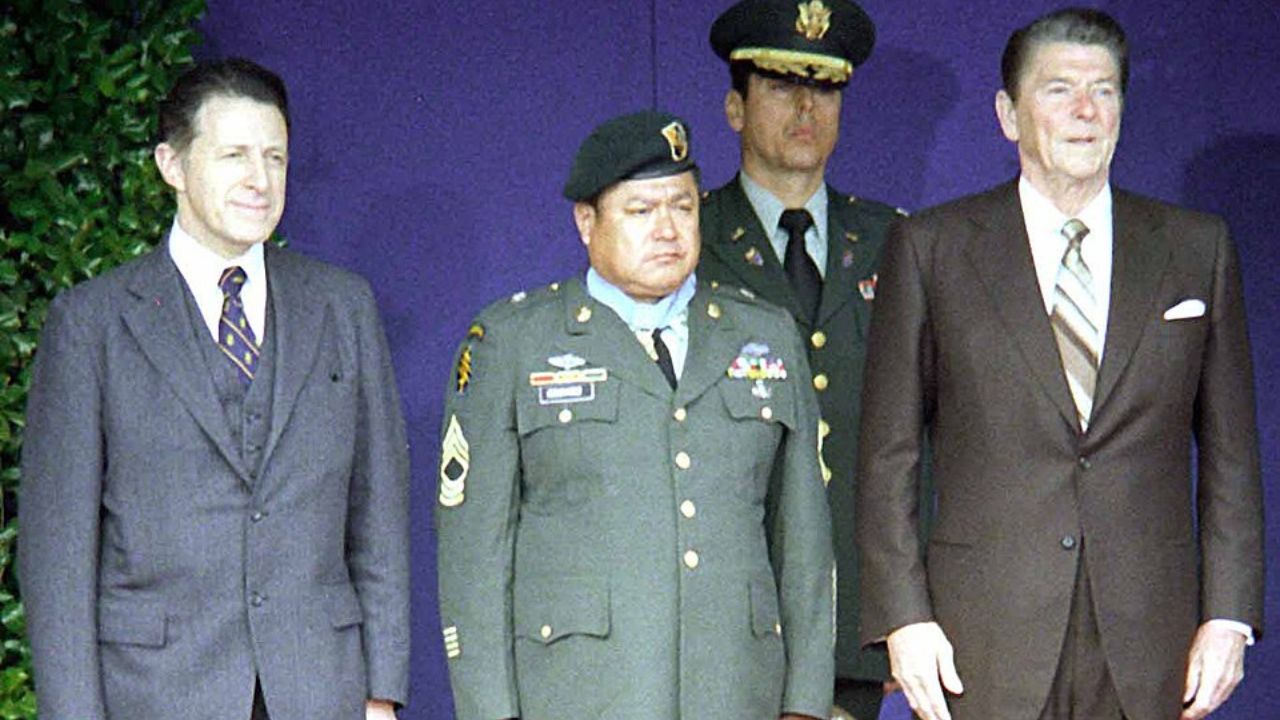
Initially, the Army recognized Roy Benavidez’s actions with the Distinguished Service Cross, a high honor that still fell short of capturing the full scope of what he had done. As more witnesses came forward and the details of the mission were fully documented, the award was upgraded to the Medal of Honor. President Ronald Reagan eventually presented the medal to Sergeant Benavidez, noting that if his story had been written as a movie script, it might have seemed too unbelievable, a sentiment preserved in official accounts of the ceremony.
In the years after the war, Benavidez used his story to speak to students, service members, and community groups, emphasizing that “where you start does not decide where you finish.” He framed his six-hour fight near Loc Ninh as an example of what determination, loyalty, and faith could accomplish under the worst possible conditions, not as a tale of invincibility. The record that he saved the lives of at least eight men by repeatedly exposing himself to overwhelming enemy fire, while serving with Detachment B56 of the 5th Special Forces Group Airborne at Loc Ninh, remains one of the most cited examples of individual valor in Vietnam, a legacy preserved in official unit histories and detailed Medal of Honor narratives.