
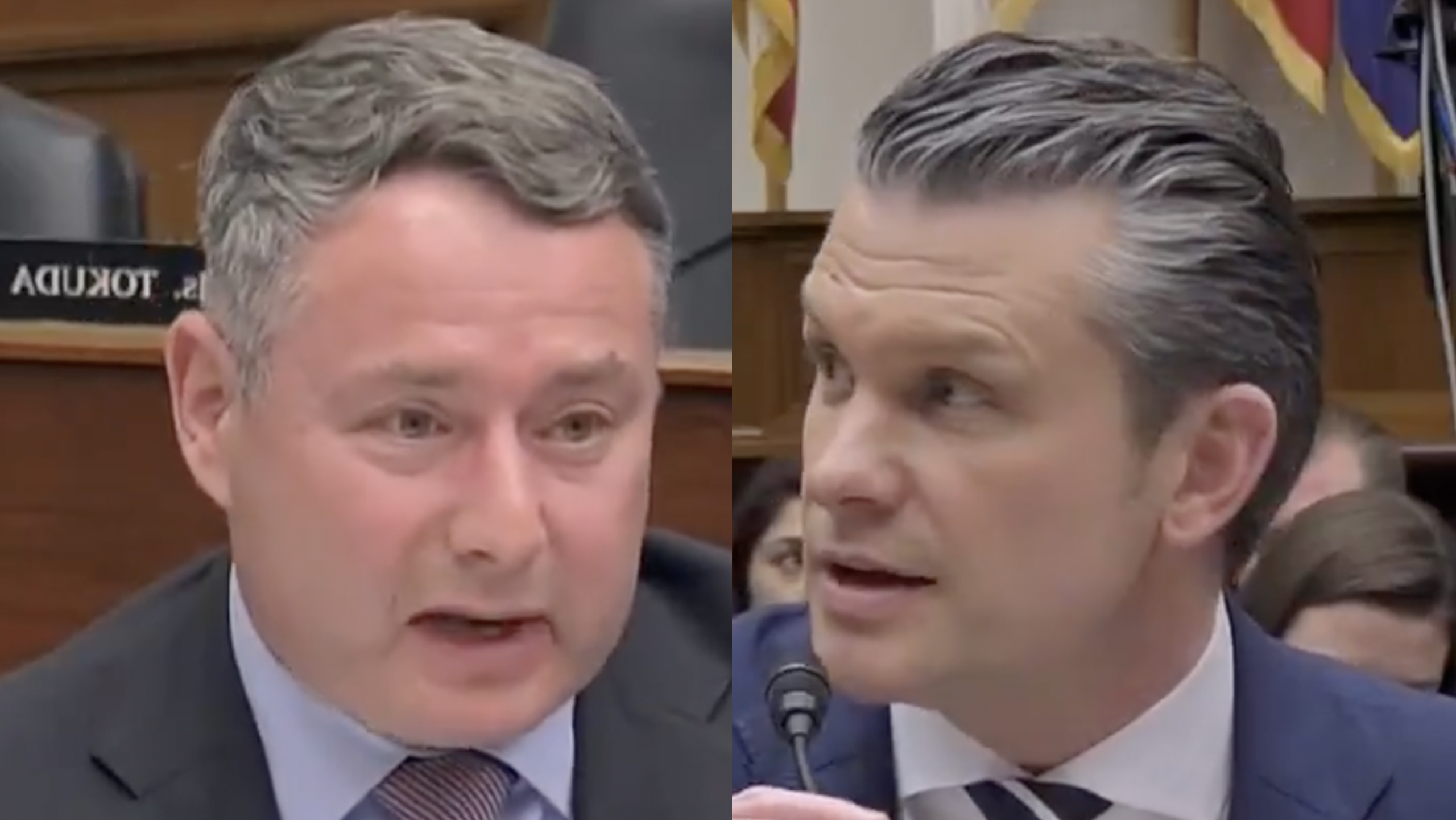
A public dispute over U.S. military leadership escalated on May 7, 2026, when Rep. Eugene Vindman sharply criticized Defense Secretary Pete Hegseth in a post on X, accusing him of prioritizing political optics tied to President Donald Trump over the welfare of American service members. The comments came alongside a video clip in which Vindman questioned Hegseth on U.S. military operations and accountability following deadly strikes in the Iran conflict, intensifying an already contentious debate over the war’s conduct and cost.
In his full post, Vindman wrote: “It’s clear that @SecWar cares more about protecting the president’s image than our soldiers. He must resign. Our troops deserve better.” The statement, published on May 7th, 2026, directly called for Hegseth’s resignation and framed the criticism around concerns that political messaging was being prioritized over battlefield accountability and troop safety.
The post was paired with video footage of an exchange between Vindman and Hegseth. In the clip, Vindman referenced a March 1 Iranian drone strike that killed six U.S. Army soldiers, including a constituent. He asked, “Do you take any responsibility for those deaths?” Hegseth responded, “I was there at Dover when they came back. Of course, I take responsibility for every aspect of this mission.”
Vindman followed by questioning the Defense Secretary on public messaging around military casualties, stating, “Well, I appreciate that because, you also complain about the fact that tragic things happen on the news makes it front page news and The press only wants to make the president look bad. Is it about the soldiers or is it about the president looking bad?” Hegseth replied, “It’s not just the president who wants… or the, the media that wants to make him look bad, it’s you. It’s actually about the soldiers, and it’s frankly reprehensible that you would make that statement.”
Vindman’s criticism in the post framed that exchange as evidence of misplaced priorities within the Pentagon’s leadership, alleging that concern for political narrative management under President Trump was overshadowing responsibility to service members deployed in active conflict zones.
Vindman’s remarks are consistent with his broader public stance on U.S. military engagement. As of early 2026, he has opposed what he calls “wars of choice,” arguing that military action requires strict congressional authorization and warning against what he has described as unconstitutional executive overreach in conflicts involving Iran and Venezuela. He has repeatedly emphasized that decisions leading to war carry direct consequences for U.S. troops and their families.
He has also criticized the Trump administration’s foreign policy approach, previously characterizing Trump as a “President of chaos and war” rather than one focused on stability or deterrence. Vindman has argued that military engagements are often initiated without clear strategy, stating that wars are “easy to start but difficult to finish,” a theme reflected in his ongoing opposition to U.S. operations in Iran.
The comments come against the backdrop of a costly and expanding conflict. According to a senior Pentagon official cited by Reuters on April 29, 2026, the U.S. war in Iran has cost approximately $25 billion so far, with much of the spending directed toward munitions and sustained military operations. The figure underscores the scale of the conflict and its growing financial impact on federal resources.
The human toll has also been significant. Reuters reporting indicates that at least 13 U.S. service members have been killed and hundreds wounded since the conflict began, alongside thousands of deaths across the Middle East. The war, which began after U.S. and Israeli strikes on Iran in February 2026, has involved widespread regional escalation, including missile exchanges and attacks on U.S. bases.
Defense Secretary Hegseth has defended the operation, arguing that the costs are justified by strategic objectives. In congressional testimony, he asked lawmakers, “What would you pay to ensure Iran does not get a nuclear bomb?” while describing critics as “feckless” and “defeatist” in response to opposition concerns over the war’s human and financial toll.
Vindman, who serves on the House Armed Services Committee and has a 25-year military background as a JAG officer and infantry officer, has frequently emphasized modernization of the armed forces, particularly in drone warfare and artificial intelligence systems. His policy positions combine support for military strength with strict limits on unauthorized uses of force.
The dispute highlights ongoing tensions in Washington over the Iran war, which has also been marked by debates over transparency, congressional oversight, and rising domestic political polarization. The conflict has coincided with broader concerns about inflationary pressure and energy disruptions tied to military operations in the region.
As the 2026 election cycle approaches, the war has become a central political issue, with lawmakers divided over its justification and execution. Vindman’s statement calling for Hegseth’s resignation adds to growing scrutiny of senior defense leadership amid sustained casualties and escalating operational costs.
The controversy underscores how battlefield outcomes, political messaging, and civilian oversight remain deeply intertwined in the current conflict, with military leadership facing increasing pressure from both Congress and the public over the direction of the Iran war and its long-term consequences for U.S. forces.